Search
Search
The search "traffic flow" yielded
98 articles

Pedestrian upgrades: best intentions aren’t always enough to make the grade.

As pedestrianism intensifies and its strongest advocates promulgate the newest and best practices, we predictably witness compelling or examples well beyond the big-city antecedents. Not surprisingly, we witness the same incremental improvements in accessibility for persons with disabilities, often in tandem with pedestrian upgrades. This should come as no surprise: after all, sidewalks should serve

Delaware Water Gap: a landmark border crossing or simply a pretty place to pay a toll?

Within the lower 48, one the humblest of great border crossings is the Delaware Water Gap, separating Pennsylvania and New Jersey.My use of an oxymoron—“humblest” coupled with “great”—is deliberate. Because in most respects (certainly from a flatlander like me) it’s a geographic marvel, yet, outside of the surrounding region, little evidence suggests that it’s a

Full skyscrapers, looming over empty streets.

Those of us who identify as urbanophilic—to which I include myself a great deal of the time—have long bemoaned the lack of density afflicting many of our American urban centers, which impedes these places from achieving not just the level of on-the-street liveliness heralded by Jane Jacobs—the first great autodidact urbanophile—but their basic capacity to

Drive-by wifi?

If we’re seriously looking—and you know I am—rarely a day goes by where we can’t spot some new sign of desperation in the retail sector. We can visit the stores themselves, and witness not just the deep sales (“By one dress shirt! Get another for a Penney!”). In the most incorrigibly floundering businesses, the thin

Alpha, New Jersey: The town the freeway DIDN’T destroy.

Stretching 144 miles from Harrisburg, Pennsylvania to the Holland Tunnel just outside Manhattan, Interstate 78 is hardly among the longer limited-access highways in the country. And, while certainly busy, I’d imagine plenty other freeways out there link a greater number of major population centers than I-78. Elsewhere in New Jersey, the Turnpike unquestionably carries a

Safety with a sneer.

Instructional signage may seem like a pretty dry subject, but scattershot evidence across the country suggests that creativity and even whimsy isn’t completely verboten. Just check this roadside admonition along Lake Avenue in Manchester, New Hampshire: It’s not the only one. A bit further down, we get this: Another block or so to the west,

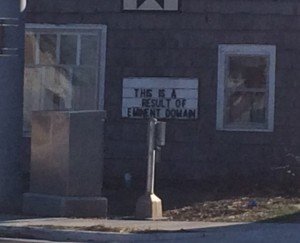
When your domain is compromised, how do you take the high road?

The impacts of government policies can be subtle, far-reaching and antithetical to their original good intentions. Identifying examples of this is part of my duty as a blogger. Sometimes, though, the evidence of a policy is right there in your face…called out by the person most affected.   This former home in Greenfield, Indiana (about 20 miles

Parsimonious (but potent) pedestrian provisions.

If you don’t have the money to make it aesthetic, at least you can make it functional. This seems to be mentality that Hoboken, New Jersey, America’s most walkable city, endorses in some of its streetscape improvements. Considering the high median incomes of this city of over 40,000 people per square mile, it’s a bit

Getting back from the groove.

Sometimes the most well-intentioned and carefully planned initiatives still yield unexpected and undesirable results. I deliberately didn’t put too much thought into the above sentence; I wanted it to emerge as spontaneously and organically as possible, then to judge it afterward. In hindsight, I would only change one word: sometimes. Replace it with “usually”. (But

Because public art can tow the party line.

In many American cities, the most prominent murals emerge on the blank sidewalls of old buildings, often through months (if not years) of well-calibrated civic collaboration. Philadelphia, the national—and perhaps the global—leader in this art form has its own long-established Mural Arts Program, a well-staffed organization that not only vets the content and creators of

Full skyscrapers, looming over empty streets.

Those of us who identify as urbanophilic—to which I include myself a great deal of the time—have long bemoaned the lack of density afflicting many of our American urban centers, which impedes these

Drive-by wifi?

If we’re seriously looking—and you know I am—rarely a day goes by where we can’t spot some new sign of desperation in the retail sector. We can visit the stores themselves, and witness

Alpha, New Jersey: The town the freeway DIDN’T destroy.

Stretching 144 miles from Harrisburg, Pennsylvania to the Holland Tunnel just outside Manhattan, Interstate 78 is hardly among the longer limited-access highways in the country. And, while certainly busy, I’d imagine plenty other

Safety with a sneer.

Instructional signage may seem like a pretty dry subject, but scattershot evidence across the country suggests that creativity and even whimsy isn’t completely verboten. Just check this roadside admonition along Lake Avenue in

Parsimonious (but potent) pedestrian provisions.

If you don’t have the money to make it aesthetic, at least you can make it functional. This seems to be mentality that Hoboken, New Jersey, America’s most walkable city, endorses in some

Getting back from the groove.

Sometimes the most well-intentioned and carefully planned initiatives still yield unexpected and undesirable results. I deliberately didn’t put too much thought into the above sentence; I wanted it to emerge as spontaneously and

Because public art can tow the party line.

In many American cities, the most prominent murals emerge on the blank sidewalls of old buildings, often through months (if not years) of well-calibrated civic collaboration. Philadelphia, the national—and perhaps the global—leader in