Search
Search
The search "utilities" yielded
42 articles

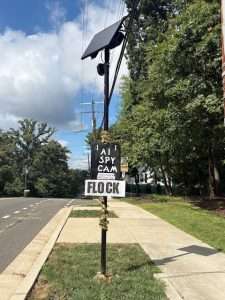
Anti-Flock: the cameras are everywhere, and they’re stronger than ever.

I normally offer a disclaimer whenever I write an article about a timely or currently relevant subject.  Essentially, these disclaimers all offer the same warning: don’t expect this to become a routine.  And, even though my last hot-off-the-press article wasn’t that long ago and generated considerable response, I still won’t get into the habit because,

Capitol complex: Arizona rolls out the green carpet for postcard views. But at a price.

As is the case in many US capital cities, the Arizona State Capitol complex doesn’t sit squarely in the heart of downtown; it’s about a mile west of the absolute center, where Central Avenue meets Washington Street.  The City of Phoenix gets that coveted space for its government campus instead, amidst downtown skyscrapers.  A mile

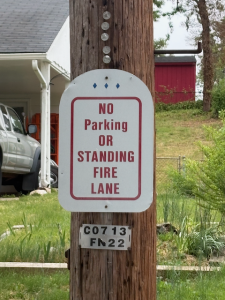
On-street parking restriction: if it looks funny, it probably doesn’t come from the City (which is humorless).

On an otherwise run-of-the-mill middle-class street, in the altogether run-of-the-mill and middle-class Washington DC suburb of Springfield, Virginia, a tiny sign indicates an on-street parking restriction, under certain terms that need a textual explanation.  The notion isn’t strange that a sign can order drivers not park on this side of a quiet, residential, local road;

Dead-end exit lane: when a road is not a street.  (Or an alley.  Or a stroad.)

Suburbia of 2026 might feel as middlebrow and car-dominated as it probably did in 1966, even if “suburbanization” was a novel phenomenon back then—a condition just emerging, of which social theorists were not yet fully aware.  But the design of residential communities from sixty years ago reveals subtle if powerful differences, judging from the equivalents

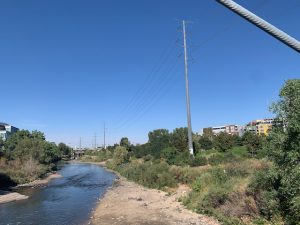
Visible power lines along the riverfront: a visual blight or a necessity?  Or both?

To the average observer, this just looks like a shallow creek threading through a lightly urbanized area.  Nothing special at all.  Kind of drab, even.  But to the locals, this riverfront image is probably quickly recognizable: the architecture of the buildings, though distant and none too striking, gives it away.  Or maybe it’s the bridge

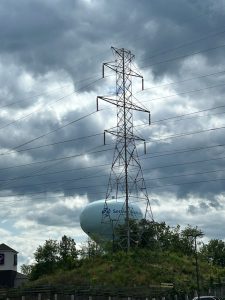
Transmission towers need booster seats too. Allegedly.

Some infrastructural features are so ubiquitous and operate so effectively behind the scenes that they become almost invisible—like most utility lines.  Compared to many developed nations, the United States still has a sizable portion of its electrical and telecomm wires hoisted high into the sky through utility poles.  In fact, outside the densely populated downtowns

What’s a flag lot? A flag on a map looks very different from the view on the street.

I don’t really think that flag lot is part of common parlance anywhere outside of the domain of real estate and land development.  But it’s such a common condition—and such a simple concept to understand—that it’s kind of surprising most people don’t really know about it.  I certainly didn’t until I dipped my toe in

Wisconsin Avenue, a tony street, has a row of trashy homes. What gives?

By and large, what people refer to as Northwest DC—especially the area west of Rock Creek Park—has never faced the problems of disinvestment and depopulation that plagued much of the capital city in the 1970s and 80s.  Even at that point when Washington DC was “the murder capital of America” (as it was for a

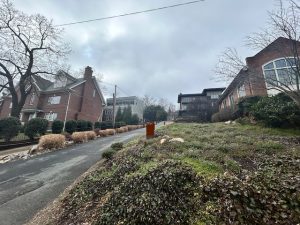
Chestnut Hill switching station: a subtle shield for an ugly use, or a waste of space?

Public utilities are a tough nut to crack, especially in urban settings, where the population density is greater—and so, consequently, is the demand for electricity, gas, water, wastewater, fiber optics, and so forth.  With higher density comes greater intricacy of the conduit; there’s more of it, and it must be more economical with its use

Transmission towers need booster seats too. Allegedly.

Some infrastructural features are so ubiquitous and operate so effectively behind the scenes that they become almost invisible—like most utility lines.  Compared to many developed nations, the United States still has a sizable