Search
Search
The search "Arizona" yielded
5 articles

Ethnic enclave: tiny Guadalupe holds its own among Phoenix mega-burbs.

The influence of pop-culture sociology has helped to impart an almost malicious intent onto most ethnic enclaves in the United States.  After all, many academics presume, if a district of profound cultural difference exists in hyper concentration while surrounded by a much larger district reflective of the homogenous cultural majority, the only reasonable explanation for

Downtown Tempe sprouts a new skyline of its own, but where’s the street energy?

Unlike most cities in the eastern half of the US, the major metros of the West routinely offer suburbs that exceed 100,000 people—sometimes double or triple that amount.  (A few of the suburbs of Los Angeles, Las Vegas, Houston, Dallas, and even Denver are bigger than the core cities of Cincinnati, Buffalo, St. Louis, or

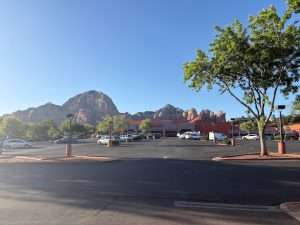
Sedona strip mall: a business incubator can’t count its chicks before they hatch.

Vacation and resort towns exist—and thrive—usually in response to a market demand to visit, to experience, and (to some extent at least) to linger in a specific location.  Whether a beach, a mountain, a landmark, an insanely agreeable climate, or some other locus of beauty or distinction, the resort town owes its prosperity to its

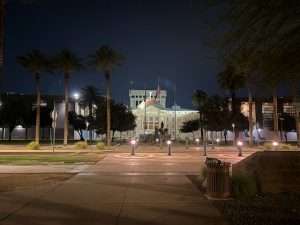
Capitol complex: Arizona rolls out the green carpet for postcard views. But at a price.

As is the case in many US capital cities, the Arizona State Capitol complex doesn’t sit squarely in the heart of downtown; it’s about a mile west of the absolute center, where Central Avenue meets Washington Street.  The City of Phoenix gets that coveted space for its government campus instead, amidst downtown skyscrapers.  A mile

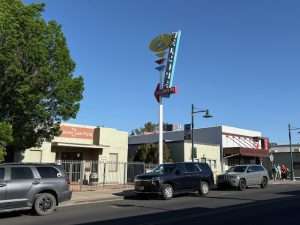
Mid-century signage: seven-decade survival on a sleepy Sonoran street.

I’ve professed my love for mid-century signage multiple times on this blog.  Whether it’s understated modernism, lingering neon, or the overt space-age wonderland of Googie, it all evokes the dawn of the motor era—that point in time, shortly after World War II, when almost every household either owned a vehicle or had easy access to