Search
Search
The search "sidewalks" yielded
105 articles

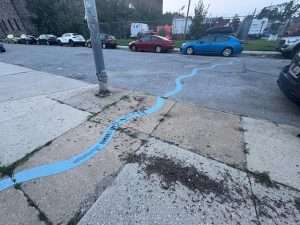
Blue stripes on roads aren’t common. So what do they mean?!

In the landscape of the American roadway, four colors seem to reign supreme for background signage: green, yellow, orange, and blue.  Green (with white lettering) is the status quo across freeways and most municipal markers for value-neutral guidance and wayfinding.  Yellow (with black lettering) is most pervasive in signaling a permanent aberration: e.g., a change
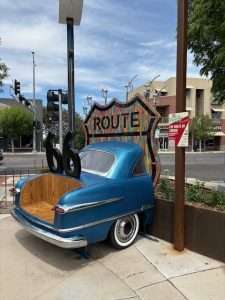
Centennial celebration: Route 66 gets its kicks, through a remix.

Few people truly appreciated it until it was (nearly) gone.  And now it celebrates its centennial.  Across nearly 2,450 miles, Route 66 linked two of the nation’s largest cities, allowing uninterrupted automobile travel across the nation’s sparsely populated western interior for the first time ever.  Prior to April 30, 1926, the date the American Association

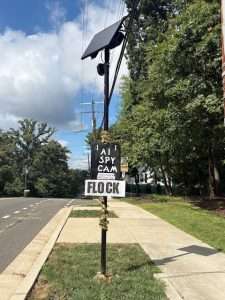
Anti-Flock: the cameras are everywhere, and they’re stronger than ever.

I normally offer a disclaimer whenever I write an article about a timely or currently relevant subject.  Essentially, these disclaimers all offer the same warning: don’t expect this to become a routine.  And, even though my last hot-off-the-press article wasn’t that long ago and generated considerable response, I still won’t get into the habit because,

Brookfield Park, where porous pavement meets a new enemy: the human foot.

Tucked away in Fairfax County, Virginia’s extensive park network is one by the name of Brookfield.  Fairfax Park Authority maintains an abundance of green space that shields this urbanized county from a state of near 100% buildout.  With 43,000 acres managed by either the County, the Commonwealth of Virginia, the regional system (NOVA Parks), or

Columbus Riverfront: a city known for its buildings tries to design water.

My latest article is available at the Columbus Republic, the newspaper of record for Columbus, Indiana.  I’ve featured this atypically design-focused small city only one time in my blogging history—many, many years ago—so it was no small privilege when AIM Media asked me to cover a major revitalization initiative for the city typically rated :

Tread strips: on stairways, fools rush in, when angels fear to intervene.

Back in March, I stuck my leg out with an article that I expected to generate a “much ado about nothing” or “marking a mountain out of a molehill” response.  I do have that tendency.  I had stumbled upon an unusual stairway configuration during a visit to the North Dakota State Capitol complex in Bismarck. 

Dead-end exit lane: when a road is not a street.  (Or an alley.  Or a stroad.)

Suburbia of 2026 might feel as middlebrow and car-dominated as it probably did in 1966, even if “suburbanization” was a novel phenomenon back then—a condition just emerging, of which social theorists were not yet fully aware.  But the design of residential communities from sixty years ago reveals subtle if powerful differences, judging from the equivalents

Privacy fences are nothing new in suburbia. So why is this one so special?

Returning back to my home turf after some time away—combined with other academic obligations—has forced me to rush through some briefer-than-usual blog articles so that I can still meet my May quota.  Having become too dependent on greater Washington DC for inspiration, it’s a refreshing change to cover content outside of Maryland and Virginia.  Therefore,