Search
Search
The search "malls" yielded
67 articles

Marley Station: beloved dead mall shines neon on a new culprit. (MONTAGE)

By 2026, it has achieved a cult following, receiving more attention from dead mall aficionados than most of its peers.  In fact, most of the vloggers who make a career out of documenting liminal spaces feel compelled at some point to visit this one.  It’s hard to say why this particular dead mall is so
Dying wing in a healthy mall: the Sears phenom all over again?

Potomac Mills, in the heart of the vast Washington DC suburbia that is Northern Virginia, continues to show remarkable resiliency amidst the widespread decline of many—perhaps even most—conventional enclosed shopping malls.  Dead and dying malls are, obviously, a familiar subject on this blog; even from the earliest days in the late 2000s, I explored Lafayette

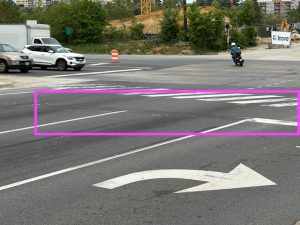
The turn radius—what does it limit more: the car or its driver?

The vehicular turn radius might seem like a simple feature, but its impact on the urban environment is akin to a pebble plunked into a pond.  And that simile carries extra weight because the pebble-in-a-pond’s impact is a series of concentric rings outward—basically another incarnation of the radii of varying sizes.  Traffic engineers have long

Security Square: even after Macy’s leaves, it’s a mall that refuses to die.

Hot on the heels of the previous article, in which I explored how an Iraqi bakery (temporarily) replaced an old Quiznos, this time I touch on internationalism with a much, much larger retail footprint—an entire mall.  The mall in question is Security Square, a few miles to the west of Baltimore city limits, at a

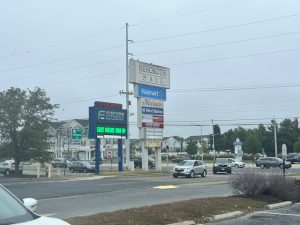
Rehoboth Mall: the dead mall deconstructed (architecturally and rhetorically).

Malls across the country, large and small, urban and suburban, enclosed and open-air, are dying.  They’re getting sucked into a vortex of shifting consumption patterns that rejects what we might call peripatetic shopping.  The image of an attractive woman clothing multiple large paper bags is increasingly passé.  People shop while seated at their home computers,

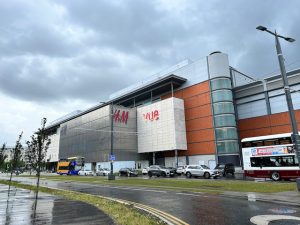
Ocean Terminal in Edinburgh: proof that the dead mall is NOT an American phenomenon?

It’s not a rhetorical question, but it’s one that I would have struggled to answer until recently.  After all, I’ve spent years exploring some of the dreariest corners of underperforming American retail: one or two dead malls in my hometown of Indianapolis (which has resisted mall decay more than most cities, almost entirely due to

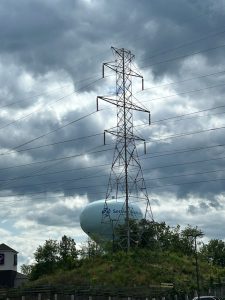
Transmission towers need booster seats too. Allegedly.

Some infrastructural features are so ubiquitous and operate so effectively behind the scenes that they become almost invisible—like most utility lines.  Compared to many developed nations, the United States still has a sizable portion of its electrical and telecomm wires hoisted high into the sky through utility poles.  In fact, outside the densely populated downtowns

Streetery of Wheaton Mall: a dining concept that pedestrianizes a garage?

Throughout the life of this blog, I’ve come down hard on malls.  And I’ve done this, not because I fundamentally dislike them—they’re a paradigm for consumerism in the automobile era, whether we wanted it or not—but because malls in general have shown a diminishing ability to adapt to the shopping patterns of the last twenty

Brand refresh: Barnes & Noble goes on a tear. No books destroyed in the process.

A quick look at the photo above and it should be obvious that something’s afoot at this particular location of Barnes and Noble.  Incidentally, I only heavily scrutinized a Barnes and Noble once before, also in Maryland, when I noticed a repositioning of merchandise within the interior just a few months ago.  This time, the

One-way streets downtown: are they really a revitalization dead end?

Among transportation planners, it is almost universally acknowledged that two-way streets are healthier for downtown vitality than one-way streets.  Storefronts on two-way streets tend to command higher lease rates, indicating that demand among prospective tenants is greater than a similar storefront that fronts a one-way street.  It’s not because one-way streets get less traffic; in

Dying wing in a healthy mall: the Sears phenom all over again?

Potomac Mills, in the heart of the vast Washington DC suburbia that is Northern Virginia, continues to show remarkable resiliency amidst the widespread decline of many—perhaps even most—conventional enclosed shopping malls.  Dead and

Transmission towers need booster seats too. Allegedly.

Some infrastructural features are so ubiquitous and operate so effectively behind the scenes that they become almost invisible—like most utility lines.  Compared to many developed nations, the United States still has a sizable