Search
Search
The search "Pennsylvania" yielded
93 articles

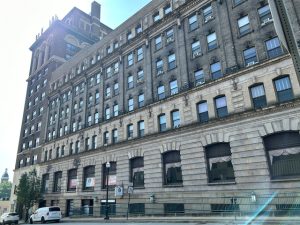
Back entrance: why some big buildings beautify their butts.

Many municipalities in northern Appalachia—which I consider to include Western Pennsylvania, much of Upstate New York, Western Maryland, Western Virginia, Eastern Kentucky, and pretty much all of West Virginia—look bigger than they are.  If one drives past them on a freeway, the density of buildings that form a skyline makes them look quite large, but,

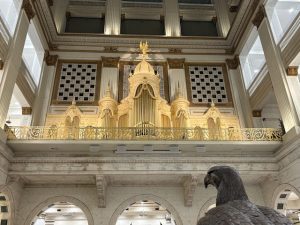
Grand Court Organ in the Wanamaker building: with Macy’s closing, what is its fate?

Though my articles rarely reflect a hot-off-the-presses event, here’s another exception to that rule, which I feel compelled to publish now (instead of three months from now) because, I fear, waiting that long will cause its significance to fade from collective memory.  The event to which I refer is obvious from the title: the demise

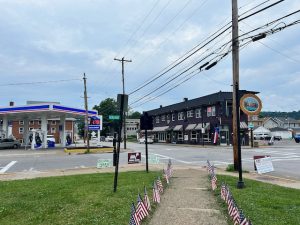
Auto-oriented use in a company town founded before the Model T. 

In a scramble to meet my quota of articles before the end of November, I offer a simple ponder and an almost 360° view at a single intersection.  A series of photos offers all that is necessary to conceive a small manufacturing city’s metamorphosis through the increasing prevalence of the automobile over the twentieth century. 

GoatScape: no need for pruning shears. Incisors will do just fine!

Biking along the Great Allegheny Passage (GAP) in the final days of summer yielded some unexpected opportunities for leaf-peeping.  The GAP, a massive rail-trail conversion linking downtown Pittsburgh to Cumberland, Maryland, allows uninterrupted bike/pedestrian access from the Steel City to Washington DC, by means of a transfer onto the Chesapeake and Ohio (C&O) Canal Towpath

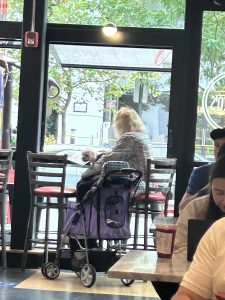
Indoor dogs at private businesses: have the laws changed in recent years?

It’s been a long time coming.  But only within the last few weeks, after encountering a big sign at Dallas Fort Worth International Airport (DFW), did I achieve full awareness of a condition that has crept across the American social domain: indoor dogs everywhere.  Here was my indicator: If it’s not immediately obvious, the overhead

Flag Day celebration (and quiz)! How one PA steel town bravely recognizes its past.

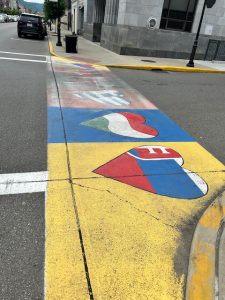
It’s Flag Day!  And it’s kind of remarkable how, given my blog’s fixation with flags over the years (including some very creative flag reimagining), I’ve never really covered this 75-year-old holiday, commemorating the 247th anniversary of a distinct American flag.  Yes, it was June 14th in 1777 that the Second Continental Congress adopted an official

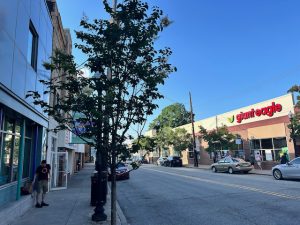
Blank wall bravado: a trendy neighborhood’s supermarket is more and less than meets the eye.

This article represents an interesting first.  Frankly, I’m surprised it’s taken this long—15 years of blogging!—for someone to approach me about this while I was out snapping pics for my blog.  Given that I have over 20,000 photos consisting primarily of mailboxes, parking meters, cracked curbs, lonely utility poles, labelscars, and miscellany that would only

Sign regulations: what it looks like if your town generally lacks good ones.

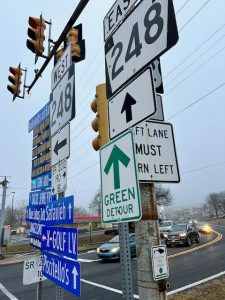
“Signage” has long been the most prominently used keyword here at this blog.  Within its respective jurisdiction, a municipal planning community fixates more than the average person—more even than me—on signs: their placement, size, color, luminosity, content, what can exist.  The American Planning Association (APA) routinely devotes webinars like this on the subject, and, at

What’s a flag lot? A flag on a map looks very different from the view on the street.

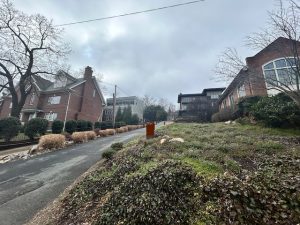
I don’t really think that flag lot is part of common parlance anywhere outside of the domain of real estate and land development.  But it’s such a common condition—and such a simple concept to understand—that it’s kind of surprising most people don’t really know about it.  I certainly didn’t until I dipped my toe in

Back entrance: why some big buildings beautify their butts.

Many municipalities in northern Appalachia—which I consider to include Western Pennsylvania, much of Upstate New York, Western Maryland, Western Virginia, Eastern Kentucky, and pretty much all of West Virginia—look bigger than they are.