Search
Search
The search "April 2026" yielded
5 articles

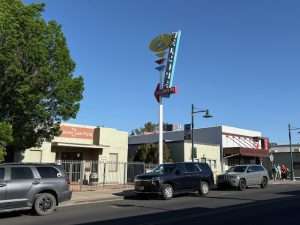
Mid-century signage: seven-decade survival on a sleepy Sonoran street.

I’ve professed my love for mid-century signage multiple times on this blog.  Whether it’s understated modernism, lingering neon, or the overt space-age wonderland of Googie, it all evokes the dawn of the motor era—that point in time, shortly after World War II, when almost every household either owned a vehicle or had easy access to
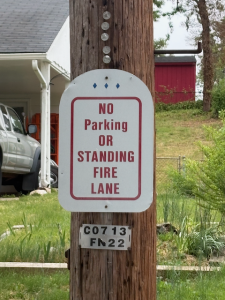
On-street parking restriction: if it looks funny, it probably doesn’t come from the City (which is humorless).

On an otherwise run-of-the-mill middle-class street, in the altogether run-of-the-mill and middle-class Washington DC suburb of Springfield, Virginia, a tiny sign indicates an on-street parking restriction, under certain terms that need a textual explanation.  The notion isn’t strange that a sign can order drivers not park on this side of a quiet, residential, local road;

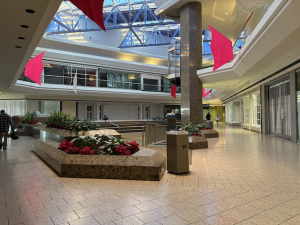
Marley Station: beloved dead mall shines neon on a new culprit. (MONTAGE)

By 2026, it has achieved a cult following, receiving more attention from dead mall aficionados than most of its peers.  In fact, most of the vloggers who make a career out of documenting liminal spaces feel compelled at some point to visit this one.  It’s hard to say why this particular dead mall is so

Ukrop’s: an old Richmond family grocer re-enters the market. As a real estate developer.

Just spitting distance from the municipal boundary of the independent city of Richmond, Virginia is a small, inconspicuous shopping center called Triangle Park.  Truth be told, all of the photos in this article depict properties just outside the commercial property called Triangle Park.  However, these photos still sit within the same triangle shaped superblock where

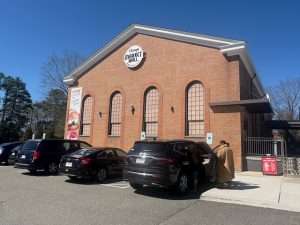
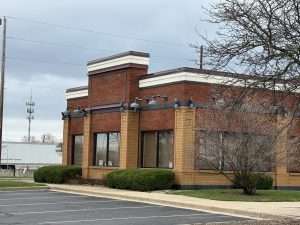
Chain restaurant architecture: years after closure, the branding stamp remains.

Most chain restaurants focus their branding on a few key visual elements: logo, font, colors.  Take Starbucks, for example.  It started in old-school, urban commercial storefronts like Seattle’s Pike Place Market, expanded to other big-city milieus, then went suburban into freestanding structures with parking lots and drive-thru windows.  It adapted the interior model to shopping