Search
Search
The search "streets" yielded
141 articles

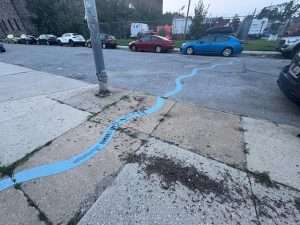
Blue stripes on roads aren’t common. So what do they mean?!

In the landscape of the American roadway, four colors seem to reign supreme for background signage: green, yellow, orange, and blue.  Green (with white lettering) is the status quo across freeways and most municipal markers for value-neutral guidance and wayfinding.  Yellow (with black lettering) is most pervasive in signaling a permanent aberration: e.g., a change
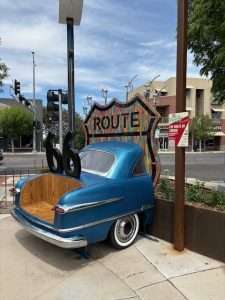
Centennial celebration: Route 66 gets its kicks, through a remix.

Few people truly appreciated it until it was (nearly) gone.  And now it celebrates its centennial.  Across nearly 2,450 miles, Route 66 linked two of the nation’s largest cities, allowing uninterrupted automobile travel across the nation’s sparsely populated western interior for the first time ever.  Prior to April 30, 1926, the date the American Association

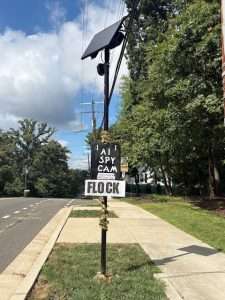
Anti-Flock: the cameras are everywhere, and they’re stronger than ever.

I normally offer a disclaimer whenever I write an article about a timely or currently relevant subject.  Essentially, these disclaimers all offer the same warning: don’t expect this to become a routine.  And, even though my last hot-off-the-press article wasn’t that long ago and generated considerable response, I still won’t get into the habit because,

Ethnic enclave: tiny Guadalupe holds its own among Phoenix mega-burbs.

The influence of pop-culture sociology has helped to impart an almost malicious intent onto most ethnic enclaves in the United States.  After all, many academics presume, if a district of profound cultural difference exists in hyper concentration while surrounded by a much larger district reflective of the homogenous cultural majority, the only reasonable explanation for

Sideways subdivision: Sin City homebuilders find new ways to pack ‘em in.

The predictability of a post-1950s subdivision in most of suburban America almost renders it impervious to analysis.  After all, there’s nothing exotic about a middle-class home with 3-4 bedrooms, 2.5 baths, and a two-car garage.  Most Americans encounter such houses on a daily basis, if they don’t already live in one.  And the prevalence of

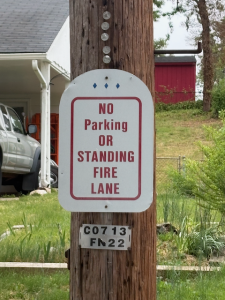
On-street parking restriction: if it looks funny, it probably doesn’t come from the City (which is humorless).

On an otherwise run-of-the-mill middle-class street, in the altogether run-of-the-mill and middle-class Washington DC suburb of Springfield, Virginia, a tiny sign indicates an on-street parking restriction, under certain terms that need a textual explanation.  The notion isn’t strange that a sign can order drivers not park on this side of a quiet, residential, local road;

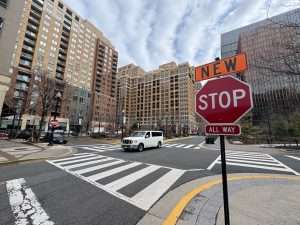
New stop sign: is it engineering?  Planning?  Marketing? 

Whether by foot or by wheel, the average American encounters a certain red octagon frequently enough that 99% of adults will know what I’m talking about with no additional context.   It’s not just that only one commonly occurring icon comes to mind that fits this “red octagon” description—though that’s certainly the case—it the fact

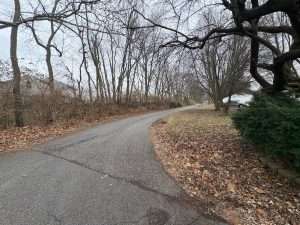
Dead-end exit lane: when a road is not a street.  (Or an alley.  Or a stroad.)

Suburbia of 2026 might feel as middlebrow and car-dominated as it probably did in 1966, even if “suburbanization” was a novel phenomenon back then—a condition just emerging, of which social theorists were not yet fully aware.  But the design of residential communities from sixty years ago reveals subtle if powerful differences, judging from the equivalents