Search
Search
The search "Indianapolis" yielded
136 articles

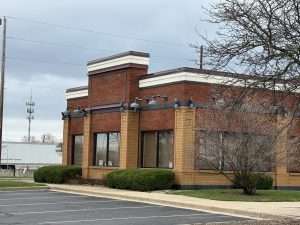
Chain restaurant architecture: years after closure, the branding stamp remains.

Most chain restaurants focus their branding on a few key visual elements: logo, font, colors.  Take Starbucks, for example.  It started in old-school, urban commercial storefronts like Seattle’s Pike Place Market, expanded to other big-city milieus, then went suburban into freestanding structures with parking lots and drive-thru windows.  It adapted the interior model to shopping
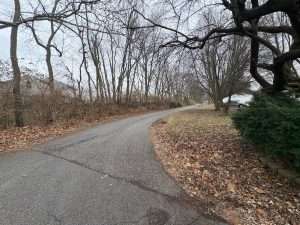
Dead-end exit lane: when a road is not a street.  (Or an alley.  Or a stroad.)

Suburbia of 2026 might feel as middlebrow and car-dominated as it probably did in 1966, even if “suburbanization” was a novel phenomenon back then—a condition just emerging, of which social theorists were not yet fully aware.  But the design of residential communities from sixty years ago reveals subtle if powerful differences, judging from the equivalents

Commercial conversion from home to monastery? Really makes you rub the Chin.

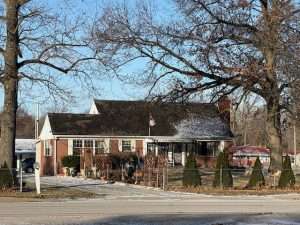
As a metro area urbanizes, the old country homes built off of major highways become less appealing as residences and more appealing as commercial entities.  This isn’t surprising; the quiet metamorphosis has taken place for decades.  A subtle commercial conversion.  People don’t want to live directly alongside throngs of fast-moving vehicles if they can help

Good from all angles? Why the Murat Temple (Old National) in Indy gets a pass.

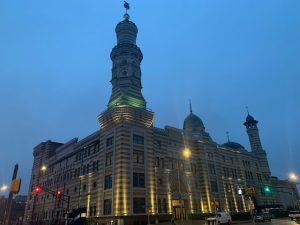
Continuing the spirit of the previous blog post—surveying big buildings and extolling those that look good from all angles—I migrate this time for a brief look at a building in my hometown that has always captivated me and certainly achieves minor landmark status.  Most other visitors to Indianapolis who have lingered in this neighborhood have

Final elegy to Sanctuary on Penn, for Encyclopedia of Indianapolis.

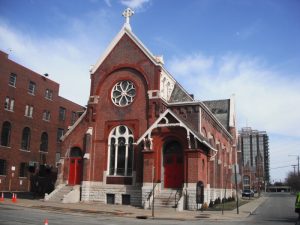
The building featured in this final elegy has probably served as the thumbnail photo more than any other structure, in my nearly sixteen years of writing for this blog.  I’m talking about none other than Sanctuary on Penn, FKA First Lutheran Church, FKA Mount Pisgah.  The late Gothic building, on the National Register of Historic

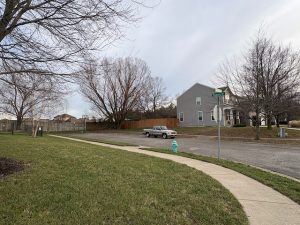
Stub street seminar: why developers keep building tiny, pointless dead-end roads.

The term “stub street” rarely comes up in conversation, yet enough people have a mental image of what it entails that it would be almost patronizing to explain what it means.  However, those cognitive apparitions vary so greatly that I’m going to go right ahead and patronize.  After all, a consistent definition of a stub

Tribute to First Lutheran: reflecting on an oft-featured, destroyed urban church.

First Lutheran Church in the St. Joseph neighborhood of downtown Indianapolis is no more.  It suffered catastrophic losses early in the morning of Christmas Eve due to a fire, and while the firefighting crew battled the blaze formidably, it was not able to prevent the roof from caving in, or most of the doors and

Heritage infrastructure in Homecroft: when evoking the past, size matters.

Many, many years ago I featured some heritage infrastructure in the quasi-autonomous Indianapolis enclave of Homecroft.  If the most appropriate descriptor for a place like Homecroft is “quasi-autonomous enclave”, it goes without saying that it’s an unusual place.  The community (which functions largely as a neighborhood) sits about seven miles south of downtown Indianapolis as