Search
Search
The search "Washington DC" yielded
93 articles

Carryout and COVID: should the Maine Avenue Fish Market continue normal operations?

There can be no question that, at this point in the effort to combat the COVID-19 pandemic, we’ve reached a stage where national unity—if any such thing ever existed—is under strain.  Through much of March and at least the first week of April, the overwhelming majority of the country agreed that a lockdown was critical

Pandemic in the park: did restrictions around DC’s Tidal Basin help flatten the curve?

Given the patchwork of regulatory subcultures that our country’s federalist system inevitable creates, it should come as no surprise that this vast, diverse country is eliciting widely variable responses to the COVID-19 pandemic, both in terms of the key metrics—confirmed cases, deaths, recoveries—and in the fuzzier, day-to-day manifestation of this most acute of public health

Social distancing sidestep: the DC restaurants that buck the trend.

I rarely feature material as timely as this; in fact, I deliberately avoid content with a short shelf life, mainly because, if one posts as infrequently as I do, one has little to gain from an article whose relevance will fade within 72 hours, as advancements on the subject quickly supersede it.  But in mid-March

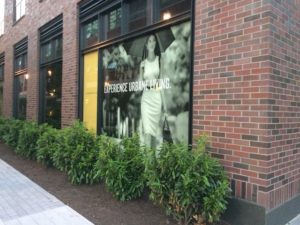
Navy Yard apartments (MONTAGE): Aspirational consumption, flaunted in photography.

For those who don’t go to malls regularly—which, in 2020, it’s safe to assume is most of us—we’ve probably stopped thinking all that much about the act of shopping altogether.  By and large, it’s no longer a peripatetic activity.  But there was a certain mystique toward the idea of walking confidently down a street—or, more

A construction staging area and a sidewalk: never a healthy pairing, but sometimes the treatment is worse than the disease.

For most of the 21st century, and certainly in the last ten years (since the Great Depression) the majority of American downtowns have enjoyed a reinvestment no longer measured merely in spruced-up old façades. The cranes, dozers and other construction equipment are all the evidence one needs. People are returning to central business districts, in