Search
Search
The search "Indianapolis" yielded
136 articles

Plugging the passed-over pocket park with programming.

My latest post is up at Urban Indy.  It scrutinizes a small park on the near northside of Indianapolis–a park so unremarkable that most of the city’s residents have probably never heard of it.  Wedged between the Fall Creek Place neighborhood and its namesake Fall Creek, Kessler Park is hardly an unattractive park.  Clean, easily

Nudging the ‘urbs in the right direction.

When negotiating the introduction of typically suburban corporate chains in an otherwise urban neighborhood, it typically takes an inordinate amount of fancy footwork.  Most American cities have a “Midtown”—either explicitly or implicitly named—that suffered colossal disinvestment from the 1950s onward, or perhaps even as early as the Depression.  Now, thanks to their proximity to revitalizing

Nordstrom brainstorming.

My latest post is up at Urban Indy, focusing on what we can do with a huge vacant piece of real estate in the heart of Indianapolis’ downtown: the Nordstrom space to CIrcle Centre Mall, which vacated in summer of 2011. Still no plans for this space have materialized.  A recent post from the Indianapolis

Contemporary infill gentrification.

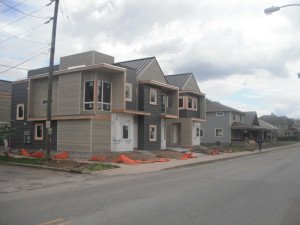
My latest post is at Urban Indy.  It focuses on two small multi-family apartment or townhome developments in Fountain Square and Bates-Hendricks, neighborhoods on the near south side of Indianapolis’ downtown that, while still very gritty, have become increasingly trendy in recent years.  Both neighborhoods still have their fair share of dilapidated housing and some

When the first one out the gate is also the last.

Several weeks ago I explored one of the most obvious consequences of the veritable implosion of the commercial airline industry.  After several years of declining enplanements and repeated consolidations of the major airlines, we will inevitably confront many manifestations of what I saw at Cleveland-Hopkins International Airport: virtually an entirely vacant concourse.  This blog article

Spurs that fail to stimulate.

My latest post is at Urban Indy.  Though the focus is on case studies regarding road spurs in Indianapolis, the situation exists in cities across the country. This seemingly unremarkable photo of traffic in downtown Indy shows the easternmost “spur” of Maryland Street, a primary downtown road that was converted to one-way eastbound in the

A modest new Gateway Arch.

My latest post is available on Urban Indy, featuring a work in progress: the Gateway South Arch in Indianapolis, at the point where Madison Avenue and U.S. 31 diverge.  It is the first phase of an extensive plan to improve the streetscape for a part of town that has seen considerable flight of businesses to

Vitality behind venetian blinds.

My most recent post just went up on Urban Indy.  It is essentially an assessment of the Mass Ave retail corridor near downtown Indianapolis.  By most respects, it’s a lively, active urban corridor, attracting yuppies, guppies, buppies, empty nesters, DINKs, you name it–a contemporary spontaneous street ballet of conspicuous consumption.  It has great old architecture,

The right kind of sidewalk clutter.

My latest post–a short one (for me at least)–is now up at Urban Indy.  It focuses on the Mozzo, a newly completed multifamily residential development in the Sacred Heart neighborhood, fronting the increasingly active Virginia Avenue commercial corridor. By and large it’s a satisfactory building, with a massing that befits the old neighborhood just a

MONTAGE: Salvaging a sacred space by expanding its use.

In more than one previous article, I have explored the challenges that urban or inner-city church congregations face.  Their aging buildings are costly to maintain; parking is inadequate in an area where land prices are usually high; the multiple floors and narrow hallways rarely accommodate disabled people; the higher rates of poverty nearby result in

Nudging the ‘urbs in the right direction.

When negotiating the introduction of typically suburban corporate chains in an otherwise urban neighborhood, it typically takes an inordinate amount of fancy footwork.  Most American cities have a “Midtown”—either explicitly or implicitly named—that

Nordstrom brainstorming.

My latest post is up at Urban Indy, focusing on what we can do with a huge vacant piece of real estate in the heart of Indianapolis’ downtown: the Nordstrom space to CIrcle

Contemporary infill gentrification.

My latest post is at Urban Indy.  It focuses on two small multi-family apartment or townhome developments in Fountain Square and Bates-Hendricks, neighborhoods on the near south side of Indianapolis’ downtown that, while

When the first one out the gate is also the last.

Several weeks ago I explored one of the most obvious consequences of the veritable implosion of the commercial airline industry.  After several years of declining enplanements and repeated consolidations of the major airlines,

Spurs that fail to stimulate.

My latest post is at Urban Indy.  Though the focus is on case studies regarding road spurs in Indianapolis, the situation exists in cities across the country. This seemingly unremarkable photo of traffic

A modest new Gateway Arch.

My latest post is available on Urban Indy, featuring a work in progress: the Gateway South Arch in Indianapolis, at the point where Madison Avenue and U.S. 31 diverge.  It is the first

Vitality behind venetian blinds.

My most recent post just went up on Urban Indy.  It is essentially an assessment of the Mass Ave retail corridor near downtown Indianapolis.  By most respects, it’s a lively, active urban corridor,

The right kind of sidewalk clutter.

My latest post–a short one (for me at least)–is now up at Urban Indy.  It focuses on the Mozzo, a newly completed multifamily residential development in the Sacred Heart neighborhood, fronting the increasingly

MONTAGE: Salvaging a sacred space by expanding its use.

In more than one previous article, I have explored the challenges that urban or inner-city church congregations face.  Their aging buildings are costly to maintain; parking is inadequate in an area where land