Search
Search
The search "revitalization" yielded
228 articles

Back entrance: why some big buildings beautify their butts.

Many municipalities in northern Appalachia—which I consider to include Western Pennsylvania, much of Upstate New York, Western Maryland, Western Virginia, Eastern Kentucky, and pretty much all of West Virginia—look bigger than they are.  If one drives past them on a freeway, the density of buildings that form a skyline makes them look quite large, but,
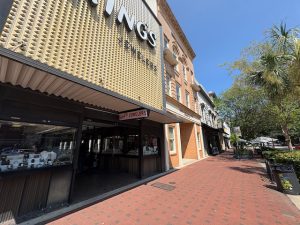
Fake façades on Columbia’s Main Street: is modern now retro, or vice versa?

The historic, eponymous main street of Columbia, South Carolina offers an abundance of smartly preserved three-story buildings, some of which no doubt reflect an effort to preserve the character and details from their post-Civil War time of construction.  Most of them look great, and vacancy rates, while far from perfect, are certainly better than a

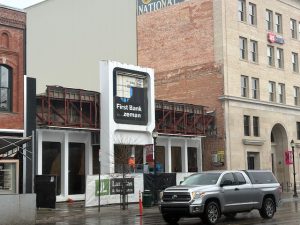
Repurposed brutalism in a Bozeman bank: how the tables turn!

Despite some glum predictions on the long-term economic health of college towns, most of the ones that harbor flagship universities still look pretty vibrant, at least if Bozeman, home of Montana State University (largest university in the state), is any example.  As recently as 1970, Bozeman was a fairly obscure town that hosted the state’s

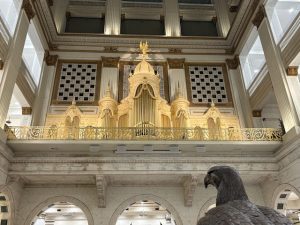
Grand Court Organ in the Wanamaker building: with Macy’s closing, what is its fate?

Though my articles rarely reflect a hot-off-the-presses event, here’s another exception to that rule, which I feel compelled to publish now (instead of three months from now) because, I fear, waiting that long will cause its significance to fade from collective memory.  The event to which I refer is obvious from the title: the demise

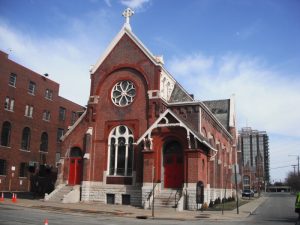
Final elegy to Sanctuary on Penn, for Encyclopedia of Indianapolis.

The building featured in this final elegy has probably served as the thumbnail photo more than any other structure, in my nearly sixteen years of writing for this blog.  I’m talking about none other than Sanctuary on Penn, FKA First Lutheran Church, FKA Mount Pisgah.  The late Gothic building, on the National Register of Historic

Security Square: even after Macy’s leaves, it’s a mall that refuses to die.

Hot on the heels of the previous article, in which I explored how an Iraqi bakery (temporarily) replaced an old Quiznos, this time I touch on internationalism with a much, much larger retail footprint—an entire mall.  The mall in question is Security Square, a few miles to the west of Baltimore city limits, at a

Tribute to First Lutheran: reflecting on an oft-featured, destroyed urban church.

First Lutheran Church in the St. Joseph neighborhood of downtown Indianapolis is no more.  It suffered catastrophic losses early in the morning of Christmas Eve due to a fire, and while the firefighting crew battled the blaze formidably, it was not able to prevent the roof from caving in, or most of the doors and

Back entrance: why some big buildings beautify their butts.

Many municipalities in northern Appalachia—which I consider to include Western Pennsylvania, much of Upstate New York, Western Maryland, Western Virginia, Eastern Kentucky, and pretty much all of West Virginia—look bigger than they are.