Search
Search
The search "revitalization" yielded
228 articles

Plugging the passed-over pocket park with programming.

My latest post is up at Urban Indy.  It scrutinizes a small park on the near northside of Indianapolis–a park so unremarkable that most of the city’s residents have probably never heard of it.  Wedged between the Fall Creek Place neighborhood and its namesake Fall Creek, Kessler Park is hardly an unattractive park.  Clean, easily

An apartment’s reversal of fortune.

This summer has obviously been a pretty dry spell in terms of blog posts, but now that I just arrived back in the country a few days ago, I hope for the pace to pick back up before too long.  August may end up a tad scattered, since I will begin the month with a

Nudging the ‘urbs in the right direction.

When negotiating the introduction of typically suburban corporate chains in an otherwise urban neighborhood, it typically takes an inordinate amount of fancy footwork.  Most American cities have a “Midtown”—either explicitly or implicitly named—that suffered colossal disinvestment from the 1950s onward, or perhaps even as early as the Depression.  Now, thanks to their proximity to revitalizing

Missouri capital redux.

Over the weekend, a blog article of mine prompted an interview from the city’s local newspaper.  The original article, published here about a month ago, focused on the obvious revitalization efforts that have taken place in downtown Jefferson City, capital of Missouri.  Although I had never visited there prior to the trip that prompted the

Nordstrom brainstorming.

My latest post is up at Urban Indy, focusing on what we can do with a huge vacant piece of real estate in the heart of Indianapolis’ downtown: the Nordstrom space to CIrcle Centre Mall, which vacated in summer of 2011. Still no plans for this space have materialized.  A recent post from the Indianapolis

Main Street geniuses and the chain of fools.

By now I’ve explored the visible evidence of main street reinvestment numerous times, through streetscape enhancements, creative infill development, improved access for wheelchairs, vintage iconography, or the preservation of the historic building façade at the expense of everything behind it (pejoratively called façadectomy).  Across the country, in towns both small and microscopic, palpable evidence reveals

A room with twice the view.

Downtown hotels seem can’t seem to get a break.  No matter how valiant the effort of local economic development directors in attracting that major chain (Hilton, Marriott, Intercontinental) and no matter how unorthodox the architects’ designs, the closeted coterie of urban advocates never hesitate to lob their Molotov cocktails at the final proposal.  I’m guilty

Contemporary infill gentrification.

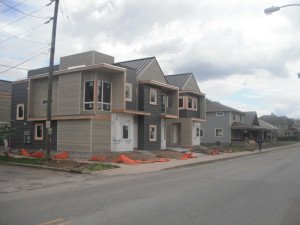
My latest post is at Urban Indy.  It focuses on two small multi-family apartment or townhome developments in Fountain Square and Bates-Hendricks, neighborhoods on the near south side of Indianapolis’ downtown that, while still very gritty, have become increasingly trendy in recent years.  Both neighborhoods still have their fair share of dilapidated housing and some

Salvaging St. Louis, Part III: Biodiversity in repopulation.

In the previous section of this three-part article, I began exploring some of the affordable housing initiatives of St. Louis that have helped it, to some extent, stem its precipitous decline, particularly in comparison to Detroit, its peer city in terms of population loss.  If this survey (you could almost call it “home tour”) seemed

Salvaging St. Louis, Part II: Planting the seeds for repopulation.

In the previous part to this study, I explored the similar population trends of two major Midwestern cities, St. Louis and Detroit.  Both cities have endured significant losses since their peak in the 1950 census.  Interestingly, Detroit seems to absorb the lion’s share of critical attention for its persistent economic malaise, yet St. Louis has

An apartment’s reversal of fortune.

This summer has obviously been a pretty dry spell in terms of blog posts, but now that I just arrived back in the country a few days ago, I hope for the pace

Nudging the ‘urbs in the right direction.

When negotiating the introduction of typically suburban corporate chains in an otherwise urban neighborhood, it typically takes an inordinate amount of fancy footwork.  Most American cities have a “Midtown”—either explicitly or implicitly named—that

Missouri capital redux.

Over the weekend, a blog article of mine prompted an interview from the city’s local newspaper.  The original article, published here about a month ago, focused on the obvious revitalization efforts that have

Nordstrom brainstorming.

My latest post is up at Urban Indy, focusing on what we can do with a huge vacant piece of real estate in the heart of Indianapolis’ downtown: the Nordstrom space to CIrcle

Main Street geniuses and the chain of fools.

By now I’ve explored the visible evidence of main street reinvestment numerous times, through streetscape enhancements, creative infill development, improved access for wheelchairs, vintage iconography, or the preservation of the historic building façade

A room with twice the view.

Downtown hotels seem can’t seem to get a break.  No matter how valiant the effort of local economic development directors in attracting that major chain (Hilton, Marriott, Intercontinental) and no matter how unorthodox

Contemporary infill gentrification.

My latest post is at Urban Indy.  It focuses on two small multi-family apartment or townhome developments in Fountain Square and Bates-Hendricks, neighborhoods on the near south side of Indianapolis’ downtown that, while