
Fifteen years ago, when I first started writing articles for this blog, those little yellow or red “doormats” at crosswalks—you know, the ones with the evenly dispersed raised bumps—were still a relative novelty. They were just beginning to become prevalent at sidewalk ramps leading to crosswalks. In 2025, I think most Americans have a vague sense of what they do, though most people don’t have a good firm name for them. And frankly, I often forget the name too; it’s not memorable. These doormats, together with the sloped curb cut, comprise the reasonable accommodations that allow people with disabilities to cross the street. The ramped element provides a safe alternative to a typical curb, which is difficult or downright dangerous for individuals in wheelchairs to surmount. And the doormats with the raised bumps? They carry an official name of Tactile Walking Surface Indicators, though a few of the other terms are at least shorter and catchier: tactile paving, truncated domes, detectable warnings, or the cumbersome tactile tiles. Regardless, they serve one unifying function: to warn blind and visually impaired pedestrians of a change in paving conditions, usually immediately before the pedestrian would enter a street with vehicular traffic.
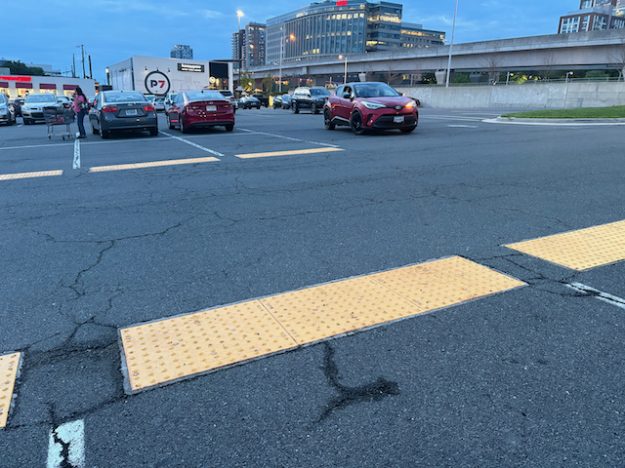
The earliest iterations of tactile paving in the United States date from the early 1990s, shortly after the passage of the Americans with Disabilities Act (ADA), primarily to warn visually impaired pedestrians that they were approaching the edge of a train’s boarding platform; if they traveled past the raised dots, they’d fall off the platform onto the tracks. Before Congress and disabled activists had agreed on a protocol for the design, many tactile paving services actually involved molding the concrete itself into raised dots; they were part of the sidewalk itself. This approach apparently prompted rapid deterioration or wearing out of the bumps, so it wasn’t effective. Another earlier protocol used a series of recurring parallel micro grooves into the pavement, but they never caught on, presumably because they weren’t easy to detect with shoes or a blind person’s long cane. (I feature some of these earlier, obsolete tactile paving incarnations in my quaint 2010 article on the subject.) By the early 2010s, when I first stared recognizing the tactile paving popping up everywhere, they consisted of a rubber like material firmly bolted to the pavement, usually either red or yellow, which provide a strong visual contrast for impaired people who can still discern colors. And in just a few years, these doormats were at nearly every urbanized street corner with a sidewalk.
Truth be told, they’re less common in the US than in many countries in Asia or Europe. In Japan, for example, the tactile paving stretches in linear paths across all varieties of public facilities, guiding blind people where and how they should maneuver to get to the most important destinations within a train station, museum, or parking garage. No surprise: a Japanese entrepreneur first developed the concept in the mid-1960s, after watching a blind man with a cane nearly get hit by car. Seiichi Miyake adopted another of the names for this technology (and, in my opinion, the most endearing): the tenji block, after the Japanese word for braille. Though Miyake’s invention didn’t catch on immediately, a faculty member at a school for the blind in Osaka ordered one for a train platform, and people liked it. By 1985, the Japanese government mandated tenji blocks for public accommodations nationwide, and privately owned buildings greater than 21,500 square feet (2000 m2) must have them near any potential hazards. Other nations quickly adopted the material, helping standardize the “blister” pattern to alert people of hazards nearby, while the “corduroy” pattern directs them on preferred paths. Tactile paving is far less prevalent stateside, and the ADA’s provisions in the US seem primarily to focus on crossings with vehicular traffic or railroad tracks—at least, until I stumbled on these at a banal shopping center in Fairfax County, Virginia.
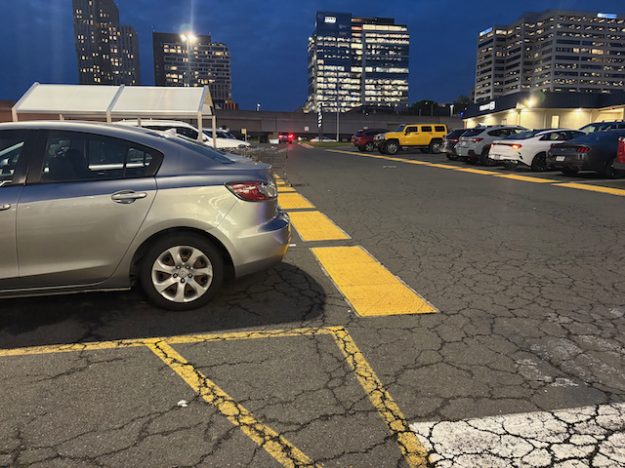
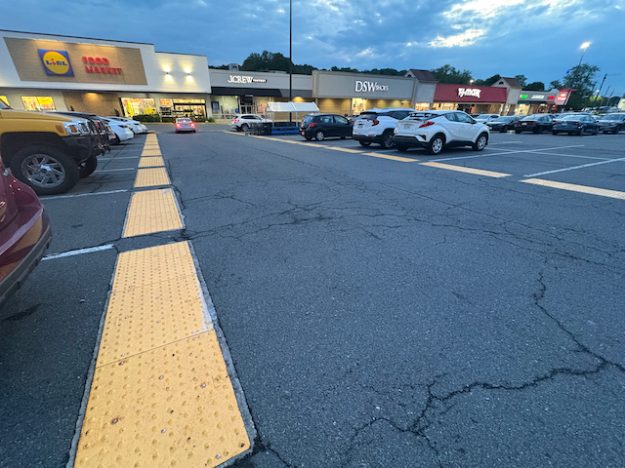
There they are: tactile paving squares in rows, lining the entrance of each parking bay. At a macro level, they strive for the same safety measure as the ones at crosswalks: helping steer visually impaired people from hazards, which in this case would be cars backing out from their parking bays into the access lanes. Or the access lanes themselves. The tactile paving spans the width of each of the spaces in this specific lane within the parking lot to the strip mall, named Pike 7 Plaza, a relatively minor shopping center just blocks away from the gargantuan retail complex that gives Tyson’s Corner, Virginia its notoriety: namely, Tyson’s Corner Center and Tyson’s Galleria, which together form one of the largest shopping nodes in the country. Pike 7 Plaza, though sizable enough to host at least five anchor tenants, is itty-bitty compared to those retail leviathans nearby.
If a busy locale seeks to pioneer new measures in pedestrian safety, the shopping nodes that encircle Tyson’s Corner are just as good of a place as any. But that’s the problem here: the more one investigates this tactile paving, the less clear its ultimate purpose becomes.
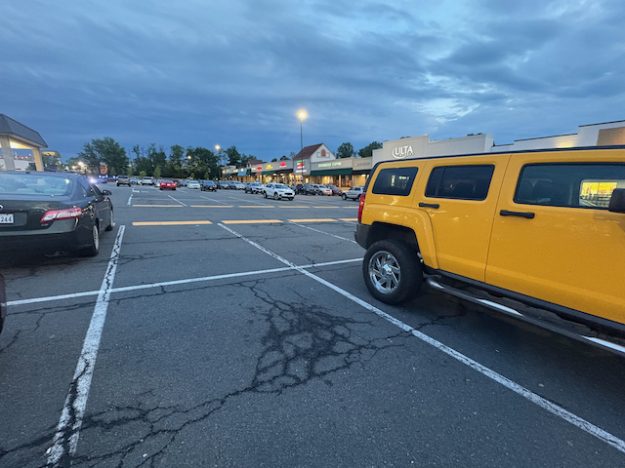
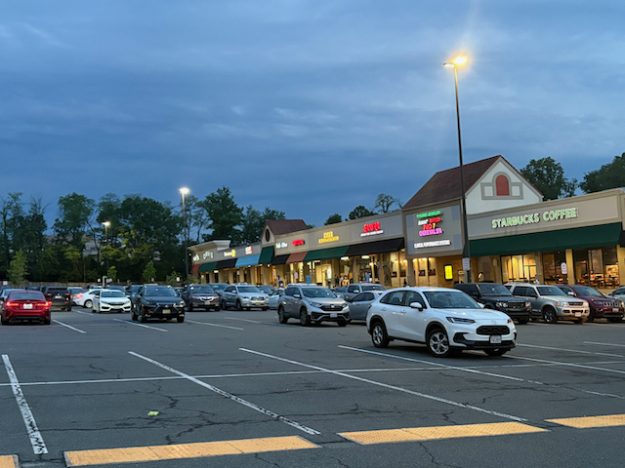
As the above photos prove, they don’t exist on every space in the strip mall; only a few lanes among the acre’s worth of parking at Pike 7 Plaza feature these tactile paving strips. Perhaps the owner/manager of the shopping center is installing them piecemeal; after all, it wouldn’t be wise to render the entire parking lot unusable for even a few days by adding them all at once.
There’s a problem to that theory, though: these tactile paving strips have been here a few years, and the owner has added no others since then. Locationally, the parking strips seem to correlate to one tenant in particular at Pike 7 Plaza:
It’s the German grocer Lidl—though long widespread in Europe, it has only become emergent in the US in the last several years, starting in the beloved test market of metro DC and working its way up the eastern seaboard. Though it boasts nearly 200 locations in the US and seems to be making a killing, the company has not yet shown any interest in venturing westward into the Appalachians.
As Lidl slowly morphs into a genuine competitor of already nationally ubiquitous discount grocer Aldi, it appears to be striving for a few other innovations, particularly relating to app-based rewards that bestow discounts to customers who make more than a certain number of visits per month. Unlike Aldi, it has a self-service bakery. Staffing is very light (like Aldi), but the cashiers are extremely proactive and announce on loudspeaker when a new checkout lane is opening, which invariably happens when the queues get too long.
To avoid turning this article into a promo for Lidl, I return to those tactile paving strips, which I believe Lidl financed when it leased space at Pike 7 Plaza just a couple years ago. An archived Google Street View from May 2023 (before the Lidl opened) shows that they weren’t yet installed. So a German company decided to export a new site-specific function for tactile paving to one of its American outposts. Is it really that simple?
Maybe. But I’m going to go out on a limb and speculate that there may be going on here than just a reapplication of tactile paving in a new context. A teaser of this article shared on social media elicited a discussion which prompted me to, well, think harder about it.
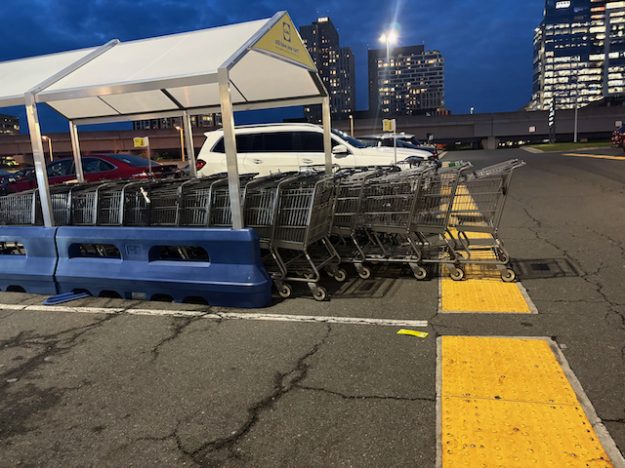
I teased the above photo, and some followers speculated the following: rumble strips so the carts don’t escape, warnings to stay clear of the cart return corral. Quite frankly, these are probably additional features beyond the function of guiding blind people away from danger.
Were these added features intentional? It doesn’t matter. The fact remains, the parking lot of Pike 7 Plaza rests along a mild slope, which frankly, makes the entire shopping center a challenging place for a grocery-oriented tenant, or any other tenant that deploys shopping carts. As I’ve noted in the past, it behooves the developer of a strip mall to clean and grade the land as much as possible. I shopped at a supermarket in Bethlehem, Pennsylvania, build on a mild slope (probably 2-3% grade), and, as soon as a person lets the cart go for even a second (to unlock the trunk of the car, or whatever), the cart goes careening down the parking lot’s slope, only to stop when it slams into another parked car. The tactile paving in this instance gives some traction that mitigates the tendency of an errant cart to roll away uncontrolled. And the tactile paving is right where people need to perch their carts as they unload the merchandise from the cart into their vehicles’ trunks, when the cart will inevitably leave their clutches. Smart move.
I’m going to go out on an even further limb, however, and speculate that Lidl might have installed tactile paving just on the rows closest to its store entrance as part of security. It is possible, that, embedded in these yellow doormats, is a signal or circuitry that traces the shopping carts and causes the wheels to lock if a customer rolls them outside of Lidl’s territory. This feature is becoming increasingly common among grocery store chains to prevent shopping cart theft. Unlike Aldi, Lidl does not require customers to deposit a quarter to free a cart from the corral (which the customer gets back if he or she returns the cart to its proper place). Lidl just lets people stash their carts anywhere. But the tactile paving helps keep them from rolling uncontrollably, and just might have the tracking technology to keep thieves at bay.
So…three uses in one! It’s inevitable that tactile paving will become more prevalent as its such a simple, innocuous strategy for encouraging safety, without ever verging into excessive, inhibiting safetyism. Hats off to Lidl for thinking of all this! Is it German technological ingenuity at its finest? Or a happy accident?

7 thoughts on “Tactile paving in parking lots: not just at crosswalks, not just for the blind.”
I was looking at every giant in dc on google maps to no avail. Didn’t even consider a European import!
Yep, and while we’ve all seen tactile paving at this point in 2025, I’ve never seen them used this way in parking lots….until now. Maybe it’s a German thing?
Thank you so much!!
I really enjoy the articles
Interesting article and installation of the DWS. I looked at some Lidl locations in Germany on Google Maps and could not see where else they have been installed. Also, I could not find other accessibility/ADA design either — such as accessible parking spaces for vehicles. While I want to assume Lidl is progressive in accessibility design, its hard to validate this.
Yes, the first and presumably not the last time I’ve encountered this sort of placement of Detectable Warning Surface (presuming that’s what you mean by the acronym “DWS”). Having been to multiple Lidl locations in the DMV, this is the only one I’ve seen that uses it. Interesting that the developer chose to add it at a site where Lidl is but one of many tenants in a strip mall. Though Lidl is routinely a minor anchor tenant in strip malls, it’s not unheard of for the chain to occupy freestanding locations, including some constructed for Lidl itself.
Perhaps I’m being conspiratorial minded, but it wouldn’t surprise me in the least if the DWS here had a tracking system that causes shopping cart wheels to freeze if they stray outside of the boundaries created by these marked spaces.
I don’t think it’s shopping cart wheel locks because that’s just a wire buried under the asphalt that sends out electric pulses at a specific frequency. An induction coil in the wheel picks up these pulses and a little onboard computer in the wheel activates a battery-powered lock. Apparently they’re unlocked by a handheld device that sends a different frequency of pulses, or by crossing another wire at that different frequency. That’s a way that a store can prevent push-out theft (simply pushing the cart out of the store without paying). By passing over a coil at the store entrance that “arms” the wheel, it can either be disarmed when passing over another coil in the checkout lanes, or triggered/locked when passing over the entrance coil again.
I wouldn’t be the least bit surprised if this was just a branding exercise. That yellow color is forefront in their logo, and this is in the main aisle coming in from the road. Being the main aisle, and those adjacent to it, perhaps it’s also a way to define a path for blind people walking in from the street to Lidl? Yes the linear markers would be more appropriate there, but I haven’t run across those in the wild myself.
Yeah, my “shopping cart wheel locks” hypothesis is a real, real stretch. In fact, I think I’ve learned to spot the actual infrastructure that creates the wheel-lock field. I had always thought those three-foot tall “bookend” looking things at the doorway were there to prevent merchandise theft, but I guess they don’t catch every unscanned barcode, and people can be pretty subtle/quick with carts if the carts won’t lock up as they walk out with stolen goods.
I don’t really know what Lidl is trying to achieve here, because it does seem elaborate for a very limited use. This being Tysons Corner, precious few people are ever going to walk to shop at this Lidl. (Grocery shopping is, for obvious reasons, disproportionately car-driven even in urban areas where car ownership is lower.) I’d imagine they are a path for blind, but they don’t really go anywhere in the anti-Lidl direction. So, while yellow is already the most popular color for tactile paving, it may be an added strategy since Lidl is indeed all about yellow.
Not sure why Lidl is taking such a slow time venturing into the German-friendly Midwest. This Dayton article from a few years ago suggests the company had a clumsy start. https://www.daytondailynews.com/business/will-happened-lidl-local-store-german-grocer-adjusts-expansion-plan/s9Fv7yVNWywqNHeZo7pHBI/
Maybe they did, but they’ve been going like gangbusters in the DC metro ever since COVID. It seems like they’re opening a new one every month.