Search
Search
The search "landmarks" yielded
39 articles

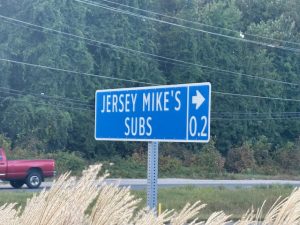
White-on-blue directional signs: they might be everywhere, but are they a gold standard?

Crossing the Occoquan River from Prince William County to southern Fairfax County in Northern Virginia doesn’t yield a lot of surprises.  Regardless of the county, it’s all suburbia, albeit a lot less dense and urbanized than Arlington County or other parts of Fairfax that are closer to Alexandria and, of course, Washington DC.  But, while

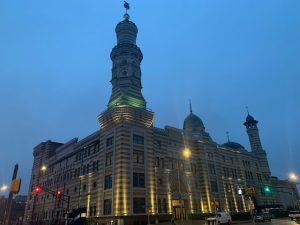
Good from all angles? Why the Murat Temple (Old National) in Indy gets a pass.

Continuing the spirit of the previous blog post—surveying big buildings and extolling those that look good from all angles—I migrate this time for a brief look at a building in my hometown that has always captivated me and certainly achieves minor landmark status.  Most other visitors to Indianapolis who have lingered in this neighborhood have

Back entrance: why some big buildings beautify their butts.

Many municipalities in northern Appalachia—which I consider to include Western Pennsylvania, much of Upstate New York, Western Maryland, Western Virginia, Eastern Kentucky, and pretty much all of West Virginia—look bigger than they are.  If one drives past them on a freeway, the density of buildings that form a skyline makes them look quite large, but,

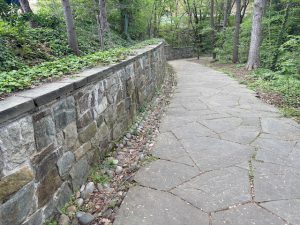
National Cathedral: sublime building, serene grounds. But how about those sidewalk storm drains?

Washington National Cathedral, among the highest-profile religious institutions in the country and certainly in the capital city, has long attracted visitors (pilgrims?) not just for its harrowing Neo-Gothic architecture, or its frequently filmed interior (the site of many presidential funerals), but also for the celebrated green space, which together occupy a hilltop plot measuring 57

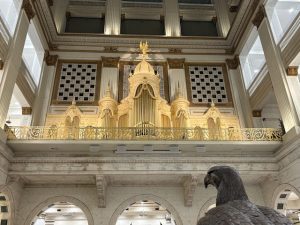
Grand Court Organ in the Wanamaker building: with Macy’s closing, what is its fate?

Though my articles rarely reflect a hot-off-the-presses event, here’s another exception to that rule, which I feel compelled to publish now (instead of three months from now) because, I fear, waiting that long will cause its significance to fade from collective memory.  The event to which I refer is obvious from the title: the demise

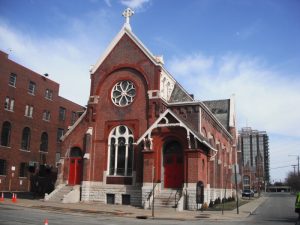
Final elegy to Sanctuary on Penn, for Encyclopedia of Indianapolis.

The building featured in this final elegy has probably served as the thumbnail photo more than any other structure, in my nearly sixteen years of writing for this blog.  I’m talking about none other than Sanctuary on Penn, FKA First Lutheran Church, FKA Mount Pisgah.  The late Gothic building, on the National Register of Historic

Back entrance: why some big buildings beautify their butts.

Many municipalities in northern Appalachia—which I consider to include Western Pennsylvania, much of Upstate New York, Western Maryland, Western Virginia, Eastern Kentucky, and pretty much all of West Virginia—look bigger than they are.