
Cleveland Park in Washington DC is, by almost all metrics, a superlatively walkable neighborhood. Just 2.5 miles northwest of the National Mall and DC’s vast downtown, the neighborhood features finely wrought detached, semi-detached, and multifamily housing, all surrounding a commercial node at the intersection of Connecticut Avenue NW and Ordway Avenue NW. It is one of the many neighborhoods west of Rock Creek that have long housed DC’s business and (of course) political elite. I’ve covered the neighborhood’s enormous centerpiece theater (vacant since 2020) in the past. Cleveland Park manifests the characteristics of an old streetcar suburb. How? Much of the housing is around a century old, dating from the prosperous 1920s. Furthermore, the layout of the commercial district mostly resembles a stop from an old trolley line, suggesting that, during most of Cleveland Park’s platting and growth, commerce still oriented itself around a busy downtown core, with smaller, satellite nodes colocated with those streetcar stops (interurbans, trolleys), along Connecticut Avenue NW and similar arterials that radiated from the core like spokes. Meanwhile, residences have long dominated the surrounding half-mile radius. Even as the well-heeled residents increasingly embraced the automobile, the harmonization of trolleys and walkable storefronts obviated the need to…um…Park and Shop.
The Rock Creek Railway, a prominent streetcar company in the late 19th century, helped lay the tracks (literally) that eventually fostered the development of neighborhood nodes along Connecticut Avenue, including the lands surrounding President Grover Cleveland’s summer home that a developer purchased to convert to smaller-parcel housing after Cleveland lost his re-election (the first time)—hence the neighborhoods name. Rock Creek Railway’s successors, Capital Traction Company and Capital Transit Company, helped ensure a strong network of commuter lines in what were then emergent bedroom communities to DC’s congested core. Fast forward a decade, and cars were firmly in the reach of many middle and working class households, even while the economy faltered in the aftermath of the 1929 stock market crash. Rebounding after World War II, widespread car ownership pushed the urbanization fringe further outward, with Connecticut Avenue NW serving as one of several conduits to Maryland suburbs. Vehicular travel increasingly outstripped the old-fashioned, restrictive transit lines, the last of which folded in early 1962. Though the streetcars are long gone, the 1970s-era WMATA system largely paralleled those old light-rail paths and stations coincident with the nodes spawned through streetcar stops. Thus, Cleveland Park largely remains the paradigm of a prosperous transit-oriented American neighborhood: a streetcar suburb in the city limits. It was a desirable, affluent reprieve from the more crowded districts closer to the center, and it remains so to the present.
I’ve linked this Google Street View of Connecticut’s junction with Ordway because it shows all the elements in place: storefronts at the ground level and businesses or residences on the second/third floors, generous sidewalks, and, on the right side of the road, the best transit America’s capital city has to offer: a bus stop and the entrance to the underground Cleveland Park WMATA (Metro) Station, represented among the sidewalk clutter by the big “M” and curvy canopy, signaling the entrance to the subway.
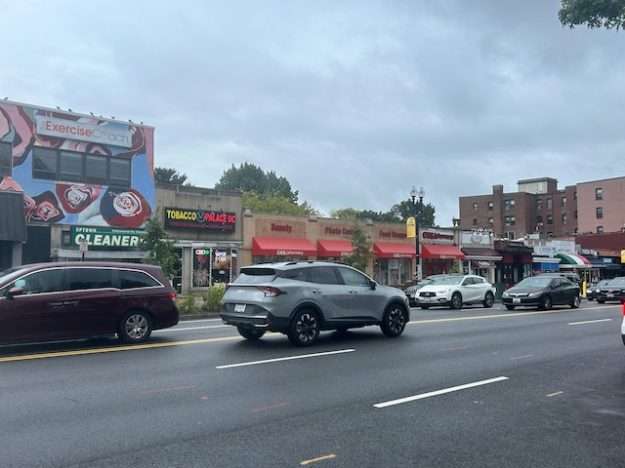
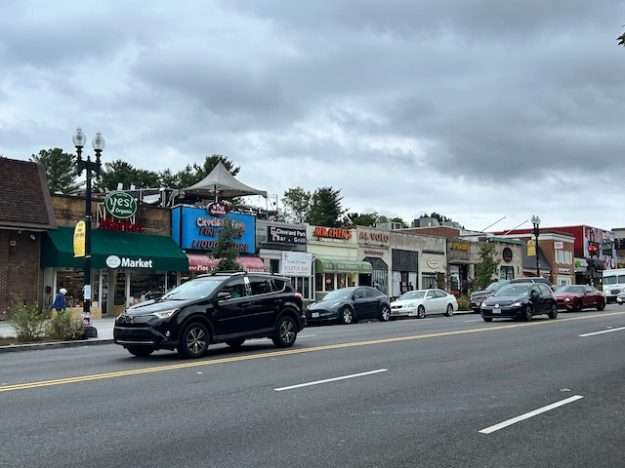
Connecticut Avenue NW is, I’d concede, a wider and busier street than is necessarily ideal for fostering pedestrian comfort. After all, it’s an arterial, extending from downtown well past the District boundary, into the suburbs of Montgomery County, Maryland. However, the crosswalks along Connecticut are abundant, timed generously to ensure walkers can get across. Even with four or six lanes of traffic, the density of stop lights and curb cuts (intersecting streets or driveways) forces vehicle speeds to remain low and comfortable. The subway inherited the trajectory of the previous streetcar, with the commercial node surrounding the Cleveland Park trolley stop adapting comfortably to changing times, from when car ownership expanded from prestigious to ubiquitous. It’s just good urban form. Developers built these street-facing commercial structures because they made sense; four decades later they persevered because they looked good. Even as transit providers changed hands, with streetcars ceding ground to motorized buses after World War II, Cleveland Park retained a transit-friendly character even as auto-ownership comprised the majority of households, because the transition from light rail to heavy rail was so smooth.
Amidst all the neighborhood’s transit-friendly merits, one nagging exception remains: the northeast corner of Connecticut Avenue and Ordway Avenue NW.
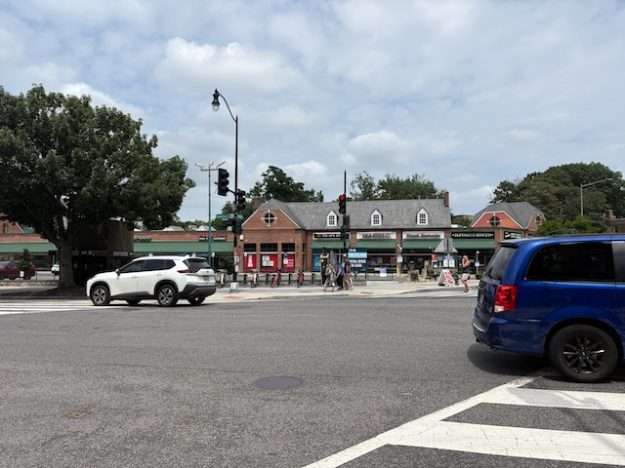
The other four corners of the intersection feature pedestrian scaled architecture with little to no off-street parking. But this corner has a strip mall, right behind the WMATA metro entrance.
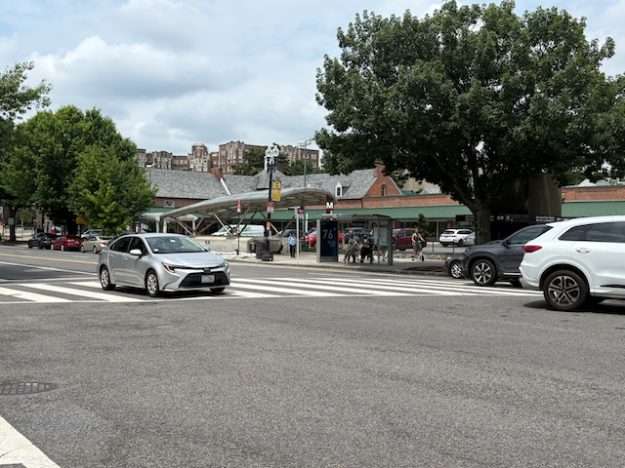
It’s the strangest juxtaposition: how, in a neighborhood where transit and foot traffic shaped most of the built environment a century ago, did a strip mall befitting the 1960s sneak itself into the most prominent intersection?
I’ll confess I genuinely didn’t know the answer, and, before digging deeper, had always suspected this very out-of-place shopping center only emerged because of the demolition of the original pedestrian scaled structures that adapted to the throngs of people disembarking from the Cleveland Park streetcar stop. And then, at some point in the early 1970s, to accommodate the underground rail that became the WMATA Red Line, original structures had to come down to support the underground station. And, in keeping with the developmental ethos of the 1970s, a strip mall replaced early 20th century storefronts.
Well, I was wrong. This modest strip mall has a name that no doubt sounded a lot more novel and creative in the year it opened to the public: Park and Shop. Pretty generic today, but back what about back in 1930? At the start of the Great Depression, a strip mall like this was a novel concept. Conceived, no doubt, before the October 1929 Great Crash, Park and Shop (sometimes inexplicably called Sam’s Park and Shop) opened with eleven tenant spaces spread across an L-shape, set back with sufficient distance to allow approximately fifty vehicles to park on the shopping center property.

A featurette from WETA (the local PBS affiliate) noted that nothing less than the Washington Post heralded the Park and Shop as “modern to the nth degree”, with parking spaces “freshly marked in gleaming white lines”. Local real estate company Shannon & Luchs chose the emergent Cleveland Park to pioneer an amazing concept called the “Drive-In” after seeing a prototype in Los Angeles (no surprise); the intersection of Connecticut and Ordway recorded a particularly high volume of vehicular traffic, which made it an ideal site. (I have no doubt both this developer and architect Arthur B. Heaton were also at least vaguely familiar of Kansas City’s storied Country Club Plaza, which offers a massive suburban shopping prototype in a fashionable early 20th century neighborhood, all of which predates the Park and Shop by several years.)
For a time, the Park and Shop actually placed Cleveland Park on the map as a satellite shopping destination, hosting both an A&P and Piggy Wiggly, among other known brands. It offered motorists the amazing convenience of driving right up to the stores, viewing their car through the storefront windows while they shop, then comfortably toting their purchases back to their cars’ tiny trunks, no doubt with the assistance of a store attendant. As WETA’s Jacob Kaplan noted in his 2017 article, it achieved a national reputation within months: the only American retail building to get Architectural Record coverage that year. Despite the Park and Shop’s evident success, the ensuing Great Depression was simultaneously the best and worst thing to happen to it: economic volatility made other developers hesitate to emulate it, which meant it stood largely alone for many years. With the New Deal creating an unprecedented quantity of new federal jobs, the DC metro weathered the Depression’s devastating impacts more confidently than most cities, preserving the fragile middle class that patronized places like Park and Shop more than many other cities. Park and Shop remained a novel concept for two decades, while the surrounding community avoided the economic devastation afflicting much of the country in the 1930s.
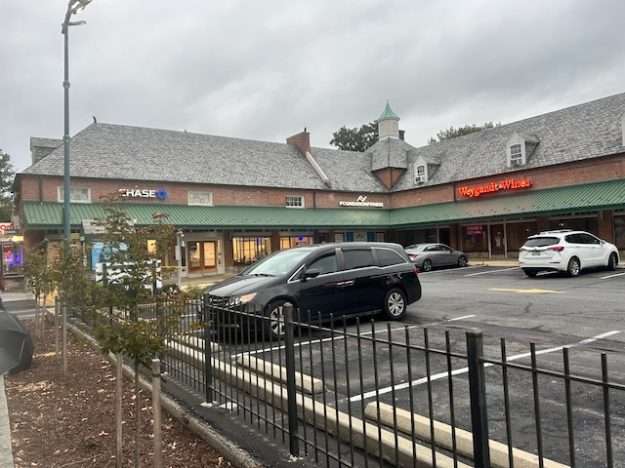
After the war’s end, automobility surged, concomitant with new family formation. Strip malls became trendy, then commonplace, then mundane. Though ensconced in an affluent neighborhood, the aging Park and Shop lost its luster by the 1970s, and a developer in the late 1980s proposed demolishing it to build something which no doubt “fit the character of Cleveland Park”: mixed-use, pedestrianized entrances, and superior floor-area ratio (FAR) to the Park and Shop, akin to the other three corners at that intersection. Inexplicably, Cleveland residents rallied to save the Park and Shop, which, though no longer novel, was still essentially an original. The neighborhood petitioned to earn DC-wide and ultimately NPS recognition as a historic district; Sam’s Park and Shop became a contributing property, complicating any owner/developer’s ability to demolish or even significantly modify it. Efforts to refurbish the property and emphasize its historic character helped lure more tenants. And it’s hard to ignore: it’s not bad looking at all. With the gables, dormers, and attractive vaulted roof, it certainly more attention to aesthetics than many of the flat boxes of the 1960s through 80s. And, since the parking lot is still small, it doesn’t really intimidate pedestrians. Park and Shop is a nicer strip mall than much that followed it.
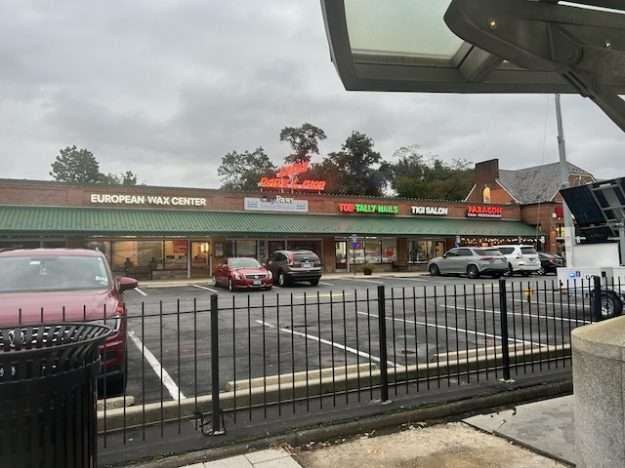
In 2026, however, the Park and Shop faces a similar predicament to the 1980s: it’s an era when many other suburban shopping prototypes are seriously faltering. (Malls, anyone?) Despite sitting right in the middle of a subway line, this vintage strip mall seems pretty lackluster today. It has less occupancy and activity than the other three corners in this intersection. And the parking lot is routinely deserted.
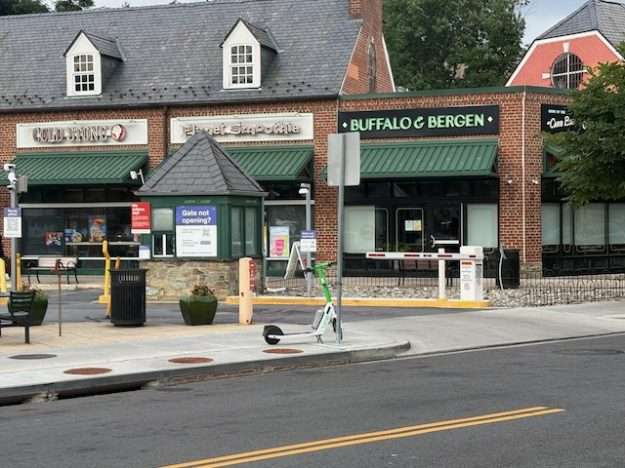
My photos, taken over a two-year period, show a continued decline. (The daytime photos with more cars in the lot are typically the oldest.) The strip mall used to host a small-format urban Target, but that closed last fall, leaving Park and Shop without an anchor. Despite the fact that it offers 50-odd spaces in a neighborhood with a dearth of off-street parking, nobody seems that keen on using the spaces. Check out these recent photos right before 8pm on a pleasant late summer evening.
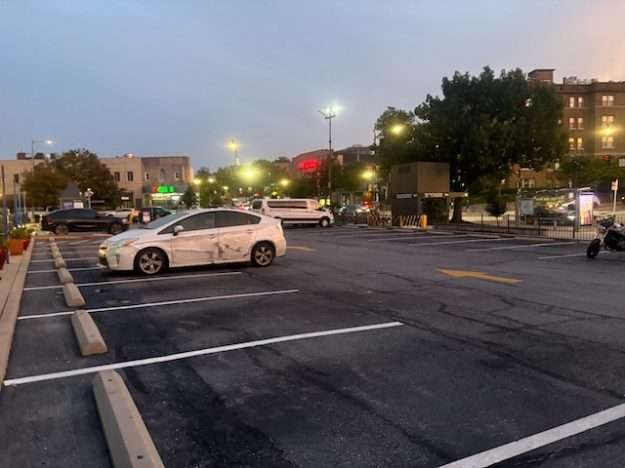
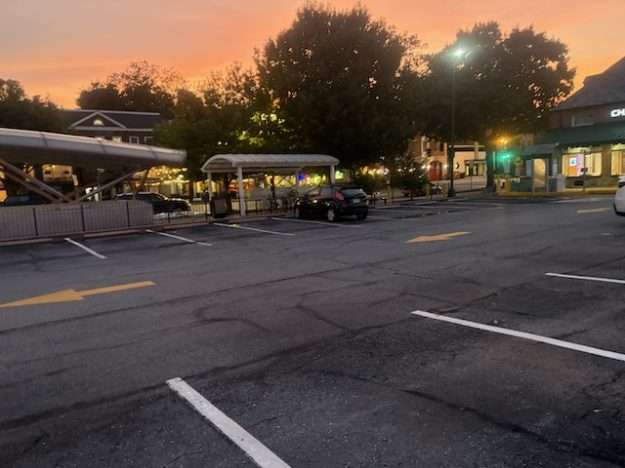
With the exception of the emergent, novelty food hall chain Wonder, few of the surviving tenants are open in the evenings, in a neighborhood replete with restaurants and bars. The Target, which occupied about 25,000 square feet mostly underground (about one-fifth the size of a typical suburban store) suffered “prolonged underperformance” during its six years of operation. Before that, the space hosted a Petco. Therefore, while the storefronts look about 80% occupied from the street level, the entirely vacant underground means it’s probably more like 60% vacant when measured through gross leasable area. Why can’t Park and Shop keep these familiar suburban brands running? Shouldn’t strip malls easily attract suburban-style chains, especially in an area with both dense population and high incomes? At the very least, wouldn’t people want to use these convenient spaces to park and linger at the nearby restaurants, even though Park and Shop has less to offer in the way of nightlife?
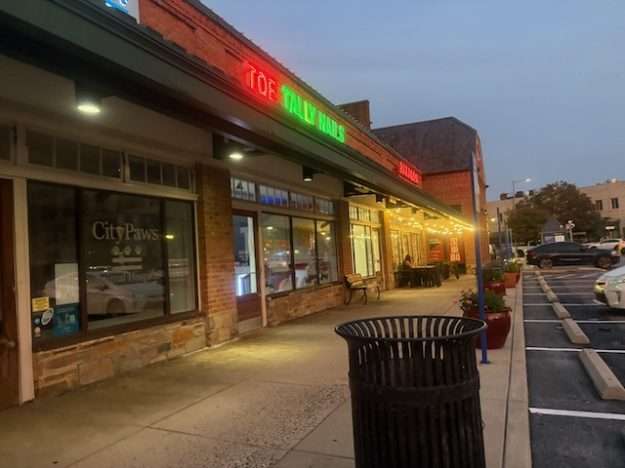
Are Cleveland Parkers just that urban-minded in the modern era, that they spurn quick and easy parking?
The explanation isn’t a huge shock to those who understand urban economics. Here’s a sign at Ordway Avene NW facing the entry kiosk visible in some of the early photos.
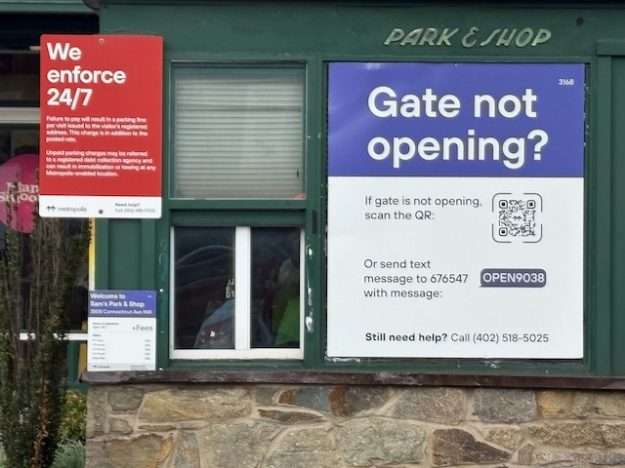
As one might expect in a place where off-street parking is scarce and land values are high, these spaces command a price—a hefty one. The fine print is hard to see, but Asana Partners, who owns the property and outsources parking to an operation called Metropolis, apparently charges $25 for less than one hour, with extremely limited validation options (maximum fifteen minutes). After two hours, parking rates increase by $5 with each new 60-minute interval.
Popular though Cleveland Park might be, it can’t impel people to park at rates comparable to downtown DC. As a result, motorists in the area either pursue nearby on-street metered parking, which, at about $2.50 for the first hour, is still significantly cheaper, or they delve further into the neighborhood, hunting for the rare free space that might require a significant walk. As a result, Park and Shop, with a 90% empty parking lot most of the time, looks deader than it really is.
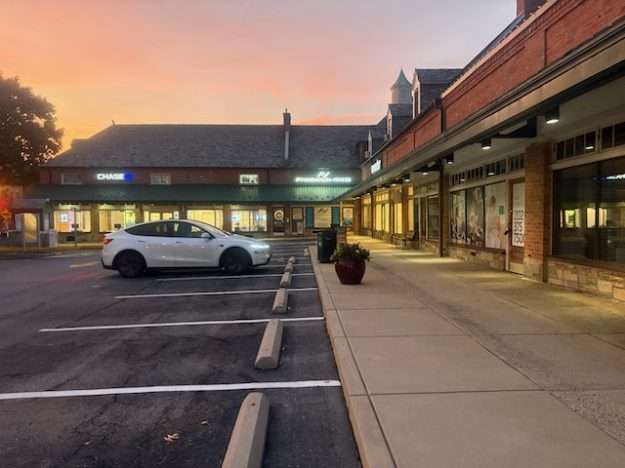
And those optics may actually hurt the appeal of the overall space, which, despite lacking the Target, at this point in September 2026 still commands a few smaller tenants. Customers just don’t park there, giving Sam’s Park and Shop the appearance of a seriously floundering retail outlet akin to its copious “dead malls” in the suburbs. Will the current owners be able to turn its fortunes around, or are they potentially deliberately driving it to ever lower vacancy, with the hope that a diminished land value might help them overcome preservationist litigation, making a case once more to demolish and turn the site into a multi-story apartment building with first-floor retail?
Probably not. But at least if that happened, this corner would finally get true transit-oriented development, which is the modern terminology for the streetcar stop of the 1920s. I’ll concede that Park and Shop is quite aesthetic and befitting the upmarket demographic of the neighborhood. But, as a retail typology, “modern to the nth degree” it ain’t. It’s about as blandly suburban as a Target. Or Petco.

9 thoughts on “Park and Shop: Cleveland Park’s strip mall oddity faces a new reckoning.”
Awesome. Did not know. Was wondering and noticed the dormers. Thank you.
Yep, it was one of the earliest of them all! If only 90% of them looked this attractive.
Too bad Fat Pete’s closed
Was that in the Park and Shop? It felt like was still a pretty buzzy shopping center even just a couple years ago.
a block away; you can see it in the last photo of restaurants. Closed last week
We have a similar looking shopping center in Charlotte. I just looked up when it was built and it was 1956
1956 was probably when this style was really starting to take off. If your Charlotte example still looks good, that’s a testament to the owner. many of the 1950s strip malls were nondescript boxes.
Lighting in that [final] pic is beautiful! 🌅
I liked this one! Used to live in Cleveland Park.