
I normally offer a disclaimer whenever I write an article about a timely or currently relevant subject. Essentially, these disclaimers all offer the same warning: don’t expect this to become a routine. And, even though my last hot-off-the-press article wasn’t that long ago and generated considerable response, I still won’t get into the habit because, frankly, I’m not that fast of a writer. Additionally, I pride myself that so many of my articles have staying power—that is, I still often get new comments for topics I featured months or even years earlier. Most importantly, though, since all my articles contain at least one image, I can’t always stay caught up on an immediately relevant subject, because I often fail to capture a salient photograph. But this time I stumbled onto surveillance cameras (and the inevitable anti-Flock activism) on a pretty humdrum residential street in Arlington County, Virginia:
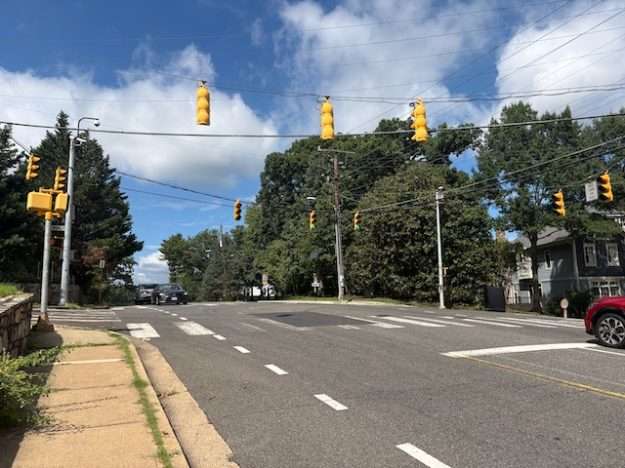
Catty-corner from where I’m standing, obscured by other sidewalk clutter, is a solar-power operated roadside camera, the likes of which most city dwellers see on a regular basis. But the recent turn of events has endowed this camera with a potent identity:
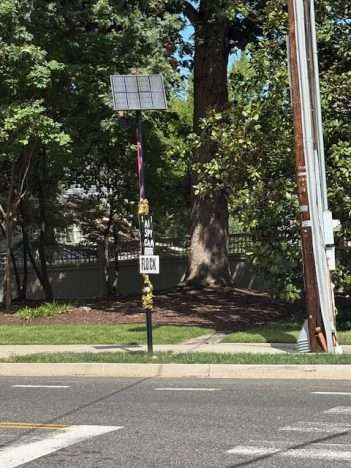
A concerned citizen (or two or three) from the neighborhood has identified it as “FLOCK”, which is a term I wouldn’t have recognized in this context, if I had encountered this image as recently as May of this year. But Flock Safety is indeed a brand name: a surveillance manufacturer only in existence for the last decade or so, but the proliferation of Flock’s patented automated license plate recognition (ALPR) technology has enabled many municipalities to issue traffic citations without the use of a a law enforcement officer. The Flock cameras remain perched on the side of the road, almost as predictable as streetlights, monitoring vehicular speeds or the running of red lights. In the event of a moving violation, the cameras instantaneously snap a photo of the license plate of the motorist, then report the details of the vehicle owner to local traffic enforcement, which then issues the citation by mail. The process has curbed commonplace moving violations, and, as many police precincts will argue, made cities safer by allowing cops on the beat to spend less time issuing lesser citations—which Flock cameras can help implement—so they can focus on the major crimes.
In Washington DC, just across the river from Arlington County, over 150 reported Flock cameras have synchronized with other competing surveillance brands to form a panopticon network of nearly 550 cameras, according to some of the more recent counts. These numbers are dynamic and constantly changing, but I recall an article from around 2020 that estimated Washington DC and New York City have just about the same numbers of ALPR cameras, despite the fact that New York City is much larger (measured by both population and land area). The pervasiveness of speed surveillance in DC has spawned mild anti-Flock sentiment, but it seemed rooted less in the company itself and more in just the city’s cynical means of using draconian speed enforcement as a revenue generation tool, at least until recently.
But in 2026, in a quiet corner of Arlington County, the Flock cameras and their semblables may not be as pervasive as in the nation’s capital, yet they arouse considerable anti-Flock suspicion.
Amidst the numerous documented incidents of anti-Flock vandalism, the signage here does not appear to involved in anything with legal consequence. I witness damage to the camera. The anti-Flock activist merely wanted to call attention to a culprit standing unassumingly on a minor collector road of limited importance, but hilly and convenient enough in its alignment to encourage speeding, which makes it a prudent place for vehicle monitoring. But it’s an “AI SPY CAM”, the activist asserts, and the referenced website (defrock.org) monitors Flock Safety’s geographic distribution of cameras with ALPR, explains the privacy violations embedded in their use, and tracks municipalities that have banned them.
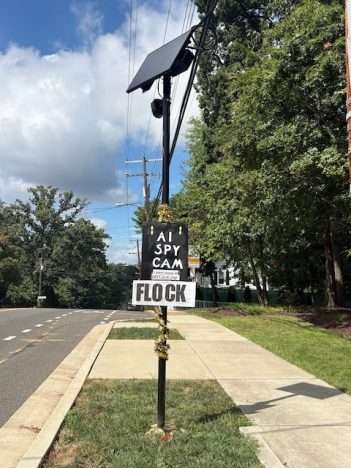
What makes Flock Safety in particular such a target of bipartisan ire? The AI technology is strong and getting stronger (as is its intent), to the point that some Flock prototypes (the Condor) can move their “eyes” to preclude blind spots, focus on targets as needed, and achieve remote manual control. Meanwhile, the Raven model can listen not just for gunfire (and identify the source fairly accurately) but human cries of distress. Yet the most pervasive models, the Falcon and the Sparrow, have harnessed ALPR with AI across a camera network to track not just cars at a fixed node for infringements (something cameras have done for years), but following specific vehicles based on make, model, or distinguishing marks to trace them across jurisdictions and even to anticipate for future violations. This degree of scrutiny has spawned anti-Flock movements on the political right (against government overreach) and left (surveillance targeting specific people). And it can take place starting at a humble intersection where a minor collector and local road elicit a mundane stop light.
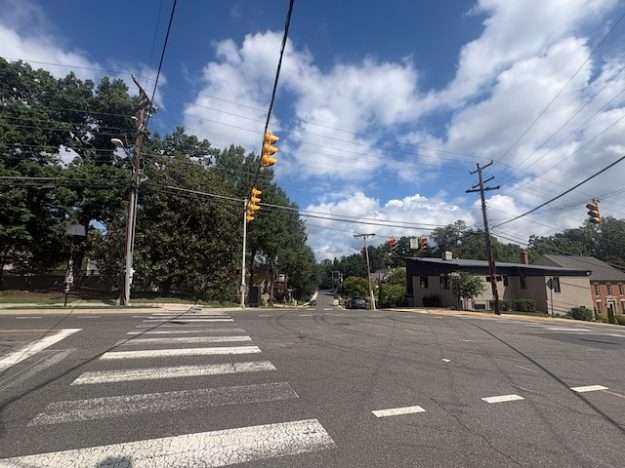
I encountered this camera and the anti-Flock activism on a quiet Sunday morning. Returning to the intersection four days later, it was all gone; the camera once again blended in with other sidewalk infrastructure.
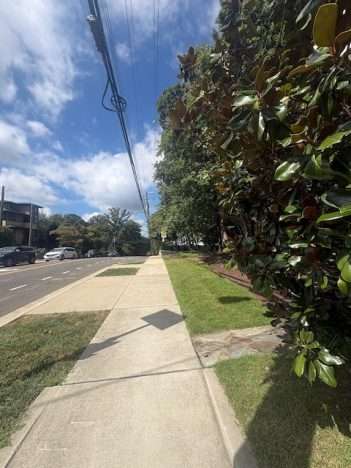
Have we achieved peak anti-Flock? Probably not. My guess is the anger and opposition will only grow, especially since it seems to spill across parties in a hyper-partisan time. (Conversely, partisan anger can reach a fever pitch but often stalls as both polarities dig in their heels.) The anti-Flock vandalism might be much worse the next time. Until then, the sinister shadow cast on the sidewalk in the photo to the left may increasingly prompt not just motorists to change their route, but for pedestrians like me to avoid anything vaguely reminiscent of Flock Safety—to run, to run (so far away).

9 thoughts on “Anti-Flock: the cameras are everywhere, and they’re stronger than ever.”
I see what you did there with the close…but you’re too young for that! (Or are we both old now?)
Definitely not old enough to remember when *it* was popular the first time around, but everything from that era had a second life in the early 2000s. Incidentally, I first learned about the group from a college-dated photography where, after a boat ride, my (then thick and luxuriant) windblown hair made me look like a certain Mike Score. Purely coincidentally, the next photo in this boat ride series was–ahem–a flock of seagulls.
Revisiting a different kind of flock, a day or two after I took these photos (and about the same time I was writing the article) Arlington County Board of Supervisors voted to discontinue a relationship with Flock Safety. The cameras are coming down in the next week or so. https://wtop.com/virginia/2026/09/arlington-county-ends-use-of-flock-cameras-and-related-technology/
I think of the Rolling Stones song… paint it black. Ha!
Of course, I don’t remember the part where they sung about wrapping it in gold tinsel.
lol
Flock cams are pretty creepy!
What is ClearView?
ClearView AI is a controversial American technology company that provides a powerful web-based facial recognition platform primarily to law enforcement and government agencies.
How It Works Image Scraping:
The company has scraped more than 70 billion facial images from public internet sources, including social media platforms, news media, and mugshot websites. Search Engine for Faces: Users upload a photo of a face into the ClearView AI Platform, and the software matches it against its massive database to find similar photos, public profiles, and web links. Investigative Tool: Police use it to generate leads for identifying suspects, missing persons, or victims of crimes. Controversies and Privacy Concerns Lack of Consent: Photos are collected without the knowledge or consent of the individuals featured in them. Privacy Backlash: The massive scale of data collection has led to heavy criticism, investigations, and legal penalties from privacy regulators and lawsuits in multiple countries, including the U.S., Canada, and the European Union.(Note: There is also an unrelated software called “Clearview” used for restaurant and franchise management operations).If you’d like, I can share more details on how privacy laws restrict ClearView AI or how law enforcement agencies use it in investigations.
What is SignalTrace?
SignalTrace is an advanced surveillance and signal intelligence system developed by Leonardo that pairs electronic device signals with automatic license plate readers (ALPRs) to track people and vehicles.
How SignalTrace Works Sensor Add-On:
The system places extra radio-frequency sensors alongside traditional traffic license plate cameras. Signal Collection: It sweeps up wireless identifiers broadcast into the air by consumer devices like smartphones, smartwatches, fitness trackers, Bluetooth earbuds, RFID tags, and vehicle tire-pressure monitoring systems. Electronic Fingerprints: The software looks for devices that repeatedly move together and bundles them into a unique “electronic signature” or fingerprint. Data Integration: It links these device groups with specific license plates and time-stamped location logs via software like the ELSAG Enterprise Operations Center. Key Features and Uses Tracking Without Plates: Police can search movement patterns and recognize a vehicle or target via its device fingerprint even if the license plate is missing, hidden, or changed. Working Backward: Investigators can start with a recurring electronic travel pattern rather than a known suspect or license plate number, helping map out convoys or associates. Wider Coverage: Sensors can function in areas where cameras cannot see well—such as malls, event venues, or transit hubs. Privacy Concerns Anonymous Yet Linkable: Leonardo states that the tool “does not identify people” directly because it only reads unencrypted broadcast signals. De-Anonymization: Privacy researchers note that police can easily work out who owns a device by matching its recurring location history to a registered car owner or home address. Surveillance Expansion: Critics argue the technology shifts law enforcement toward tracking general associations and movements before a crime or formal suspicion is established. If you’d like, I can share more details on: How data retention policies apply to these electronic footprints The privacy debates surrounding ALPR expansions in the U.S.
https://snipboard.io/cPveog.jpg
Yes those that are drawn to control and power at abusing these to stalk exes lovers and enemies. Very sad
Hear hear! There have been multiple instances of people abusing the eye-in-the-sky nature of these cameras all across the country where they’re used. I suppose, if the heart is inclined to evil, a person can abuse a Flock camera or a ballpoint pen entrusted to them in equal measure. But the software advances attached to Flock Safety seem tailor-made to follow people around as much as possible. Almost as though catching speeders is a supplemental use but nosing into people’s business is the REAL goal.