
A strip mall is usually the most predictable and omnipresent of low-density suburban commercial land uses. Every American over the age of ten knows what one looks like: a row of shops, usually low-slung (one-story), a sidewalk linking the storefront entrances, and an abundance of parking out front. They’ve gotten more aesthetic in recent decades, and the districts with high land values may offer a second floor, but the fundamentals are about the same in 2026 as they were in 1956, when they were a novel concept. While strip malls can attract insurance agencies, army/navy recruiting, accounting firms, or physical therapy and rehab, the presence of those yawning windows out front has typically attracted retailers, capitalizing on the transparency to display merchandise or signage advertising the latest deals. These features allowed strip malls to supplant the traditional storefronts of old commercial buildings in historic American main streets or downtowns. Strip malls don’t concern themselves with multiple levels or handsome brick façades, because neither the strip mall tenants nor their customers expect them. Far more important is all of that easy parking that’s often scarce in a traditional, walkable town center. So how does one explain a place that looks like this—a hybrid strip mall?
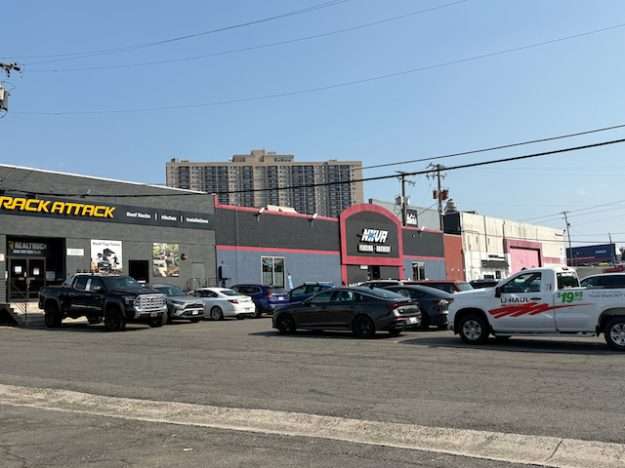
My use of the word “hybrid” will make sense soon. The photo above does not show a typical strip mall: it’s mostly windowless, features vaulted ceilings, and does not link the entrances with sidewalks or any continuous pedestrian protection. In one respect, it’s the Wild West of retail, but in another, is it even retail at all? It looks more like light industrial: little manufactories that don’t yield a lot of pollution or noise and, as a result, don’t get subject to the sort of zoning sequestration one might expect for a refinery or waste treatment plant. But is it light industrial? Not really. As the photo indicates, only one tenants is a broadly familiar chain: the Seattle-based outdoor outfitter REI) while the other tenants feature a smattering of uses that in most respects, do not accommodate a customers seeking to walk in and leave with a product. In other words, not retail.
Maybe the fault is mine in even labeling this place a strip mall. Perhaps. But I have only shown one of the two frontages—the west side. Meanwhile, the south side of this unusual structure looks like this:
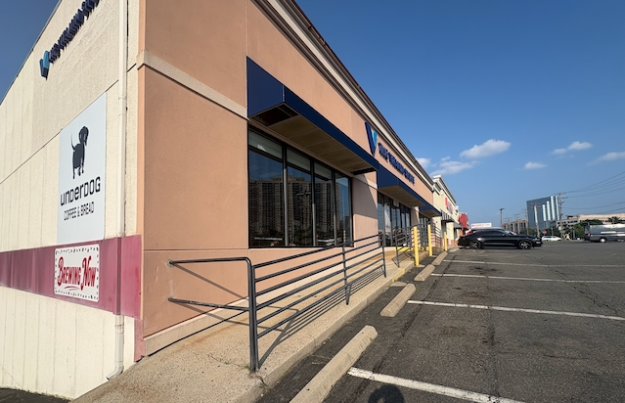
Lots of windows, a small sidewalk separating car parking from the entrances, concrete parking stops. Much more like a conventional strip mall. And yes, the tenants here are typical: The Vitamin Shoppe, Party City (defunct), Carpetland, Blinds to Go, a vape shop. Retail.
Perhaps now its s bit more clear why a call it a hybrid strip mall. From the point I’m standing, I can look directly across to the corner of the two intersecting streets.
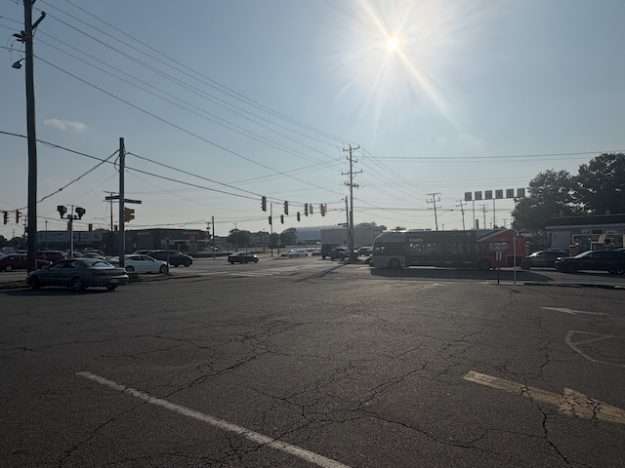
This seemingly nameless shopping center stands as one among many in a long-established shopping district in Fairfax County, Virginia—part of the seemingly endless Washington DC suburbia, where this commercial node has the name Bailey’s Crossroads. The intersection involves Leesburg Pike (VA-7), a major arterial linking Alexandria to Leesburg, and Carlin Springs Road, a major collector linking Bailey’s Crossing and Ballston, a heavily urbanized neighborhood a few miles to the north. I’ve covered historic signage in the area before. But most of the shopping centers in Bailey’s Crossroads—and there are quite a few—don’t engage with their respective streets quite like this one.
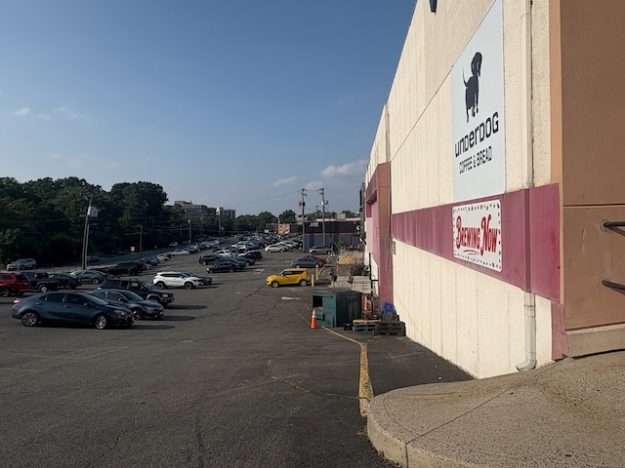
The side with all the retail-oriented windows (Vitamin Shoppe, Carpetland) has less overall frontage but greets the heavier arterial traffic. The more interesting side (in my opinion) with high ceilings, no windows, and entrances a few feet off of street level—almost evocative of loading docks—faces Carlin Springs Road. The design seems strategic: light industrial uses don’t benefit from curb appeal, nor do they attract passers-by for an impromptu visit. Most people who go to these more specialized businesses are seeking precisely the use within those businesses.
But, despite the physical form of the Carlin Springs Frontage to this strip mall, none of the uses involve industry or really even warehouse/wholesaling.

The tenant most customary of strip-mall suburbia is, without a doubt, REI. And it’s a bit surprising that it should opt for a windowless building, given that the interior features merchandise that, with a good presentation, could elicit visual appeal: not just apparel, but tents, climbing/hiking gear, snow sports, and fitness equipment. But the fashionable outdoor recreation cooperative is quirky that way, I guess: it can retain its fiercely loyal customer base (many of whom are members) without flashing its latest wares or promotional signage out front. In fact, the REI here in this strip mall is a bit of an institution: it has leased space at this location since at least late 2007, a time when the brand had not yet achieved nationwide recognition. The chain has expanded; in 2026, all but seven states have an REI location.
The other tenants reflect the huge variety of offerings in this retail/wholesale hybrid strip mall. To the immediate left from REI is Rack Attack, a showroom for vehicular hitches, roof racks, truck bed covers, etc. Though this is clearly a retailer offering merchandise, these aren’t the sort of objects that would benefit greatly from a window display. And a business like this is niche: I can’t imagine it has a great deal of competition; additionally, through its appeal for people who use their vehicles to haul outdoor recreation gear, it may have specifically sought proximity to REI, in much the same way that nutritional smoothie bars and health supplement stores like to locate next to gyms. Speaking of gyms, the space next to Rack Attack was, in a previous life, a Gold’s Gym. Now it’s a studio/range catering to fencing and archery.
This warehouse-oriented side of the hybrid strip mall offers a variety of businesses that likely cater to a recherché client base.
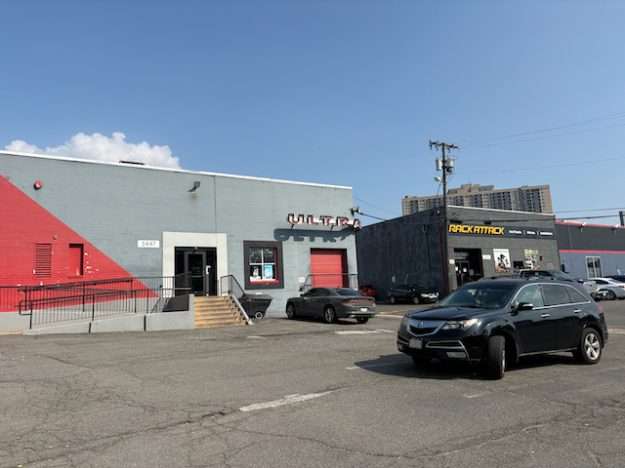
To the left of Rack Attack is a small service alley, but this unconventional strip mall continues with the next structure; the entire hybrid strip mall complex shares one parking lot. The gray and red building is Ultrazone, a “multilevel arena” for laser tag (proving there’s a purpose to these high ceilings). Laser tag was briefly the rage in the late 90s, but those days are long gone. It apparently still has its devotees. Pivoting further to the left reveals a similar theme:
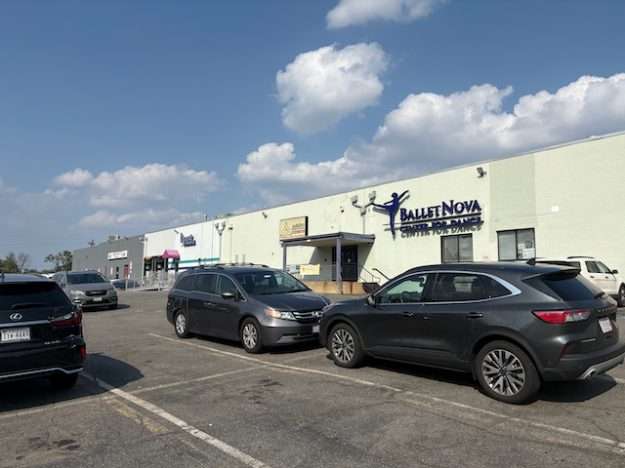
Closest to where I was standing is a dance studio, followed by a martial arts (jiujutsu) studio behind the small white rectangular sign. Beyond that stands a gymnastics studio, and, in the lefthand distance, is Factory Motor Parts, an auto parts supplier that typically serves fleet-owning companies, other independent service centers, and wholesale distributors. At last the sort of tenant one might expect from a hybrid strip mall with a significant component for warehousing or light industrial. Continuing along Carlin Springs Road, outside the range my cameras lens, is a place called Pho Supplies Inc., labeled an “Asian grocery store”, though with a name like that it could also be a distributor. And, still further away from the intersection with Leesburg Pike, is Colours Imaging (a large-format sign and imaging shop), a franchise of the well-known moving/hauling company College HUNKS, a cheerleading studio, and—at least until it relocates—an aerial and circus studio.
Returning to the frontage near the corner of the property…
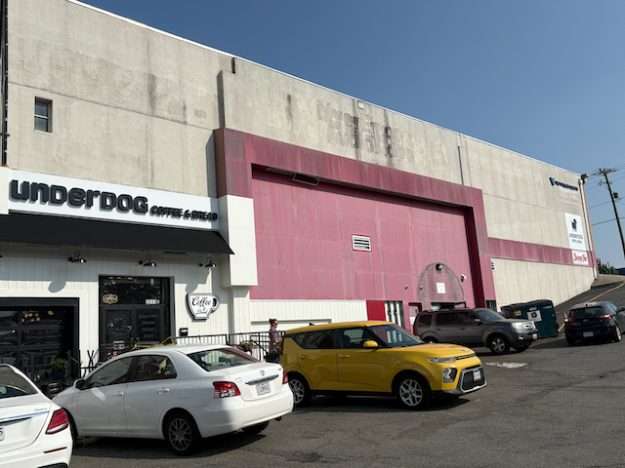
…to the immediate right of the REI is a brand-new location for an already new coffee shop; this second location is many orders of magnitude larger than the original in nearby Annandale. In fact, it’s one of the single largest mom-and-pop coffee shops I’ve seen, defying the model of most by exceeding (if my spatial estimates are reasonable) 3,000 square feet. I suspect the space sat vacant quite some time, and the owners of Underdog Coffee and Bread secured a sweet lease.
Then, finally, the most mysterious tenant of all:
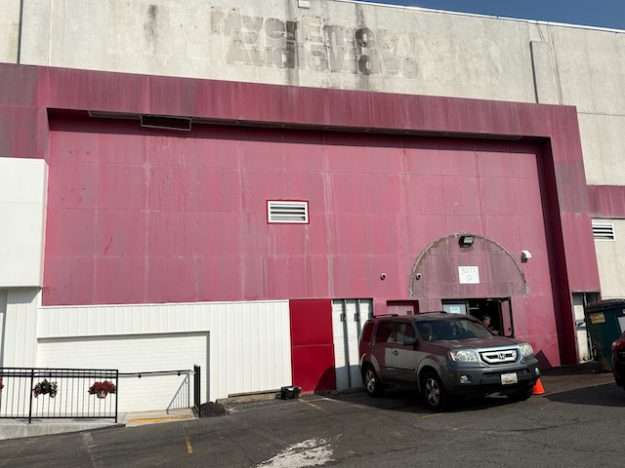
As the label scar above the red frame indicates, this was once a MyerEmco Audio Video (a local chain devastated by the same late 2000s misfortunes that helped to kill Circuit City and H.H. Gregg). But what is it now? Cars parked out front and the door is hanging open, with people coming and going. My cynical brain says, “Drug front”, but apparently it’s more innocuous.
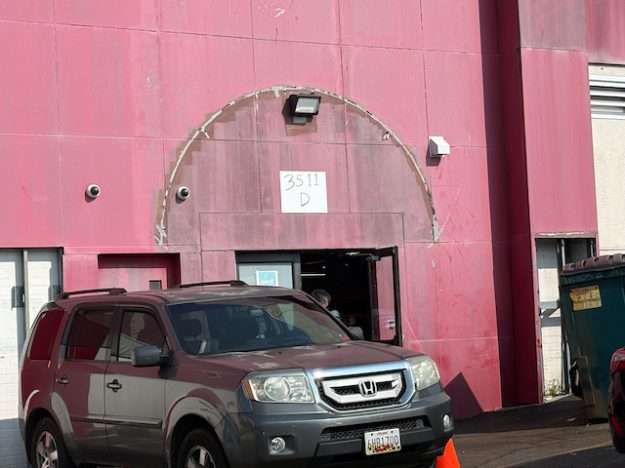
A tiny blue-and-white sign to the left of the open door says GoPuff, which initially reaffirmed my suspicion that this was some sort of shady cannabis distribution center. Nope. Further research indicated that this was a warehouse for the formerly emergent digital delivery service. I wasn’t familiar with the company, but apparently it was a sleeping giant in the late 2010s as a mobile app-driven initiator of lightning-quick delivery of convenience store items. The Philadelphia-based company faced labor shortages during COVID, resulting in a decline in delivery quality and sales, followed by considerable layoffs. The last eighteen months have been more fortuitous thanks to a $250 million infusion in capital, and this barely labeled outpost in Bailey’s Crossroads may simply exist as an early indicator of the tech company’s trepidatious comeback. If the space was, like its neighbor Underdog Coffee and Bread, long vacant, GoPuff probably enjoys rock-bottom prices to its lease, and since it’s less a retailer than a distributor—a place for delivery drivers to pick up goods—it doesn’t need a lot of fancy signage to announce itself.
I’ve devoted far more scrutiny on the tenancy of this strange hybrid strip mall than I had originally intended. Normally I don’t like to do this, unless I’m pontificating on overall retail health. Why is this an awkward subject? Because tenants come and go so readily. These photos are brand-new right now, coming from mid July. But by this autumn the tenant mix will likely change at least a little, and it could be quite different by this time in 2027. Therefore, I’m basing an analysis on a potentially ephemeral condition. Yet, at the same time, many of these tenants have been here for over fifteen years (as proven by this ancient summer 2009 Street View): REI, Vitamin Shoppe, the laser tag place. Something about a weird retail-wholesale hybrid strip mall seems to work here in Bailey’s Crossroads, not only because of the difference in street frontage (Leesburg gets the retail, Carlin Springs gets the wholesale), but because the Carlin Springs entrance rest at a lower elevation. The 2009 Street View reveals this slope, which keeps a similar roofline to the Leesburg side but allows the pitched ceilings and loading dock entrances along Carlin Springs. The developer from five decades ago (if not more) took a bit of a risk by fusing two commercial typologies, amidst the uncertainty that retail shopping would want to share a roof with warehouses or small-scale industrial (and vice versa). Judging from the occupancy in 2026 amidst the implosion of retail, it seems like the risk paid off.
Most interestingly, however, this nameless hybrid strip mall shows the breadth of tenants willing to take these different spaces, based largely on the physical characteristics of interiors. Yes, a few wholesalers remain for car parts, hitches, and convenient store items. REI isn’t going anywhere. But a surprising number of businesses have leased these large, boxy, windowless units for the floorspace they allow for various forms of recreation and fitness: gymnastics, dance, fencing, laser tag, jiujitsu, nouveau cirque. It’s like a giant decentralized amusement park but without a glitzy entrance; no tickets either. It probably never was the intent of the original developer of this nondescript structure to host such a variety of fun, but if the businesses can keep chugging along for decades, the property manager of this hybrid strip mall sure isn’t complaining.

19 thoughts on “Hybrid strip mall: a retail/wholesale beast in the suburban jungle.”
Except for REI, most of the side facing Carlin Springs look kinda old. The stores facing Rt. 7 look a little updated.
The RT 7 side was updated a couple of years ago, when the Toy’s R Us across from it closed, the Carlin Springs Rd, had a Tuesday Morning and the Myer Emco, both have closed and the REI is the only storefront that is in good condition.
Thanks for pointing out the Toys ‘R’ Us, which hadn’t occurred to me….or the Tuesday Morning, which I think was still operating until around 2022. I agree that REI has the best-looking storefront, but it is also by far the most capitalized of the businesses on this side (most of the rest are mom-and-pops), and it has an incentive to retaining a positive association with its brand. It’s more likely to attract impromptu customers than the other businesses, most of which are so specialized that people are clearly coming to this strip mall for that specific purpose.
On vacation in Iberia this spring, I noted that this form along the frontage roads by exurban freeways there, particularly outside Madrid and Lisbon. Many of the stores appeared to be hybrid wholesale/retail sellers of one specific type of home improvement (kitchen, or bath, or tile, or lighting. or appliance) or auto/truck parts/service. Some might have been used car dealers with service bays and/or indoor showrooms.
Here’s a link to one such cluster outside Madrid on a highway frontage road (along the highway to Toledo):
https://maps.app.goo.gl/efbxA2BfVGWNGva87?g_st=ac
Before I even clicked your link, I had a mental image….and it proved pretty accurate. Yeah, it makes sense that these sort of uses should be right up against limited-access highways, so the logistical fleets have as little additional distance to travel, maneuvering clumsily on local roads. Reminds me of what you might see in Texas or Missouri, two states that I’m pretty sure statutorily require frontage roads along freeways–and the sort of land uses one might see when approaching urban areas. (Though they wouldn’t ever be as dense as what you’re showing around Madrid.)
When wholesale-style buildings operate in close tandem with more conventional retail, it doesn’t surprise me that it becomes a series of “decentralized category killer” uses, like home improvement as you mention, or vehicle accessories. Or, as I noted in Bailey’s Crossroads, alternative recreation studios, more oriented on individual athletic development (akin to gyms but not gyms) than team sports.
I think development nerds probably form sticky memories of development form anywhere we look out the window of a car, train, or bus.
When I read your post, the image I linked came immediately to mind and it literally took less than two minutes to find it on Google maps.
Clearly this development form is one of the many archetypes of modern economic geography…where market forces and development economics define places and spaces.
Lol, I knew Northern VA but wasn’t sure where and once you said REI in this post, I knew! 😂
It’s such a landmark. And this one is an oldie: been at this drab location for at least 17 years. Long before it was a nationally known brand.
I believe it’s where I bought my first pair of hiking boots
I know that strip mall, it’s lost a couple of stores over the years, there was a Tuesday Morning, and a large consumer electronics store (that location was empty for years), the docks are in the back, I remember having to go to the back, to get a purchased item (you couldn’t take it out of the front of that particular store).
Wasn’t the electronic store a Meyer-Emeco. I lived near that center off West Braddock RD for over 10 years. I think there was CA Pizza Kitchen in it too at one point.
Yes, it was a MyerEmco, as my article reinforces. I didn’t live in the region at the time, but my guess is it was one of these family-run all-purpose electronics stores that popped up in the 70s/80s, peaked in the 90s, then struggled during the Great Recession at about the same time Circuit City met its demise. My home city of Indianapolis had a place called Ovation that had this exact trajectory. Kind of surprised Best Buy has made it through, though it’s a bit of a shadow of its former self. I guess the more upscale versions (Bose, Bang & Olufsen) are hanging in there, but they’ve closed many locations too.
Surprised a semi-fancy chain like CPK would ever locate in this ugly strip mall.
I know it’s a complete eyesore
Definitely. And yet it retains its tenants over the years, even though the owners have done nothing to spruce it up. Even the parking lot is terrible.
100% agree
I love our weird retail here. It must be due to the uneven terrain/elevations in certain areas. In Alexandria there’s a little shopping center with an Aldi, ABC store, etc. (typical stuff) on the front side. and since it was built into a hill, there is a Planet Fitness and a laser tag arcade in the same shopping center plaza, but you enter them from a rear entrance and the whole thing is essentially in a basement vs. the Aldi which is at street level.
I think you are seriously on to something here. The side facing Leesburg Pike is easily 10′ higher elevation than the side facing Carlin Springs, which only some of my photos manage to capture. The original developer kept the same roofline across the whole structure, so the lower elevation tenants have what would be a basement entrance but with much higher ceilings. The whole thing looks like it was originally designed for loading docks–i.e. warehousing or even light industrial. Some retailers like REI didn’t care. Other tenants are in fact wholesale. And still others are studios for athletic activities, who probably like the unusually large (and cheap) floor space, high ceilings and lack of windows.
And yes, I know the Alexandria strip mall you’re referencing with a Planet fitness and arcade in the lower level. A very similar concept to the one seen here.
What it really proves is that, even if zoning tries to separate these uses, the difference between retail, wholesale, indoor recreation, and light industrial is more subtle than we might think…really more of a continuum than completely separate categories.
I used to take ballet there!!
This shopping center seems to have kept a lot of tenants over the years that focus on fitness or novelty hobbies. Not too shabby for an ugly strip mall!