
Seen a flick at a single-screen theater lately? Ever seen a movie at a single-screen theater at all? Odds are strong—for any American over the age of 35 who grew up an urban cluster (basically any community over 5,000 people, per the Census’s revised definition—the answer is probably “no”. Some very remote small towns have managed to retain the single-screen movie theater, primarily because there’s nothing else within a 60-minute drive. And most larger metros have at least one surviving single-screen movie theater building, but it is unlikely that the structure exclusively features first-run movies as it might have forty years ago—presuming it shows movies at all, or presuming it’s not simply decaying in neglect.
Multiplexes, which drove the single-screen theater to near extinction, didn’t enter the cinema industry aggressively. Single-screen movie theaters dominated commercial main streets during the Golden Age of Cinema from around 1928 (with the distribution of the first “talkie” films) to at least 1955 (when Eastmancolor fully supplanted the elaborate Technicolor process), and many prospered for years after. Even in the middle of the twentieth century, as Americans were migrating their living, shopping, and eventually working patterns to bigger footprints in the lower density suburbs, movie theaters still continued to offer one or two screens—the duplex. Even early mall-culture movies like Fast Times at Ridgemont High (1982) could not credibly depict a theater with numerous screens; with few exceptions, they didn’t exist.
After the midcentury experiment with duplex theaters (which were never that common), the multiplex arrived in the early 80s, delivering a whopping fourteen screens under one roof in (surprise!) West Hollywood. By the end of that decade, they became the standard delivery vehicle for high-profile movies under one roof, sometimes offering a single big-ticket movie in two or three screens—in other words, up to fifteen screenings a day, if the demand was high enough. By today’s standards, though, these multiplexes were meager: they averaged about six screens, though often featuring a little as three, or eight screens on the high end. In the age of Ghostbusters or Crocodile Dundee, a multiplex with twelve screens was a monster. By the 1990s, however, the three-screeners in malls were losing ground and even closing to megaplexes with over 16—and perhaps as many as 30—separate screens within a massive building, surrounded as one might expect by an even more gargantuan parking lot. Throughout this time, the single-screens of yesteryear, depending heavily upon Main Street’s available on-street parking, had to reinvent themselves: as live-action theaters; second-run movie venues; arthouse, cult, or independent cinemas; or adult and snuff films. The majority still couldn’t compete, so they closed. Rehabilitations and revivals have met with mixed success.
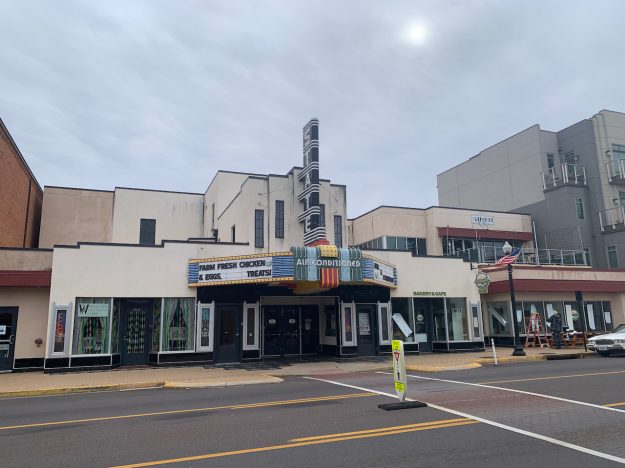
I already explored this trajectory in greater detail, chronicling the rise, fall, revival, and second demise of the State, a handsome old single-screen movie theater in Culpeper, Virginia that opened during the Great Depression as the Pitts Theater. Culpeper itself is a healthy smallish town that has expanded in visibility in the last thirty years as a distant satellite to Washington DC, far enough away to still feel semi-rural (and to avoid the steep home prices, at least somewhat), while still offering a tolerable commute to busy northern Virginia edge cities like Tyson’s Corner, Springfield, Vienna, Ashburn, Reston. (Train commute is also possible: the Culpeper station offers three Amtrak lines.) Given that Culpeper has surged from 6,500 to over 20,000 people since 1980—back when the State Theatre was still viable—it would make sense that an extensive rehabilitation prompted by state preservation grants would ensure the the 550-seat venue a lucrative second life. But the State Theatre’s comeback was brief: opening in May 2013 with much fanfare, Culpeper’s signature single-screen couldn’t stay solvent and closed again after barely three years. Resuscitation efforts through special events have been spotty. Its biggest influx of cash came in 2018, when a country music star purchased all the theater’s seats (formerly belonging to DC’s Kennedy Center) for an arts venue in Mississippi. To the best of my understanding, the State Theatre’s management has attempted to sublease the storefront space and the second floor, with intermittent success; businesses have come and gone. At the moment, the vaulted theatre space gets its most intense use has a nonprofit rock-climbing venue. I wouldn’t begrudge this; it’s a clever repurposing. But there’s no way a rock-climbing can bring 500 people under one roof the way a hit movie or concert could. Without seating, the single-screen theater purpose is nigh impossible. And that is the state of the State.
This extensive introduction offers an appropriate segue to another single-screen theatre tragedy about 60 miles to the northeast, in the Cleveland Park neighborhood of Washington DC.
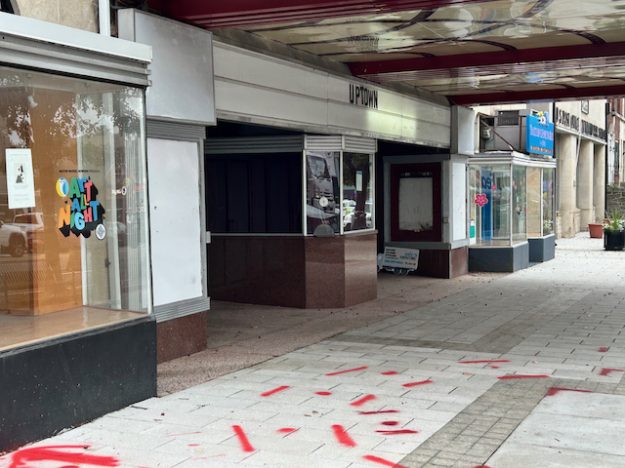
This part of the city remained affluent even during DC’s abysmal time as a host of recurrent riots (1960s) up to its dubious distinction as the nation’s murder capital (late 1980s).
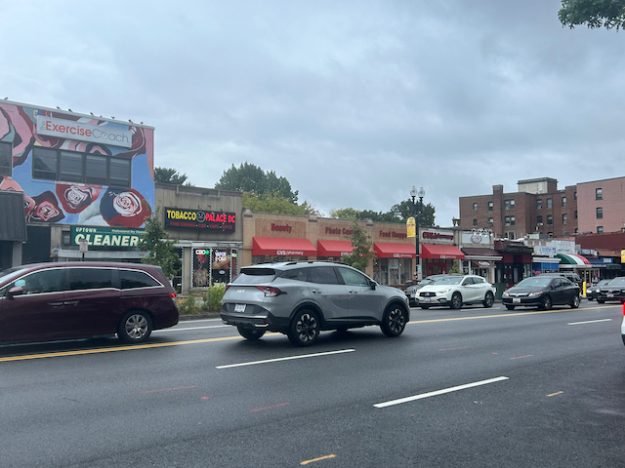
Not directly confronting the social turmoil the nation’s capital has always incubated, Cleveland Park remains a successfully self-sustaining neighborhood with single-family housing flanking its commercial main street, Connecticut Avenue NW, elevated in profile through a WMATA metro stop.
Cleveland Park’s continued prosperity possibly helped shield the Uptown Theater from a demise when most of its peers were folding in the 1980s. But, in all fairness, how much could the neighborhood do? Other single-screen movie theaters closed across the country, not because the neighborhoods declined. Even amidst riots and urban flight of the 1960s and 70s, people craved new movies. A failing neighborhood might eventually watch its single-screen theater close…but they were closing in the thriving neighborhoods too. They simply couldn’t compete with a structure that offers five or even ten other movie options. Yet the Uptown Theater persisted for decades, perhaps because it boasted the largest screen in the District outside of the Smithsonian’s Lockheed Martin IMAX at the Air and Space Museum: a theater only bigger in terms of screen size (5 stories tall; biggest in the world) but not seating. At the time of the Uptown Theater’s opening in 1936, it offered 1,316 seats across two floors; a 1996 overhaul of the interior reduced the seating to 840 seats. Still huge.
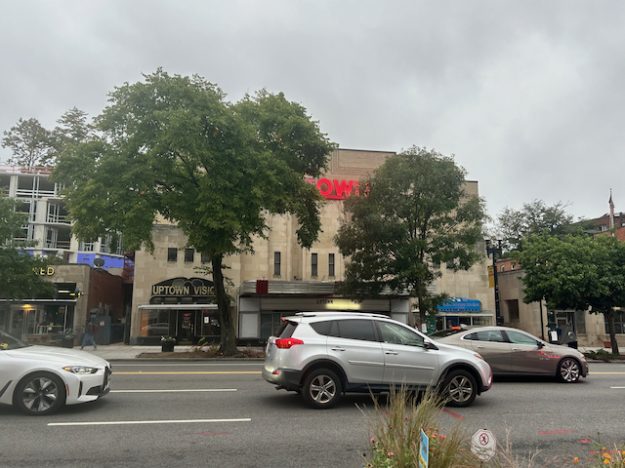
The Uptown Theater’s size, its proximity to a Metro stop, the affluence of the neighborhood, and its location in the nation’s capital all helped contribute to its enviable role as the site for world premieres: 2001: A Space Odyssey, Mississippi Burning, Dick Tracy, Dances with Wolves, Jurassic Park. This mighty single-screen theater, which otherwise may have struggled to achieve profitability due its size (climate control is trickier and more important in theaters, where patrons are sensitive to overly cold or warm venues) earned a reputation for “movies as events”. The Uptown Theater’s prestige continued when local ownership (Circle Theatres) sold operation rights to the national company Cineplex Odeon in 1987, which bucked its trend of shiny-new multiplexes, by retaining Uptown’s reputation as a cut above most single-screen theaters. During Odeon’s tenure, Uptown hosted restorations and reissues of 70mm classics like Lawrence of Arabia, Spartacus, and My Fair Lady. However, the movie theater screening/distribution industry underwent a shakeup in the late 1990s that echoed that of mall department stores: Loews Theatres purchased Odeon in 1998, then AMC Theatres purchased Loews Cineplex in 2005.
While remaining under local ownership, AMC continued operating the Uptown Theater successfully for fifteen years, prolonging the legacy of offering the District’s biggest non-IMAX screen to host mainstream, first-run blockbusters. But the Uptown Theater’s epoch came to an inauspicious end in March 2020, when AMC announced the closure after screening the Pixar flop Onward. Over four years later, the bright red signage lights remain operating (at least some of them), but this Art Deco anchor to Cleveland Park is empty.
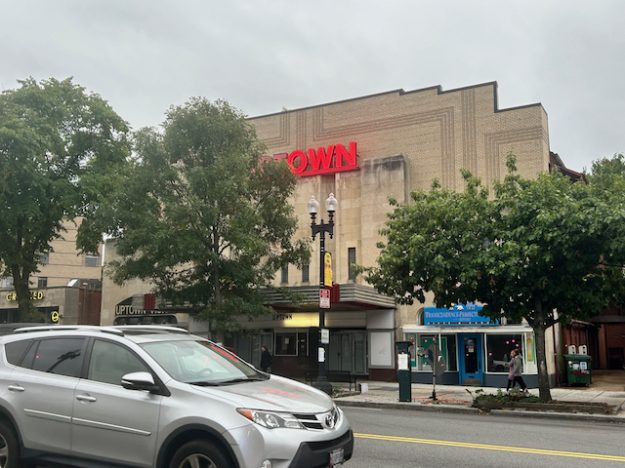
The timing of the closure (March 2020) was apparently coincidental; it took place on the eve of widespread business closures at the onset of the COVID-19 pandemic. However, the lease ended on the last of that month, and AMC had hinted over the years that it might not renew the lease, indicating that streaming services were making it harder for single-theaters and multiplexes to eke a profit. With the enforcement of COVID lockdowns, Uptown apparently shuttered a few weeks earlier than anticipated.
Uptown Theater lasted much longer that the average single-screen theater: 84 years. Attempts to increase its lucre by forging agreements between neighborhood activists and arty Landmark Theatres haven’t gained much traction. The City unanimously approved the Uptown’s admittance to the National Register of Historic Places a year later, citing its largely untouched Art Deco façade. But this hasn’t piqued the interest of any other theater operators. After all, the moneyed, high-achieving demographic of Cleveland Park (and most of Northwest Washington DC) might enjoy an Uptown repurposed for independent and foreign films. But such movies rarely elicit the demand to fill over 800 seats in a single screening. As one Washington Post editorial in spring 2023 noted, the Uptown’s final years continued to host what passed for blockbusters. But Ant-Man and the Wasp (2018), though #1 at the box office, offered only a dozen people at a late screening. The single-screen theater also lacks a back-up option; in a multiplex, the screens are nearly always of different sizes and seats. If one movie unexpectedly tanks in a big auditorium while a smaller movie sells out, the operators can switch the screenings to align with the demand, until a new set of movies comes along. (I’m sure that certain contractual obligations and mechanical projection challenges have made this switcheroo easier said than done, but money is a fantastic incentive to break the rules.) Uptown and the other single-screen theaters must ride out the failure, made all the more difficult if it’s a popcorn movie that succeeds at suburban multiplexes but offers little appeal to a “sophisticated” urban crowd. In other words, a pic like Ant-Man.
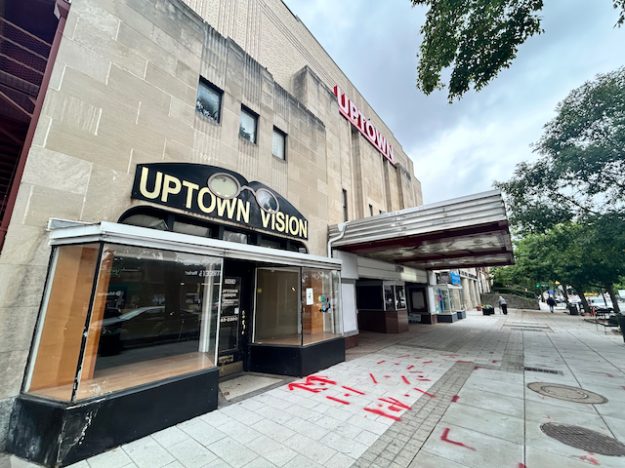
The Uptown Theater property has continued to languish over the last two years. As the recent photo above indicates, it lost its last two storefront tenants—something even the State Theatre in tiny Culpeper has usually successfully secured. The lightly administrated website Cinema Treasures, which has served as a primary research tool for this article, clearly doesn’t get scrubbed regularly, but crowdsourced updates help keep it reasonably reliable. As it stands, from what I can tell, in keeping with my claim in the very first paragraph of this article, Washington DC only offers one Golden Era single-screen movie theater that operates primarily films: the Miracle Theatre in Capitol Hill. Opening to vaudeville acts in 1909 as the Meaders Theatre and adapting to many changes/renamings until a 1961 closure, Miracle Theatre functioned as a church for decades. National Community Church purchased the property in 2011 and reopened in 2016 with 371 seats—barely over half what it had at opening. It’s a popular storefront fixture in the Barracks Row corridor (8th Street SE), but it only shows second-run films at an erratic schedule, sometimes only operating 3 days a week, and occasionally featuring live performances. It serves concessions, beer, and wine—so far, the formula appears to work, as long as patrons keep a clear eye on the daily calendar (a weekly one would not be reliable). But second-run movies, screening just days before available to the public through streaming or on-demand, are not usually major events. All other single-screen theaters in Washington DC are either closed or have converted to primarily/exclusively live-action productions.
A better counterpart to the Uptown Theater is Avalon Theatre, just a mile or two away in the Chevy Chase neighborhood. This building claims to be the oldest that has shown movies from its opening date in 1922 and never fully shuttered (depending on how liberal of a definition one uses for “shutter”). It offered 1,200 seats and a 3-manual theatre organ in its earliest days, almost as big as Uptown. The Pedas Brothers operated the Avalon under their Circle Theatre chain, which also included Uptown for many years; the Pedas family still owns the vacant Uptown building. The brothers converted a ballet school above the theater into a smaller 200-seat auditorium in 1971; a mid-1980s renovation reduced the seats in the main auditorium by 50%. Like Uptown Theater, the Avalon underwent the same Odeon/Lowes operational buyout, converting to an arthouse duplex in the 1990s. Then a Loews Cineplex bankruptcy reorganization prompted the closure of the Avalon in 2001, yet community activism to save the place actually worked. A nonprofit took over the Avalon’s lease, spurring an extensive restoration of long-lost historical elements and a rebirth in 2003, operating entirely as a nonprofit, multifaceted arts venue ever since, specializing in first-run screenings of otherwise obscure independent and foreign films. Chevy Chase is even more affluent than Cleveland Park, which no doubt helped finance the Avalon’s massive overhaul and a self-sustaining nonprofit; the theater has its own development team. But can Northwest DC support another venue just a 20-minute bike ride away? Avalon and Uptown theaters are just different nodes along Connecticut Avenue NW. Furthermore, if a nonprofit successfully mounted an arts operation at the Uptown, how to keep it from siphoning both its customer base and the artistic productions away from the duplex Avalon?
One saving grace to single-screen movie theaters: although the unusual, sloped proscenium interiors are difficult to repurpose, the outer shells were typically built to last. Bearing this in mind, single-screen theaters across the country often get converted to other retail/commercial uses, as long as the neighborhood remains economically viable. A perfect example of this is elsewhere in Northwest Washington DC: the Palisades neighborhood, perhaps the toniest of them all.
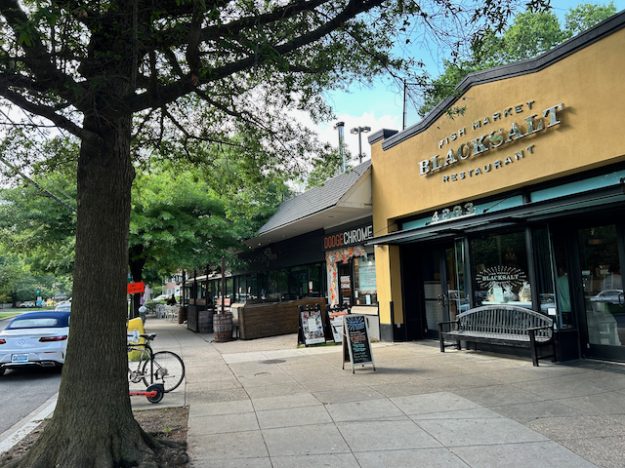
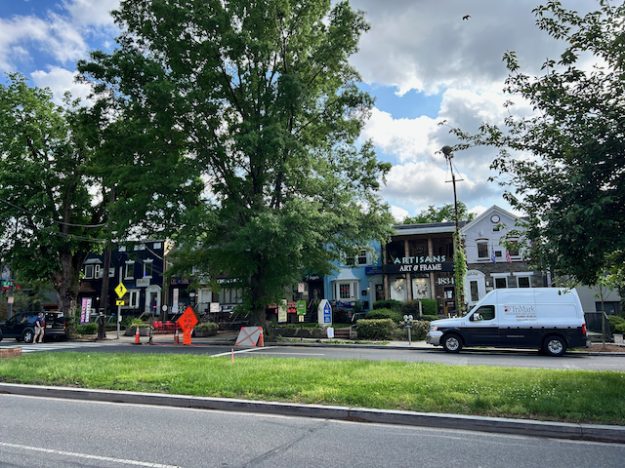
The commercial core is diffuse: little more than intermittent nodes along MacArthur Boulevard NW, no doubt in alignment with former stops on the old, long closed trolley/streetcar/interurban. But one of those nodes hosts the old MacArthur Theater, which opened as a 1,000-seat single-screen theater in 1947, converted to a triplex in 1982, then closed in 1997.
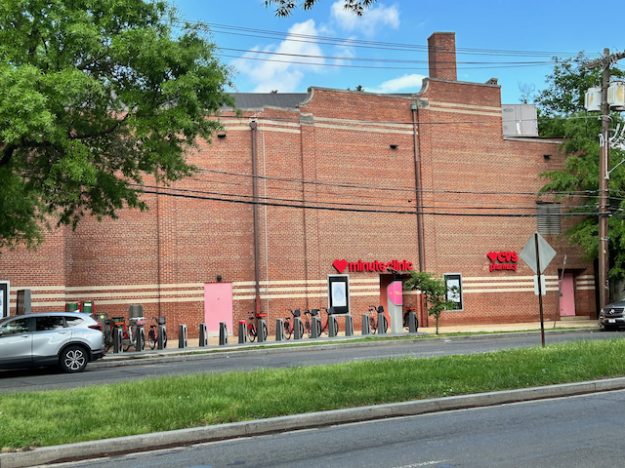
The windowless side of the theater creates a blank-wall eyesore for MacArthur Boulevard NW, but what else could they do? It was a huge place. And the red signage makes it obvious what happened next:
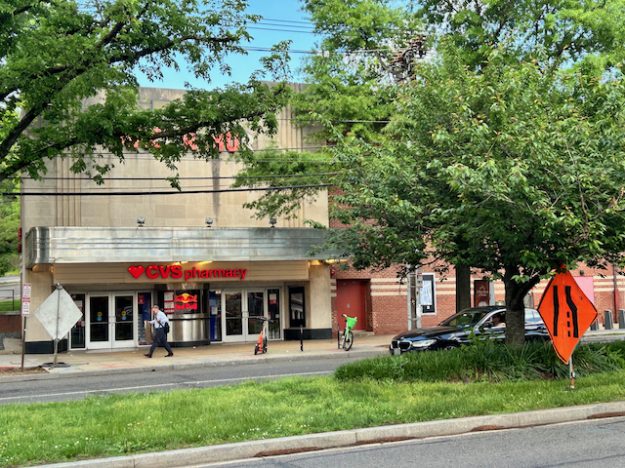
It became a CVS Pharmacy, a relatively common fate among old single-screen theaters in the region.
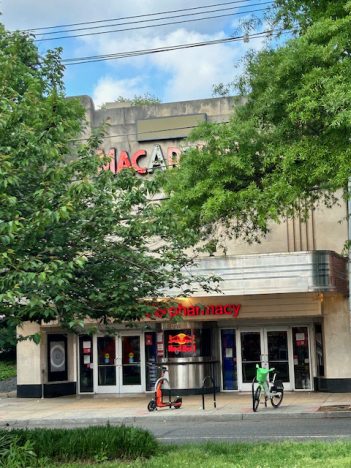
I wouldn’t want to suggest this is what should happen to Uptown Theater; if it did, most of the locals would consider it a failure. The deep pockets of a major retailer, though, would at least secure it from implosion, and the pharmacy giants are usually willing to play ball when it comes to façade preservation, especially in a modern era when windows make drugstores more prone to barbiturate bandits. The marquee entrance to the MacArthur Theater still looks like something from the 1940s.
The evidence from across the very well-heeled Washington DC metro proves what is routinely obvious in these situations: no silver bullet exists for the single-screen theater. An operating entity that cannot align the physical constraints of the theatre building with its perceived audience will not succeed. Furthermore, a few months of poor judgment can spell demise for the business. And by “poor judgment”, I mean lack of prescience. An exciting-looking release by an edgy director may prove a money-losing turkey, but a single-screen theater can’t switch to something more profitable midway through a weeklong business cycle. Such compounded errors in judgment could prove lethal. And the increasing plushness of home entertainment systems makes it hard for all but the most distinctive celluloid productions to persist within movie houses.
This pushes the future-oriented single-screen theaters in the direction of many others before them: to go live action, which of course no home entertainment system will ever duplicate. Washington DC is filled with venues intended for movies that have turned into music or theater. If it’s an easily location (such as downtown) and the picture palace boats an opulent interior, then why not? About the only problem with this solution is that live-action also has finite demand. And single-screen movie theaters may face a new auditorium style competitor: the steadily shuttering urban church sanctuary. At the very least, these cultural shifts represent a boon to the talented rehab architect. And acoustic engineer.

8 thoughts on “Single-screen theater is a tough business. Even posh neighborhoods would agree!”
my dad saw the premiere of star wars in that theater!
That would have been the perfect movie to see at the Uptown. It was one of the first 32 theaters to screen Star Wars a few days before its national premiere. Movies like that are just so rare these days. Even “Barbenjeimer” from last summer paled in comparison to “Star Wars”.
John Payne loved that theatre. I remember him being very sad when it closed.
yeah I wish I had known more about the place from pre-COVID days. Apparently it was a long slow decline. Blockbusters used to run in the theater for half a year. Now we’re lucky if they last three months. With so many multiplexes, sell-out screenings are rare, so everyone gets to see it in the first two weeks. And then they’re available on streaming by the next season…
Alas…
I haven’t been to a movie theater since before COVID and even then not very often. That said, these days I’d be much more likely to see a big screen movie if it were a single screen neighborhood theater, primarily if I could walk there. I personally hate the built environments around multiplexes (either malls, power centers or strip malls) and hate driving to them, so basically never go. But I’m not much of a fan of contemporary movies – and let’s just say I’m in a more relaxed phase of life – so no doubt am a bit out of the norm.
I’m pretty infrequent these days as well. I went to a theater in lately 2019 that never reopened after COVID and got demo’d to make an extension campus for Virginia Tech a year or two later. (I featured it in this article: https://dirtamericana.com/2020/08/regal-cinemas-corona-replacement/ )
I think I’ve been to theaters maybe 2 or 3 times since COVID–only one comes to mind. Most of the theaters built in the last 10 years now have recliner seats that are reserved specifically; i.e., customers have to indicate the seat they desire. And while the comfort level of the seats is great, the inability (or unwillingness) for theater personal to manage the behavior of unruly patrons only helps make those home entertainment systems seem that much sweeter. Heck, I’d sacrifice a comfy chair if it means getting a viewing experience without noisy, inconsiderate fellow moviegoers. And I’m sure most people would agree. As prices increase astronomically, people are going to be less tolerant of those who can’t abide by the broadly understood social contract of staying quiet during a show.
I was a pretty big movie buff growing up in the 90s and then the 00s. I was very attuned to the movie industry. Back in the days of video rentals, it would usually take 6 months before a movie first gets released in the theater and it makes its debut on video. I don’t follow it as closely these days, but from what I can tell, even big-name theatrical releases usually have a short lag time: they debut, they shift to second-run theaters just a few weeks after they fall out of the Box Office Top 20, and then go right to on-demand service. Sometimes only three months or even just two. This makes the movie less exclusive and more of a disposable commodity…all while ticket prices have increased in even greater proportion than inflation. It’s no surprise that movie theaters can’t seem to get butts in seats for all but the biggest flicks. As I noted, sometimes the #1 box office movie in a give weekend still leaves the theaters 70% empty on Friday nights.
Pre-kids my wife and I were very frequent movie goers, but for whatever reason that desire never returned post kids. It may be due to the issue in my prior comment or it might also be due to the changing media scene (ie you can stream almost anything now) that deemphasizes the big screen.