Search
Search
The search "Pennsylvania" yielded
93 articles

Bigger Washingtons (Part II): the remaining cities that honor George.

Continuing from where Part I left off, this article will explore the remaining 15 municipalities named Washington in the United States, the District of Columbia excluded.  Ranking them from least to most populous, the previous article covered the smallest eight; this will conclude with the seven bigger Washingtons, up to the most populous of all.

Anthony Santaniello: a eulogy for a lover of subways.

In what is a first for American Dirt—and what I hope not to become a regular occurrence—I offer a tribute to a fellow urbanist and friend.  Longtime employee of Philadelphia City Planning Commission and then Philadelphia Streets Department, Anthony Santaniello passed away on October 21st.  Anthony wasn’t just a casual follower of the work on

Custom racks: a stylish place to park your Cannondale. Or canine.

Bicycles may never become a primary means of getting around in the United States, at least not to the degree that they are in, say, Denmark or Netherlands.  Our cities are too spread out, cars have (at least until recently) been comparatively cheap and easy to own, and—perhaps most important of all—a majority of Americans

Westwood Kmart: the company closes another. And then there were two.

All too frequently, what I expect to be a “small” subject ends up blowing out of proportion.  For example, the last two articles took significantly more time and effort than I expected.  The research bore fruit, and I struggled to constrain my analysis to a mere 1,500 words.  Now I’ve finally found a subject that

Chestnut Hill switching station: a subtle shield for an ugly use, or a waste of space?

Public utilities are a tough nut to crack, especially in urban settings, where the population density is greater—and so, consequently, is the demand for electricity, gas, water, wastewater, fiber optics, and so forth.  With higher density comes greater intricacy of the conduit; there’s more of it, and it must be more economical with its use

Towamencin Shopping Village: a strip mall, all dressed up for a date, but not a single suitor. (MONTAGE)

I’ve featured more derelict malls and shopping centers than the average reader can shake a selfie stick at.  (An apt reference, since the oldest chroniclers of struggling retail—the sites DeadMalls.com and LabelScar.com—haven’t received updates since the popularization of the selfie stick.  But they were great sites when I first started blogging!)  As far as depressed

Family-run fiascos: small business as a coronavirus casualty deserves a post-mortem.

As the end of 2022 approaches, it’s essentially a truism that coronavirus-inspired closures devastated many small businesses.  For a brief period, the unemployment rate was as high as 14.4% (the rate in April 2020), a condition on par with the peak of the Great Recession, but it got there much more quickly this time around. 

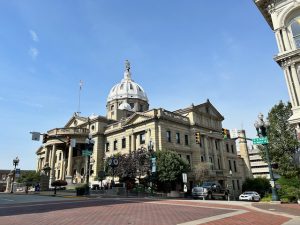
Chambersburg courthouse: when prosperity helps to bridge the old and new. Literally.

It’s hard to assess the exact time measurement of a single generation.  How long is it?  Fifteen years?  Twenty?  Usually not more than that.  However, it’s intended typically to convey the time necessary for a person to “come of age”—that is, the duration from birth to the point when he/she is making adult decisions, including

Anthony Santaniello: a eulogy for a lover of subways.

In what is a first for American Dirt—and what I hope not to become a regular occurrence—I offer a tribute to a fellow urbanist and friend.  Longtime employee of Philadelphia City Planning Commission