Search
Search
The search "taste culture" yielded
208 articles

Linguistic strategy at Trader Joe’s: the recipe to a beloved chain’s success.

Saying “I like Trader Joe’s” isn’t very edgy; it’s not going to instigate a revolution anywhere.  They aren’t exactly fighting words.  Ranking right up there with California phenomenon In-N-Out Burger as one of the least controversial chains that dole out food, a person is far more likely to provoke fisticuffs for saying “Trader Joe’s is

Blank wall bravado: a trendy neighborhood’s supermarket is more and less than meets the eye.

This article represents an interesting first.  Frankly, I’m surprised it’s taken this long—15 years of blogging!—for someone to approach me about this while I was out snapping pics for my blog.  Given that I have over 20,000 photos consisting primarily of mailboxes, parking meters, cracked curbs, lonely utility poles, labelscars, and miscellany that would only

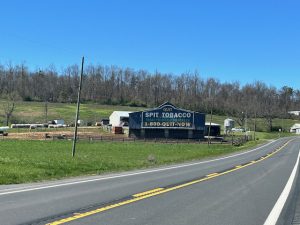
Folk pop: the classic Mail Pouch Tobacco ad gets the meme treatment. For better health.

I’ve never bothered to discern what Pierre Bourdieu would probably brand the “echelons of taste” that distinguish “folk” from “pop”.  Their thematic intersection owes a great deal to the fact that they share a prosaic, anti-elitist undercurrent, but the commonalities probably don’t extend much further.  While both folk and pop eschew the highbrow ethos that

Rax Roast Beef: a peek inside one of the last locations of a once-mighty 80s chain.

“Fast food with style.”  That’s the motto that I, coming of age in the late 80s and early 90s, associate the most with Rax Roast Beef.  But let’s face it: when this formerly thriving restaurant began floundering, the slogans shifted with the seasons.  Thirty years later, it’s hard to say which marketing campaign is the

Anthony Santaniello: a eulogy for a lover of subways.

In what is a first for American Dirt—and what I hope not to become a regular occurrence—I offer a tribute to a fellow urbanist and friend.  Longtime employee of Philadelphia City Planning Commission and then Philadelphia Streets Department, Anthony Santaniello passed away on October 21st.  Anthony wasn’t just a casual follower of the work on

Color choice: a gladiator match between brand green and brand red, in a strip mall coliseum.

The infamous book How to Lie with Maps initially offered a light-hearted attempt to explore how maps can entice, mislead, inflame, and generally propagandize, often without necessarily depicting anything geographically untruthfully.  Juxtapositions (not always to scale), labels, color choice, and infographics can all endow an editorial skew on what seems like objective spatial representation.  And

Vintage retail video: is Kmart in 1999 better than anything today?

After inadvertently stumbling across some vintage footage of shopping culture from yesteryear, I couldn’t help but ask myself: Is it reasonable, at this point, to compare the revolution in how we consume goods with the old cliché of a boiling frog?  How much longer before we the frogs feel the temperature climbing?  Using any vintage

Burnett Plaza: where human-centered architecture almost gets the shaft.

Poking out over the squat, one-story barbecue joint in the photo above is a relentlessly iterative office building, with not a single variation in its fenestration across all thirty-nine of its upper floors.  Windows look the exact same, row after row after row.  The only exception is the far left and far right of this

Anthony Santaniello: a eulogy for a lover of subways.

In what is a first for American Dirt—and what I hope not to become a regular occurrence—I offer a tribute to a fellow urbanist and friend.  Longtime employee of Philadelphia City Planning Commission