
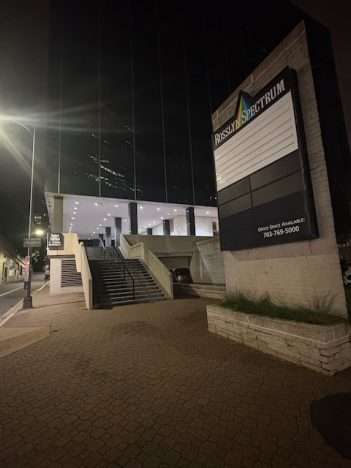
The font, the name “spectrum”, the combination of rainbow against a monochrome backdrop, the inclusion of a prism—it all evokes an aesthetic gestalt that probably seemed pretty fashionable during its 1980s inception (concurrent with the album Glassworks, maybe?), then enjoyed a lingering viability as a signifier of all things highbrow and “arty”, all the way up through the 1990s. But I didn’t discover Rosslyn Spectrum by walking in front of the building; I caught the back side through the blink of an eye, when I would drive along interstate 66 and this marquee would flash along my periphery. The white space for lettering (“Now Playing”) was always blank, which, combined with the dated look of a rainbow prism in 2019, told me that Rosslyn Spectrum was no more. And in 2026, it’s still no more—an empty arts venue in the heart of a commercial area with sky-high incomes and educational attainment levels, which were exactly the ingredients that prompted Arlington County arts advocates to build and support Rosslyn Spectrum…yet probably left many scratching their heads when, despite years of trying, it never really caught hold.
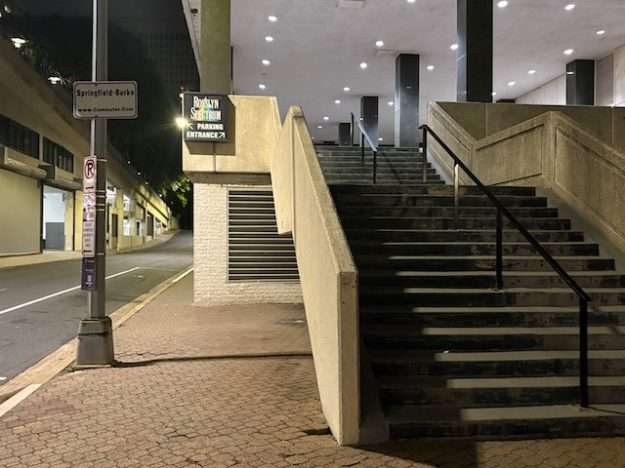
Rosslyn is the commercial district in Virginia closest to DC; the Georgetown neighborhood is a 15-minute walk away on the convenient Francis Scott Key Bridge. But it wasn’t always a thriving business center. As I noted in my feature on the notorious gas station church a few blocks away, Rosslyn was, for much of the 20th century, a no-man’s-land of pawn shops, impound lots, dodgy bars, small-scale industry, and Rottweilers behind chain-link fences…until I-66 and the WMATA subway system (1960s and 1970s respectively) provided easy access and galvanized land values. Almost overnight, it occurred to developers that they could build offices convenient to downtown DC but without the height limitations. And Rosslyn surged. Capitalizing on this growth, an entrepreneur built the Rosslyn Plaza Theater in the lowest level of a new office building, to show movies appealing to the growing concentration of workers in the area. The theater was big: nearly 1,000 seats for its single screen. And free garage parking. But was it lucrative?
Few details exist on the Rosslyn Plaza Theater that aren’t blocked by WaPo pay walls, but most evidence suggests that it struggled to compete against the emergent suburban mall theaters of the 1970s and the multiplexes of the 1980s, which offered more selection and easy parking. Even though Rosslyn was making a name for itself as hub for white-collar jobs with high wages, the district didn’t go from dowdy to tony overnight: after trying to make it with mainstream Hollywood fare, the Rosslyn Plaza Theater found its niche in the 1970s with skin flicks, which in turn elicited protests from the small but affluent contingent living in the immediate vicinity. Brandishing itself as “well-dressed, well-reined, very sophisticated” soft-core alternative to usual X-rated fare, Rosslyn Plaza survived through a modest but deeply loyal audience for about twenty-five years. It closed in the early 1990s.
Then, in a matter of months, Arlington County recognized a potential asset in this capacious auditorium surrounded by service-sector gentrification. The County partnered with a local developer (Charles E. Smith) to purchase and repurpose it as the Rosslyn Spectrum Theater and Conference Center, which opened in 1997 with 379 comfy seats. The Rosslyn Spectrum expunged the smut from the space, bringing elevated culture to the heart of Rosslyn, which by the 1990s was a hub for white-collar industry. It debuted with Shakespeare, then alternated between live theater, chamber music, and occasional screenings of high-profile arthouse flicks. At last, the NIMBY’s of the 70s got the high-class venue they were hoping for.
So yes, the look and feel at Rosslyn Spectrum do indeed date from the 1990s—exactly the logo I would have expected for an arthouse back when I was first starting to learn about a world of movies outside of Hollywood blockbusters. But why didn’t they spruce things up as the Rosslyn Spectrum continued its run into the 2000s and 2010s? Probably because it was a fierce struggle throughout its life to retain any sort of viability. In 2010, the Artisphere opened right next door, in space formerly belonging to the now-defunct Newseum (which had relocated to an opulent multi-story space near the National Mall that ultimately sewed the seeds to its demise). The Artisphere absorbed Rosslyn Spectrum into its programming, essentially inaugurating a performance-oriented campus amidst the staid cubicles and fax machines. But it didn’t work: even with five performance halls, three galleries, a ballroom, and studio space, the two venues in aggregate did not meet expectations. Distinctive architecture notwithstanding, the Artisphere didn’t have the magnetism to become an entertainment hub; it closed after just five years. The structure achieved a brief new life as a branch in a national chain of co-working space, but it has largely been empty and inactive since even before COVID.
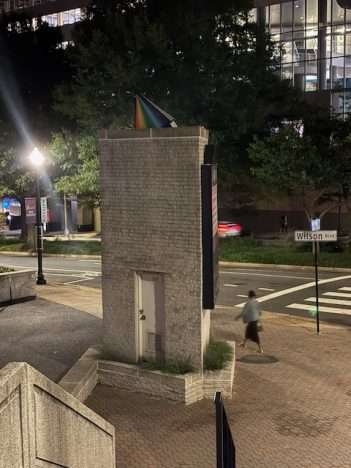
Once again an independent entity, Rosslyn Spectrum limped along as developers floated new concepts for an almost complete reconstruction of the late 60s era Rosslyn Plaza building. Long-standing partnerships ended, like one with National Chamber Ensemble. The County allowed its lease to expire, in anticipation of the redevelopment. But it’s never taken place; several of the development partners (including the Charles E. Smith company who spawned Rosslyn Plaza) broke off agreements and pulled out. Much like the various performance venues in the Artisphere next door, Rosslyn Spectrum has sat vacant but never blighted: its blank white marquees illuminated, the rainbow logos continuing to allude to a era that failed to become the venue’s salad days. So it lingers in limbo.
But why was everyone so bullish on a structure that only thrived for about 5% of its viable life? What made Rosslyn seem like such a surefire center for the arts, and why did this presumption prove so foolhardy? The neighborhood has the population density: a fair amount of residences, and the area is jam-packed with professionals during the work week. The incomes in Rosslyn are high; educational attainment, though high throughout the region, is particularly noticeable in a white-collar employment district. Alas, for all its merits, Rosslyn is not a place anyone associates with evening entertainment.
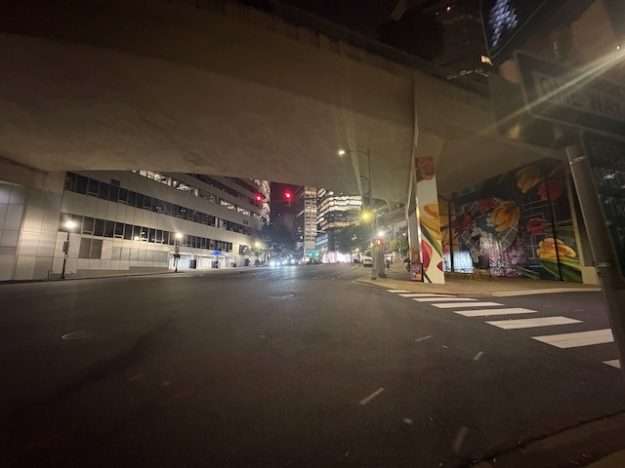
Sure. it’s well-lit and plenty of people are out at night. The jobs pay good wages. The transit networks couldn’t be better. It’s an easy walk across the Key Bridge to one of the nation’s elite universities, and Georgetown students almost certainly manifest an above-average participation in the arts. But Rosslyn is not a nightlife destination. Though it has plenty of fast-casual restaurants, coffee shops, supermarkets, and an urban-footprint Target, it’s much more attractive to the day crowd. Rosslyn isn’t very buzzy at night, and time has shown that the neighborhood’s constituents don’t really want nightlife, hence Rosslyn Spectrum’s failure.
The fact is, metropolitan geographies can only accommodate so much nightlife before a city suffers from over-supply. Meanwhile, high-minded art, music, and theater caters an even more recherché base: the very notion of elitism is not the subject matter per se, it’s the notion of exclusivity gatekeeping entry to the domain. The developers understood this when they shrunk the seating by nearly two-third upon converting from a soft-core movie hub to Shakespearean revival theater.
Other nearby districts give the Friday night crowd what it craves. While I’ll concede that demand for nightlife can vary from city to city, in Northern Virginia, it doesn’t help that the next two WMATA stations to the west are significantly more hoppin’: both Courthouse and (especially) Clarendon. Folks in Rosslyn can either hop a train or walk to nodes with far more full-service restaurants, bars, coffee shops, and nightclubs. Furthermore, Georgetown right across the river offers much of the same, but some of the most upscale shopping in the country. And regarding entertainment, even the Kennedy Center (a long walk but only a 15-minute drive) might have siphoned away some of Rosslyn Spectrum’s customer base. Rosslyn is just an area where happy hours either end at 5:30pm or they continue at one of the livelier bars down at Clarendon. An arts venue isn’t intrinsically magnetic; it needs to synergize with a diffuse nightlife culture in the form of watering holes and upscale restaurants. Rosslyn lacks these, so both Artisphere and Rosslyn Spectrum felt increasingly isolated.
Perhaps a redevelopment of Rosslyn Spectrum and the entire Rosslyn Plaza will reinvigorate demand: more density, more big spenders, more chance for mixed-use development. Then again, part of the reason previous redevelopments failed is because real estate partners’ determined the demand wasn’t great enough and could not be made great. And so that prism logo gets more dated with each passing year. So what’ll it take? A liquor store at every corner? A density level on par with Manhattan? Perhaps the only thing that Arlington County needs is for Rosslyn to return its 1970s ascendency, with a clash of cultures duking it out on the neighborhood arena stage. That’s right: it’s time for roller derby.

11 thoughts on “Rosslyn Spectrum: Arlington County’s bid for high art gets spurned.”
I have performed there once and have seen 2-3 recitals there. I think it’s lack of visible parking, and there is no backstage or wing space.
Sounds reasonable, especially the latter factors you mention. It had its origins as a single-screen movie theater (first 25 years), and the repurposing for theater probably failed to account for this…or the architect simply couldn’t accommodate within the building’s existing constraints. Yet they tried to use it for plays.
Rosslyn in general isn’t a big destination for evening entertainment, especially compared to a little ways down the road at Courthouse and Clarendon metro stops.
Sure did. Performed many concerts for Arlington Arts.
This wasn’t necessarily a failure of arts as an attraction – there isn’t really anything to do directly near Spectrum. You have to walk through the concrete canyon over to Lynn St. for restaurants or anything that one might do directly before or after a show.
I also worked in the adjacent building. Parking wasn’t the problem – they made the garages free after 5pm.
It’s true that its uses were limited for anything other than music – no ability to fly rig, not a lot of dressing room or wings. Arlington Players managed to use it, but I don’t think you’d put a professional theater company there. Proximity to The Birchmere meant a hard-ticket show was always going to be challenging.
They tried. Arlington’s technical department remains top-notch. But you can’t overcome “location, location, location.”
Excellent points. Unlike Courthouse or Clarendon, Rosslyn really isn’t a destination for evening entertainment. Relatively few of the restaurants are open much past 8pm. It probably explains why the Rosslyn Plaza Theater (which is how Rosslyn Spectrum began in the late 60s) tried and failed to work as an extra-large one-screen movie theater. Within a few years it was reduced to showing mostly “adult fare”.
The aspirations where that Rosslyn Spectrum would be a destination unto itself. But arty offerings are intrinsically selective. Few venues can expect to routinely all 300 seats with classical chamber music unless the performers are celebs…and why would they go to Rosslyn when Kennedy Center is a stone’s throw across the river? The Artisphere went even bigger and flopped harder and more quickly.
And yes, if they decided to go for more mainstream pop stuff, they’d be competing against Birchmere which has an abundance of easy clear parking–not that parking was the hurdle for Spectrum, but the combination of eclectic (or even esoteric performances) with the perception of difficult parking probably made Spectrum and Artisphere less appealing. Location indeed.
When I worked across the street at WJLA / News8. / Politico, we used it a couple of times for town hall events
Not a bad use for the venue at all. But probably not ideal from the manager’s perspective, since town hall events don’t usually generate much revenue (or any at all). But a venue owner who is desperate to bring people in will try to accommodate anything, if partly for publicity.
It was always meant to be a movie theater, and cinemas, live theater, and live musical performance venues all have subtle differences in what they need architecturally. Even the acoustic demands are probably not fungible.
we likely paid a venue rental/ tech fee since it was for live TV – but that was long ago 🙃
Lived within walking distance to here back around 2007? Roslyn was always a dead area, loud from highway traffic, but should have been a good location. The slightly redeeming part was the short walk to DC across the bridge and easy car hop to other places.
Yep, I don’t think it’s changed too much since then! It’s a pretty busy place for all the lucrative white collar work during the daytime, but at night, the real hub of activity is probably the Target, which stays open until 10, but how many restaurants can say the same? They cater to the lunch crowd.
Courthouse and Clarendon, which do have nightlife, aren’t that bad of a walk. And, as you note, there are plenty of arts options across the bridge in Georgetown. Or, if it’s a nice night and you’re feeling spry, the Kennedy Center.
The spectrum was host to the Peeps diorama competitions haha
An event of unparalleled prestige. I’m sure the Kennedy Center was green with envy.
To be frank, I’m a bit disappointed. I used to live in Bethlehem PA, headquarters of Just Born candies. They had an annual Peeps diorama competition too, which seemed great because it was a homegrown thing. Little did I know that other cities emulated it.
I don’t even want to know how schools might teach the public with Mike and Ikes or Hot Tamales.