
I usually shy away from timely subjects because I want my articles to have staying power. And there’s no better way to do the opposite than to cover a subject “hot off the presses” with a clear, almost immediate expiration date. It generates great buzz for 48 hours…at most. Time-sensitive subjects evoke those “presses” far more (however obsolete the presses are in 2026) because such articles are much more akin to journalism than freelance feature writing. I don’t harness any other resources than my phone camera and the domain name that I’ve paid for since 2014, so it’s hard for me to capture the latest scoop without the infrastructure and financial backing of a real media outlet. At the same time, I live so close to the epicenter of much American news that shunning any and all current events seems like a critical missed opportunity. So, now that the dust has settled and the presses are cold, I offer a revisitation of an event that generated a fair amount of hoopla at the beginning of the month, though probably not as much hoopla as its organizers would have liked. It’s time to cross the Potomac River into Washington DC’s National Mall and reflect on the signature event of America’s 250th birthday: the Great American State Fair (GASF), the apex of the year-long Freedom 250 celebration.

To make this article as simple, factual, and photo-driven as possible—and also to avoid further sullying the imagery by perpetuating the massive politicization that accompanied the event—I’ll try to minimize background and context. It’s easy to find scads of media coverage out there on the subject already. I seek to judge it with a naïve pair of eyes, which, frankly, is authentic, because I did not follow the development of this event much at all, and I wasn’t even sure what was going on when various other people took photos of themselves at the mall in the early days. It was well toward the end of June before I realized anything at all was brewing at the National Mall in advance of the Fourth. I just didn’t put two-and-two together. Once I learned, the clock was fast ticking: these photos come just two days before the Great American State Fair officially closed on the 10th. And I arrived at about 8:35pm, with just twenty-five minutes to scurry around and snap photos, using an above-average sunset as the backdrop.
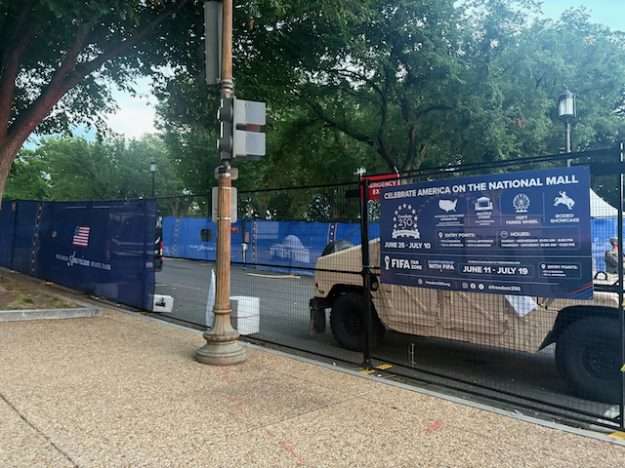
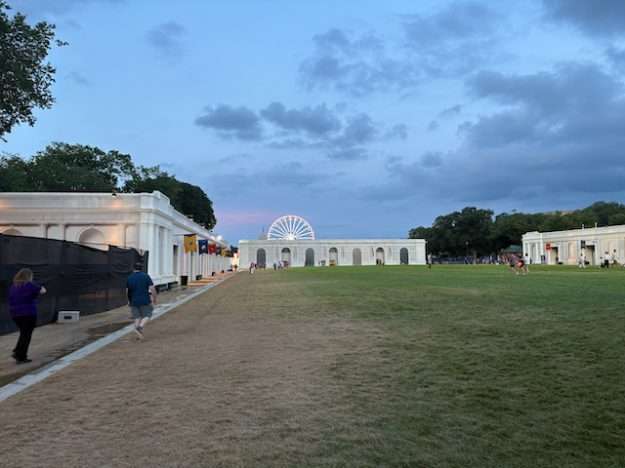
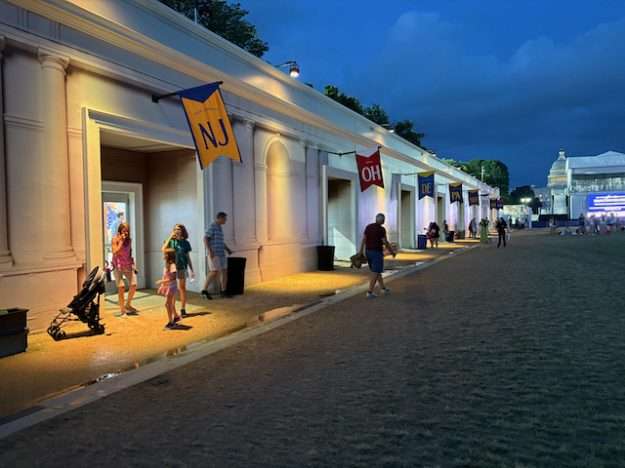
No matter which point a visitor entered the National Mall, he or she would encounter a sprawling blue barrier. Here’s a vista where the Smithsonian National Museum of American History is directly opposite:
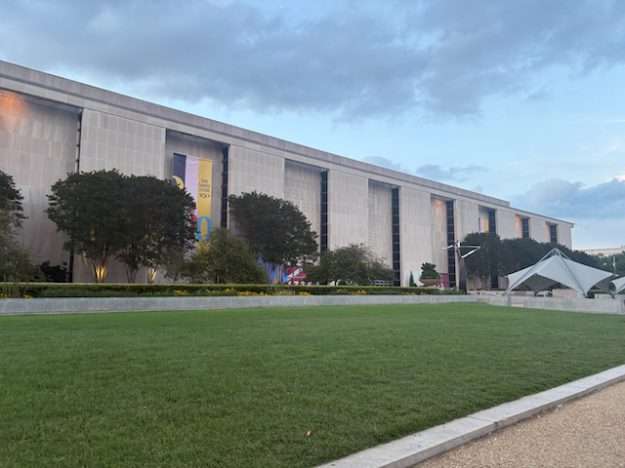
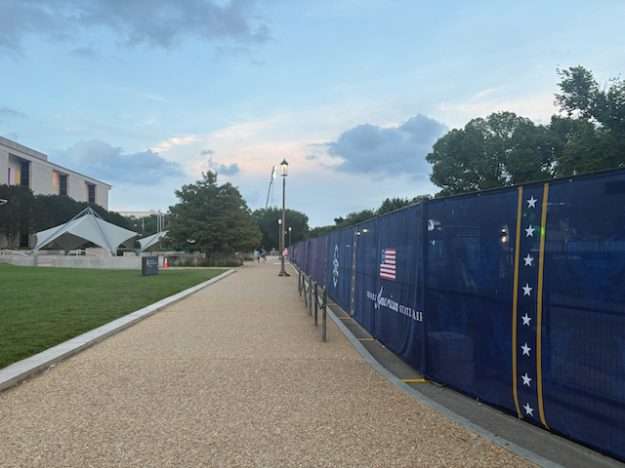
Though the event was free, the State Fair still had secured entry with metal detectors and bag checks. Arriving right before closure, I faced no delays.
Although the Fourth of July supposedly lured even bigger crowds than usual for the spectacle of fireworks typical of Washington DC, I have to admit it certainly didn’t translate to a huge event on the subsequent Wednesday near the end of the Great American State Fair’s calendar.
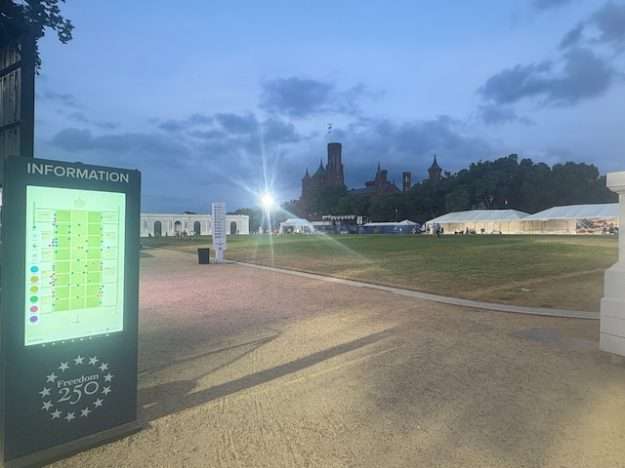
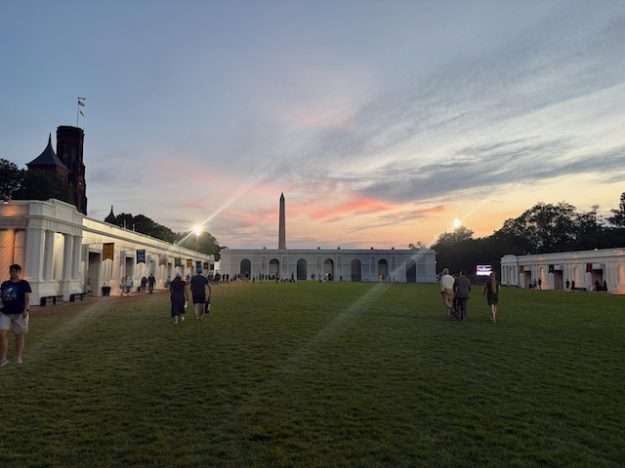
While it looks deserted, and parts of it most certainly were, the size of the fair space is considerable enough that it would take tens of thousands of people to create the appearance of a full crowd. The National Mall rarely appears crowded; even the last few presidential inaugurations were half-full.
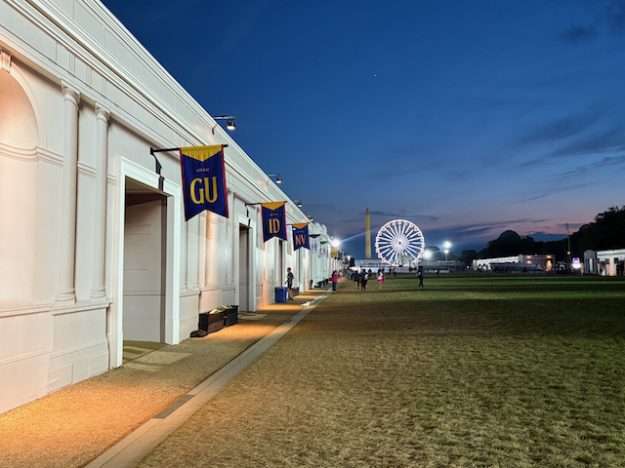
The exposition halls traced the perimeters of the Mall’s grassy central squares, vaguely resembling a university’s quad. The obvious inspiration was the famed World’s Columbian Exposition of 1893 in Chicago, which assembled bold displays of uniformly alabaster neoclassical architecture to celebrate both the 400th anniversary of Christopher Columbus’s arrival in the New World, and the Windy’s City’s rebound from the Great Fire of 1871. It was “The White City”. Everything arose from the ground quickly in 1893, but the Chicago World’s Fair captivated the globe for a full six months. Freedom 250’s Great American State Fair received a mere five weeks, and the a closer look at the structures cannot betray their hasty assembly.
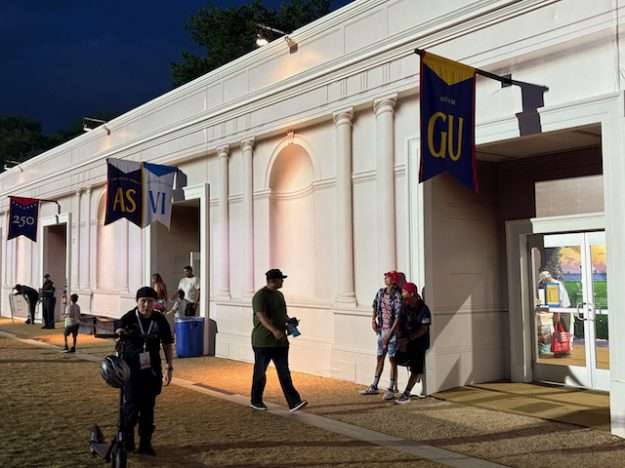
Most of the façades were 2-D, with shading to create the impression of relief ornamentation and texture. Photographed from a distance, none of it looks too bad, but any thorough observations reveals that it was all just a skinsuit, printed onto canvas assemblies that a crew of several dozen could dismantle in 48 hours. It had less permanent content than Daniel Burnham’s White City 130 years earlier. It didn’t really convince at dusk, and I’m sure was even more artificial under bright sunlight.
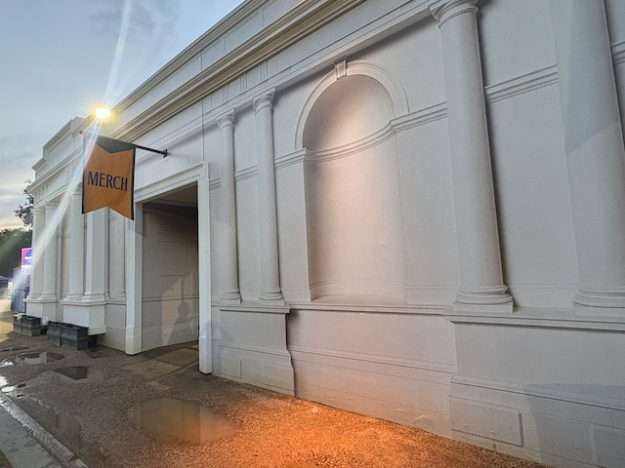
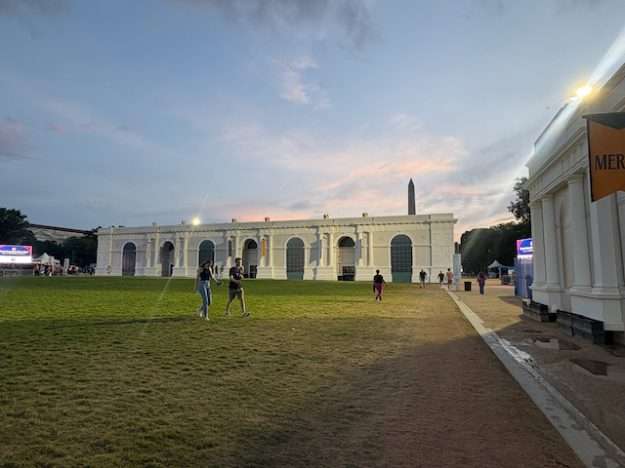
But if the goal was an enduring image, the planners of this event should have chosen a staging area free of other programming or activities; even the biggest boosters would never accept National Mall undergoing a permanent transmutation. As long as this Great American State Fair remained in operation, the attractions at the Fair blocked proud vistas of the US Capitol, Washington Monument, and the many Smithsonian museums that flank the Mall.
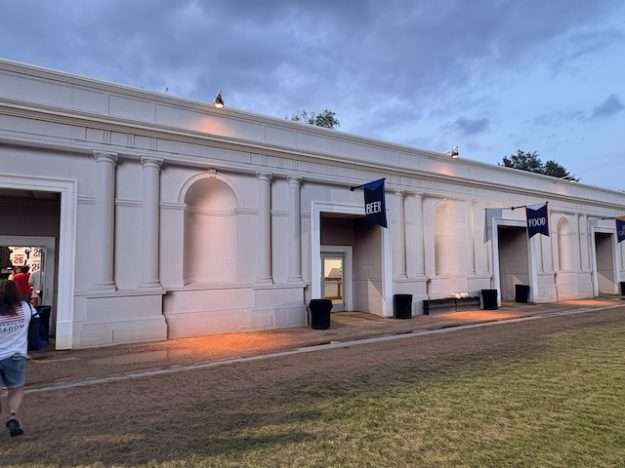
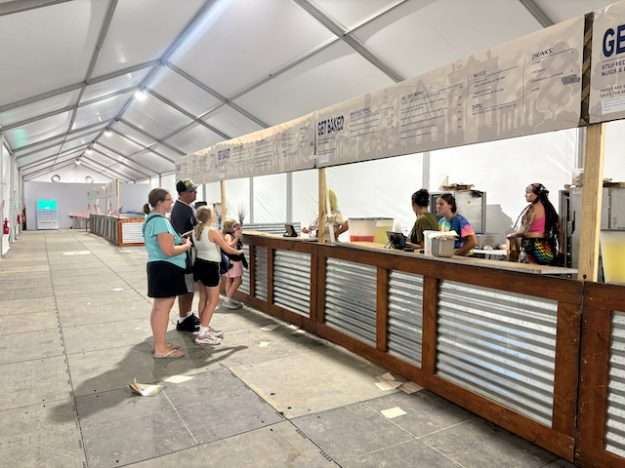
While most of the exhibits were free, the State Fair offered a few opportunities for revenue generation, partly because several of them served food, as expensive as one expects when people are boxed in and the market doesn’t have to compete.
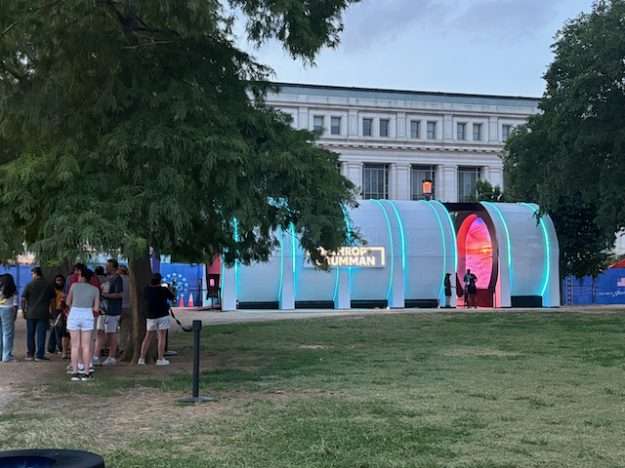
On the perimeter beyond the quads, a few deep-pocketed sponsors offered some additional bling, like this apparent VR exhibit.
But the quads themselves served as the heart of interpretive space, offering a variety of vaguely defined subjects: innovation, faith & family, American canvas, and various executive departments (interior, war, transportation). I only had time to skim the surface but the full map of the GASF is visible here.
Among the few tents I had time to visit, it soon became clear that the interiors meshed with the exteriors: nothing fancy. Having been warned by others who visited before me—others who I do not believe harbored any animus toward the goal and objectives of Freedom 250—the general sentiment appeared to be: everything was cheap-looking, hastily assembled, and the organizers apparently conceived the project six months in advance, instead of years…or decades.
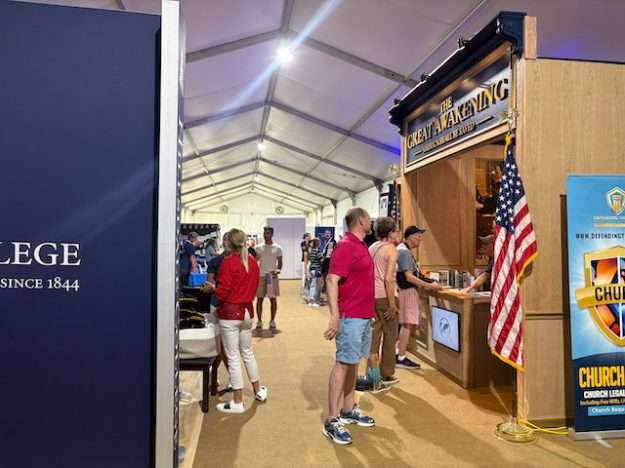
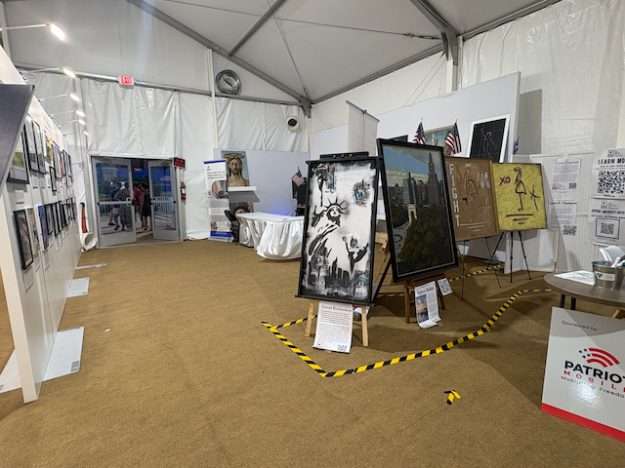
Most of these themed exhibits offered displays that aesthetically resembled what one might see at a trade show. And did I say “tents”? Yes, once indoors, the printed canvas made much more sense.
But I’m carping. For sure, nothing looked high-budget, and no amount of printed shadows could hide the pre-fab nature of the enterprise. Did it really matter, though? Many visitors were either out-of-state or even out-of-country, since the FIFA World Cup was going on at the same time; the GASF offered a fan zone with viewing stages close to the US Capitol. I suspect that, on a weekday evening like the one in these photos, the majority of visitors were in the nation’s capital as part of a multi-day vacation, and that many of them lived far enough away that this trip comprised a once-in-a-lifetime pilgrimage. In light of these considerations, the obviously temporary foreground against the backdrop of enduring landmarks yielded a juxtaposition rife with photograph opportunities.
And the interior presentations were varied in subjects, sponsoring agencies, and aesthetics, just like a typical trade show.
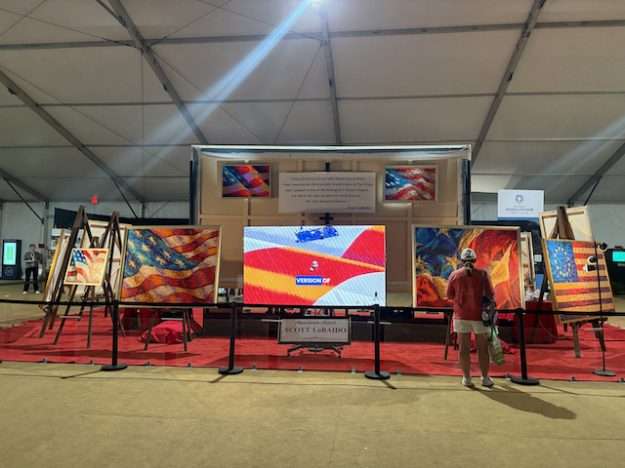
And why shouldn’t they be? In many respects, isn’t a world or state fair an elaborate trade show? During my brief time on the National Mall that evening, my observations suggested that the crowds, thin though they may have been, seemed to enjoy themselves, because the exhibits weren’t predictable. One display might keep the kids amused for two minutes; another might last a half hour.
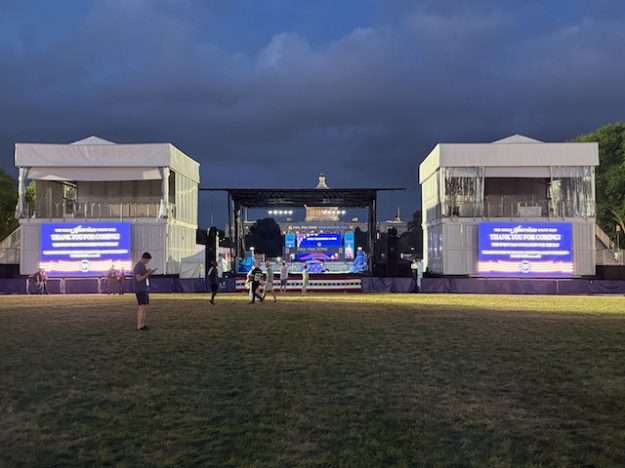
The days preceding the GAST suggested many ups and downs involved in the staging of the event, but two setbacks achieved inordinate negative publicity. (And I’m not even going to postulate on the algal bloom at the Lincoln Memorial Reflecting Pool; that mucky debacle took place nearly a half mile from the events depicted here.) The first major setback involved the sizable number of artists and entertainers scheduled to perform, many of whom dropped out in the weeks immediately preceding. I have little to add on this subject because my visit didn’t provide a lot of evidence of main-stage performances; nothing was taking place that night.
The second major setback was the sizable number of states that did not send “delegates” in the form of interpretive displays for their allotted segments within the quads/tents. Up to ten states opted out, due to (so they claim) budgetary or scheduling concerns. I spent the majority of my brief time at Great American State Fair scanning the state displays to see how noticeable this disparity might be.
Given the spread-out nature of the National Mall and these exhibitions, a walk from one state to the next could take five minutes. Generally speaking, the exhibition organized them by regions, and I found myself near the Southeast initially. Florida was insanely popular: a line of at least thirty people out the door. Others advised me to step inside Tennessee and get a free sample of brisket; I didn’t have time. So I at least visited two southern states where I had lived.
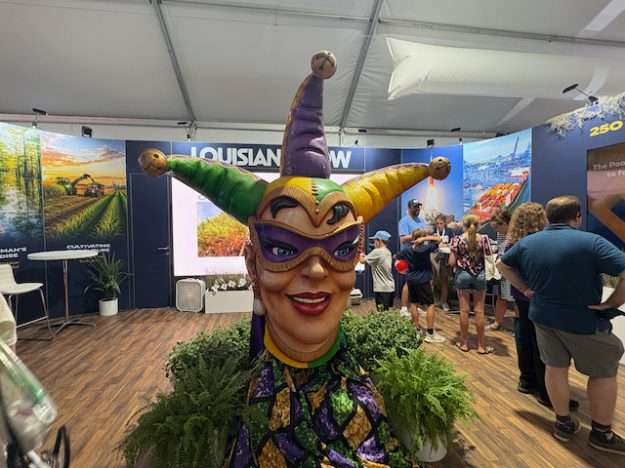
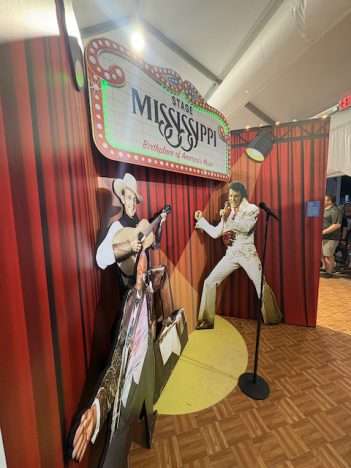
Yes, Louisiana speaks for itself. It was bold and loud, dominated by New Orleans content, but for my money’s worth, the Mississippi exhibit was more balanced, thoughtful, and informative.
From the Southeast, I had to scramble over to the region where I grew up—the Midwest—where only Illinois was a non-participant. The rumblings from Indiana-based media suggested to me that my home state’s display was “embarrassing”. But was it?
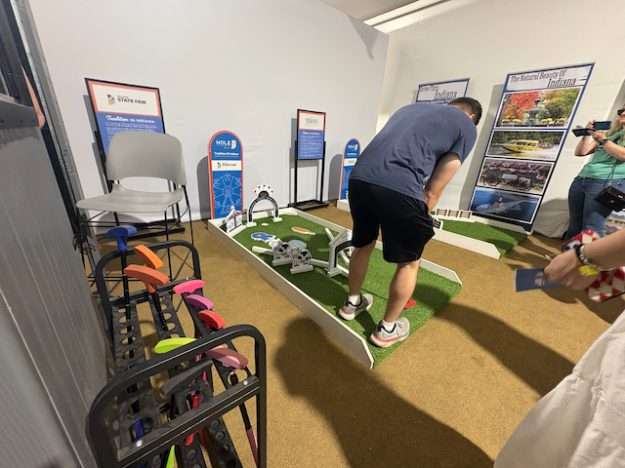
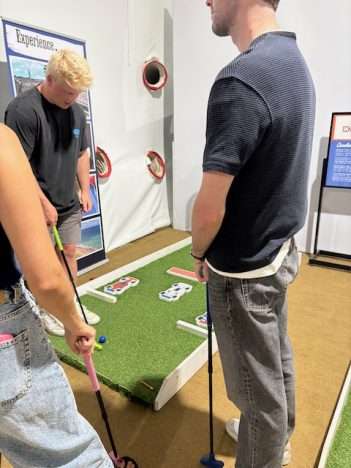
(Note the air vents to the right of the golfer. Though it probably would have been unwise to completely obstruct them, it surprised me that the people who staged this pavilion made no effort to at least shroud them or minimize their visibility.) These photos capture everything the Hoosier State decided to send. Thematically, it was skimmed from the pages of the state tourism bureau, but the mini-golf element made it significantly more interactive. It was more popular than all but a few states, and the sponsors kept the tent open to the public several minutes after 9pm because the interest was great enough.
Other states fared much more poorly, regardless of whether they overtly participated or not. For example, the image below is confusing:
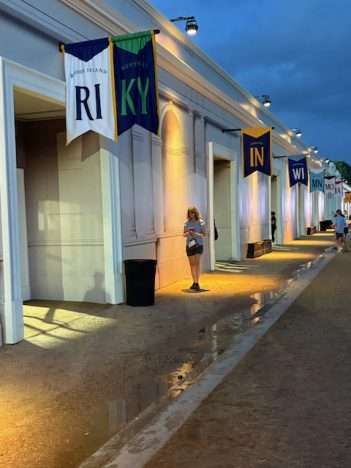
Why pair Rhode Island and Kentucky together? They aren’t geographically common. Rhode Island was among the ten non-participants, so did it get bunched together with Kentucky, who did participate? I didn’t have time to poke my head in unfortunately, but my subsequent follow-up research suggests this may have been a misleading placement of the banners and nothing else. Most states, as the images show, received their own entrance. Or perhaps Kentucky had a particularly meager contribution, thus prompting the organizers to pair it with Rhode Island, which contributed nothing.
So what about the other states that opted out of a display at the Great American State Fair? Concentrated heavily in New England, they didn’t seem to enjoy as much dedicated space—two states per pavilion—but then why should they if they offer nothing?
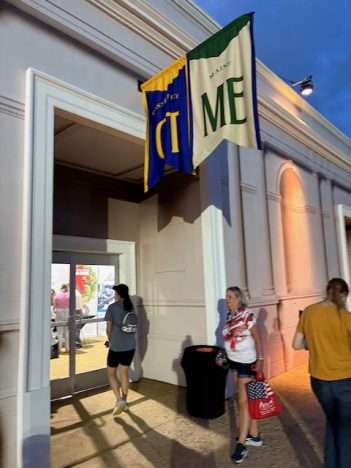
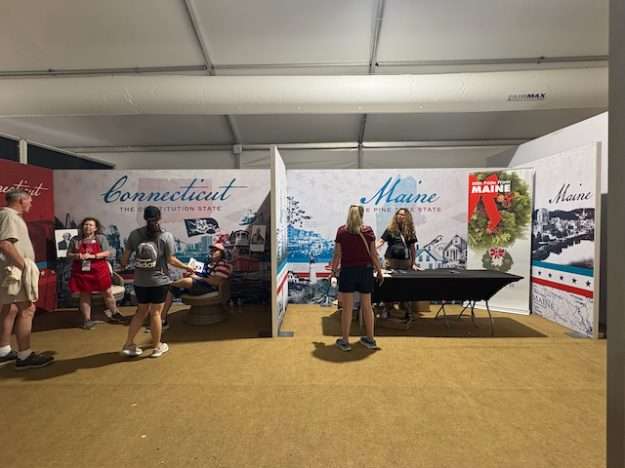
At the very least, the organizers of GASF still gave Connecticut and Maine a tiny exhibition within their shared pavilion, and a delegate stood nearby to answer questions. It was more than the states themselves provided.
And I’m not sure what happened to the last two states admitted to the union.
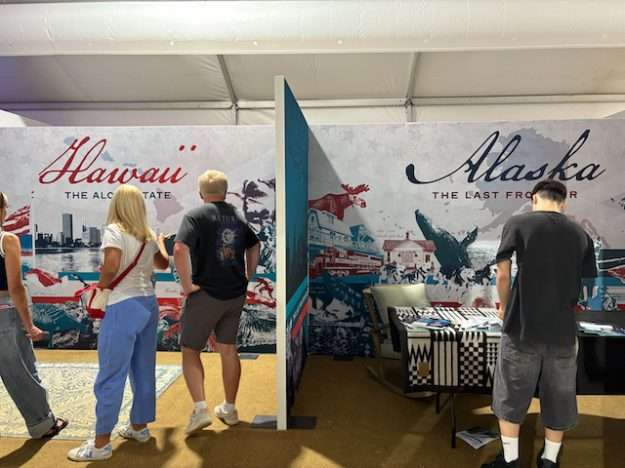
Though Alaska and Hawaii apparently contributed exhibits to the GASF, the image above looks more or less the same as the displays for Connecticut and Maine. I’m not sure what happened, other than they potentially contributed so little visual material that the organizers paired them in a single pavilion to make it look less obvious. Or maybe they had already dismantled their exhibits by the time I arrived? Not likely, but it looks like an information booth more than a State-curated exhibit.
Of greater interest were some of the non-states, territories and protectorates, who offered just as much as, if not more than, several of our thirteen colonies.
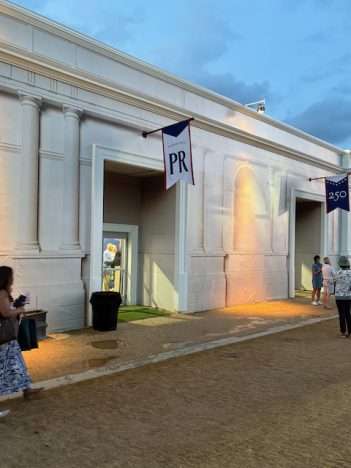
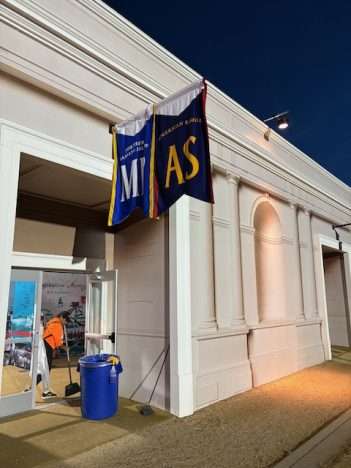
Puerto Rico had its own pavilion, as did Guam, the latter of which I caught a glimpse and clearly invested in a real display—much more robust than Hawaii or Alaska. Then American Samoa, Northern Mariana Island, and US Virgin Islands shared a pavilion.
No doubt other people, turned off by the whole enterprise as well as rumors that it would appear hyper-partisan, spent less time at the GASF than I did or bypassed it altogether. But my quick trip showed no evidence that it boosted the profile of one major party over another and the content, hastily assembled though it often was, revealed a devil-may-care attitude and an entrepreneurial vision.
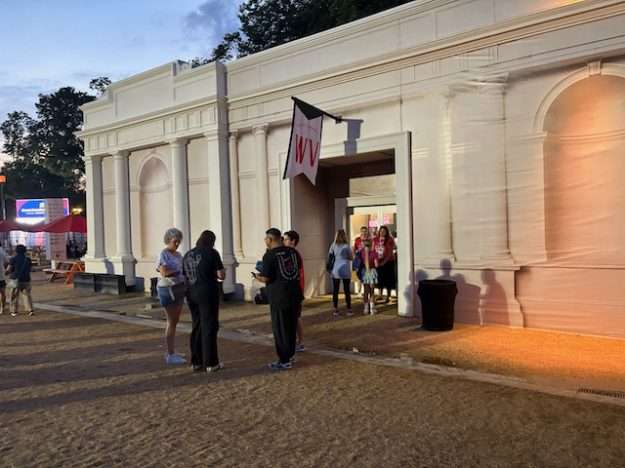
Behind Floriday, the second most popular state from my perspective was West Virginia, and though they had closed by the time I got to see what the fuss was about, one of the hosts said they offered free karaoke inside. It wasn’t enough to hear Europeans belting “Country Roads” at the various FIFA World Cup games; here was a chance for Americans to sing something from a hometown musical icon.
The Great American State Fair wasn’t boring or stale, and most people could step inside one pavilion and, even if unimpressed, wonder what the next one would look like. The GASF showed little evidence of polish or careful planning, but it more than compensated with a bombardment of material.
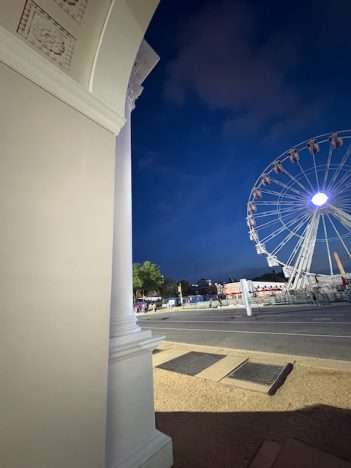
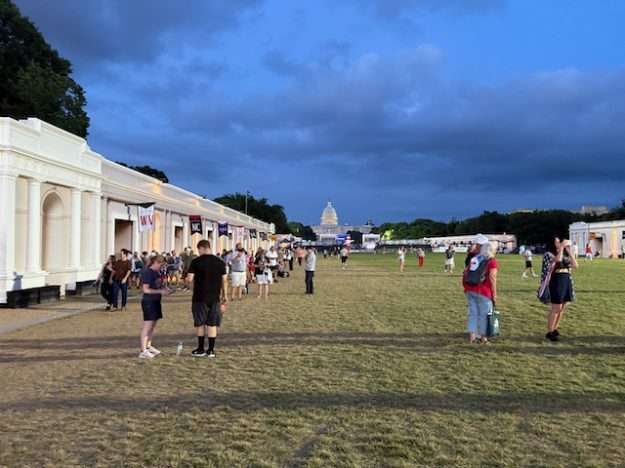
I will concede that, now that the dust (what little got kicked) has settled, the entire event was a modest success—a modesty on par with the scale of its execution. The forces rallying to elevate it met an equally powerful force seeking to undermine it, all borne out of partisanship that fueled both sides. And the negative publicity in the weeks preceding its rollout, which involved both artists and states backing out of participation, no doubt muted some visitors’ enthusiasm. In hindsight, it seems foolish for any state to claim it lacked the budget to send a display, considering that the most lavish ones probably didn’t cost more than a few hundred thousand dollars—and most much less. These states were foregoing an opportunity to promote themselves to a bevy of foreign and American visitors with curiosity piqued by a massive celebration.
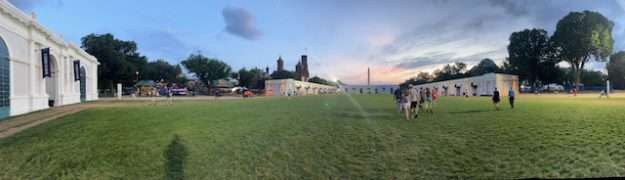
If event planners were to make this an annual Independence Day celebration and were to replicate this thematic approach in 2027, I think it would appear far more of a flop. As a one-time event consisting primarily of tents sheathed in modular, pre-fab decorate material intended to last for barely a month, it offered enough diversity of content to keep people entertained, even if the hit/miss ratio approached 1:1. The Great American State Fair piggybacked on the existing monumentality afforded by sight lines and viewsheds intrinsic to the design of the National Mall. It would have seemed more slipshod if these same tents went up in a random green space that lacked the spectacle—yet at the same time, even the event’s biggest boosters wouldn’t have wanted a Ferris wheel or a triumphal arch standing permanently to impede the views between the Washington Monument and the US Capitol. Its ephemerality almost ensures it will recede to a much smaller footnote in American history than the Chicago World’s Fair. At the very least, it demonstrated to the American people that semiquincentennial is a real word signifying a number, and that this number should resonate. The true landmarks of the National Mall are here to stay, and at least a few are even better than before. Meanwhile, tens of thousands of visitors will cherish memories of belting Brad Paisley at a West Virginia Karaoke tent.

58 thoughts on “Great American State Fair: a retrospective montage ~250 hours later.”
Arizona & Indiana I’d say we’re surprise exhibits that brought their ‘A’ game. Tennessee had best snacks 😋. Guam was a fun territory as well. I’d say some of the other Midwest states.
Overall agreed lackluster. Idea of a fair on mall great, execution far to be desired.
I agree that Indiana seemed like one of the more popular and better conceived ones. Incidentally, the Indiana-based media deduced that Indiana “should be ashamed of its abysmal contribution”. Sour grapes!
sounds like some sore losers at Mini Golf
Wish I had been able to go.
I had a blast!
Tho I wasn’t there on Day 1 they seemed to have gotten it all together on time. I think it’s not surprising the discrepancy in crowd size one day to the next. And would naturally peak around the 4th. It went on for about half a month so all in all was still well attended when given the final count. As someone said it was almost more like an expo. So while it had some fair “qualities” (but not all), the other themed tents, exhibits and State tents made it more unique and compelling. Was definitely worth this once in a lifetime experience.
the Bicentennial was far better, and was not about the President and pushing National Christianity. It was for everyone. And it showed back then as well as the little crowds showed for this one.
the Bicentennial was far better, and was not about the President and pushing National Christianity. It was for everyone. And it showed back then as well as the little crowds showed for this one.
I was looking for evidence of what you described while I was there and found none.
Either you weren’t there, or videos lie from Republicans sources. Which one is it?
My videos don’t deny the fact that the decorations were cheap and the crowds were mediocre. But I still didn’t see what you describe. If you’re hell-bent on looking for something because ideology motivates everything, you’ll always end up finding whatever you’re looking for.
Considering that the event itself was called Freedom 250 as opposed to the America 250 that was originally planned and that it was poorly run and organized, and had booths from his rich friends I can tell why you didn’t find any evidence. I guess him having a rally and talking about himself wasn’t a big clue
Websites exist for both https://freedom250.org/ and https://america250.org/. I think this probably diluted the message and brand and made harder to figure out what, where, and when things were taking place. Not a wise decision because it loses focus overall. Maybe it was indeed poorly organized, but it also wasn’t without many, many, many deliberate attempts at sabotage. Yes, there were “rich friends” as sponsors, but that certainly doesn’t make it partisan in itself. Both parties have rich friends bankrolling their campaigns.
Nonetheless, it’s weird that the very word “freedom” somehow exists as evidence of partisanship. Not sure it’s an intrinsically partisan concept.
it was a great experience. Imagine how much better it could have been if people just loved their country enough to showcase their state. Instead of being blinded by politics, hatred & constant outrage, lol
I went. It was a tradeshow for Trump and Evangelical Christianity. It wasn’t the celebration of America. And it was poorly attended. Too bad that the America250 month long Folklife festival was blocked.
You must have seen portions that I didn’t. I would agree that crowds were sparse outside of a few key exhibits, but the Mall is huge. It doesn’t even usually fill for presidential inaugurations. The last time I’ve seen a packed Mall was images of the Million Man March.
Yes and add to that it was half a month long. If it was like most fairs of about a week or so (or less) the crowds would have been more concentrated, but was more spread out here, tho still packed numerous days around the 4th, so it’s good it was spread out.
Yeah because no one was there
Tried to go twice. Both times shut down for “severe” weather. Would have loved to see more of it. I don’t think the poor crowd control and lack of communication I witnessed was Trump’s fault. The SS at one point was even throwing chairs at people. This experience showed me how the media twists information.
of course it’s his fault because he is such a control freak everything has to go through him
He personally chose the company that did the planning, set up and ran the operations. I am sure there was kick back involved for that no-bid contract
Close to 10 million individuals spanned the National Mall for the Great American State Fair across its run! What a great non-partisan way to celebrate the 250th Anniversary of our great country! Thankful to have a patriotic America first president to have it all set up! 🇺🇸🇺🇸🇺🇸
The Smithsonian Institution was a block or two away, and people chose instead to spend time here. Instead of seeing real artifacts from the history of our country and beyond, people lauded over diagrams of the history of corn and $20 turkey legs. #Murica!!
Such philistines.
They liked that giant ear of corn so much
The only thing successful thing was showing Trump drawing 10s and 10s of people at his speech
No one showed up
A HUGE waste of Money
Considering that the whole thing looked like it was done on the cheap, what would have been the right amount to spend on such a major occasion? I’m not necessarily arguing with you but it did not look lavish or fancy at all. What would have been a good use of money for the nation’s 250th birthday?
It was awful. Such a shame that the orange turd took over this nonpartisan event and made it partisan and horrible.
What was the most partisan feature you saw—the element that clearly embodied the party in control of the executive branch right now? I was only there 25 minutes so I didn’t get that many photos.
That’s a tough question. His face was all over every Government Agency, it seemed all about him. Also, he had Truth Social booth as well as his Trump accounts booth. Then you go with who performed.
A Truth Social booth seems like something that would get media coverage. Can’t say you’re wrong but I can’t find any footage of it.
The merch was the biggest opportunity to be partisan but I saw nothing. A news source confirms that all branding focused on “250” and not executive leadership. https://youtube.com/shorts/62RGr-O6taQ?is=ctwCAz2BJVmp0Pts
I did see some banners around town with DJT’s face upon them. There were large banners on the front of the Dept. of Labor showing Trump and Theodore Roosevelt. A very Pyongyang moment.
They look like crypts.
I can’t disagree there.
So much fun. 4 days there and still didn’t get through it all.
I was only there one day and thought it would be enough to see it all but I missed some stuff. I did get to visit every state booth except Florida because of the huge line
Trump pocketed the money and gave us a shitty celebration. Putin is proud.
A pathetic disaster straight out of Idiocracy or Monty Python. People who never attended a fair in their lives, who didn’t know how to run such an event, what sort of things might be FOUND at that event, who were too arrogant to find somebody who had any of that knowledge……
The Georgie and the Neocons Test:
If they actually tried to screw things up, would it have turned out better?
Probably.
It wasn’t very grand or spectacular and looked like it was conceived in six months. What would have been the right things do include at a state fair? A swine pavilion? Bumper cars? Skee ball? Funnel cakes?
RIDES? Food other than hibachi? I like hibachi, but it aint fair food. Livestock exhibits?
Real music? Something not run by MAGGOTs so states would actually participate?
In other words, stuff that Trumpedo and his lapdogs couldn’t conceive and wouldn’t understand.
Ten million? I think more like maybe 10,000 and that would be stretching it.
Somewhere in between seems like a safe guess.
Even with it being pretty dead on the Wednesday night when I was there, I could tell from what I was seeing that that single day saw more than 10K visitors.
My family loved it
Everything he touches turns to shit and dies… Less than two years and most of American citizens guaranteed rights I’ve been stolen right out from under them well all the money in the treasury is spent on VANITY project or goes directly into the pockets of politicians and oligarchs.
Safe humanity, save the environment, save America, save yourself in the future of your children and vote the fuckers out.
Best fair ever created
It was a white trash mess. People almost got killed.
You may be on to something. I was there, and I’m DEFINITELY white trash.
It would have been a lot less enjoyable with more crowds. As it is a few of the booths like the Florida one took forever to get in with the lines. Plus it makes no sense for everyone to be standing out on the grass doing nothing when everything to see is pretty much inside the booths
It could have been amazing. But, Trump took it over and made it a haphazard, partisan circus.
Just a minor observstion re the 1893 Columbian Exposition. The buildings there were also temporary. They were made of staff, a mixture of straw and plaster.
Yes they were. I’m sure they were pretty dowdy at the end of their run, though I think they were built to at least look reasonably good for most of the Fair’s 6-month running time. I can’t imagine these gussied-up tents at America 250 looking all that great by Thanksgiving. Then again, since it’s mostly washable acrylic/synthetic materials (vinyl I’d assume) maybe a regularly washing would keep this as fresh as day one.
Correct me if I’m wrong, but didn’t at least a few landmarks or structures get built to last for that major Chicago event, and some of those are still standing?
The reason I ask is because I always understood the Chicago World’s Fair to help galvanize the incipient City Beautiful movement. ANd I could have sworn at least one building (Museum of Science Industry?) had its birth from the Fair, even if was modified beyond recognition so it could become the museum known today.
I think the element that may have stymied the GASF the most was the high temperatures on Independence Day week. Not fun baking in the sun for mediocre product. The Smithsonian was more interesting (and had air conditioning).
The weather was intense for about four days in early July (including the Fourth, I think), but DC has summer temps like this about every other year. And, while I agree that it made things unpleasant for those not used to summer heat in this region, the organizers brought pallet’s worth of bottles of free water, which my photos failed to show. And then, in the food tents, they’d charge about $8 for a similar bottle of water….duh.
In other words, I’m being harsh on the GASF in this regard because I don’t think heat alone was enough to explain the lackluster turnout.
Agree. High temperatures and weather threats midsummer in the Mid-Atlantic region (Philly, Wilmington, Baltimore, Washington) are not exactly a surprise and should have been planned around.
As I responded to JC, the event did at least have abundant free bottled water…as they should have and definitely needed it. Extreme heat alternating with violent thunderstorms is just normal summer weather in this region though.
It seemed more embarrassing that they didn’t plan for it on the actual night of the Fourth. Not sure if the fireworks were postponed because of genuinely threatening storms (Mother Nature kicked up a fuss for over 90 minutes), but the fact that speechifying continued until 11:45pm meant a start-time of right before midnight–not really a kid-friendly event. Since I have to get up early on Sundays, I missed it too.
The same storm front blew through the Philly area earlier on the 4th. The fireworks at Valley Forge were moved up an hour to 8pm and rushed to completion. A concert in Faimount Park was delayed and concluded waaay late, followed by fireworks, similar to DC.