
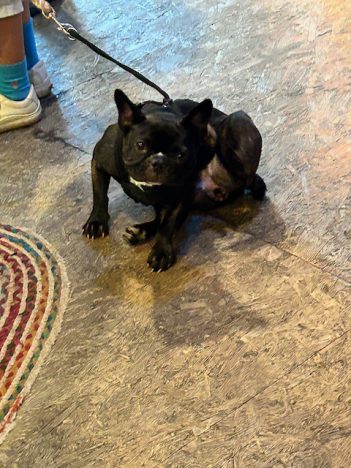
Cute little dog! A French bulldog, it seems? It’s got those bat ears. Are they still both the most popular and most expensive dog breed in the country? Doesn’t matter. I wrote a feature about regulating animals in privately owned businesses barely a month ago; I don’t usually return to a topic that quickly. And despite the fact that the article received an unusually low level of engagement, here I am. I can’t help myself. It’s a subject that vexes me, but I feel like my previous opinions would have poked the sleeping bear…if the cave weren’t empty. So, to use another animal-oriented figure of speech, I’m kicking the beehive again with a new provocation, in light of some additional info I have discovered these last few weeks. Hopefully I’ll get some feedback, some of it angry—but if the angry feedback includes a well-reasoned argument, I’m more than happy to prove me wrong.
But before I reveal that new info, I’ll revisit the subject briefly, focusing on my final conclusions from August. Fundamentally, I take umbrage with this little scenario:
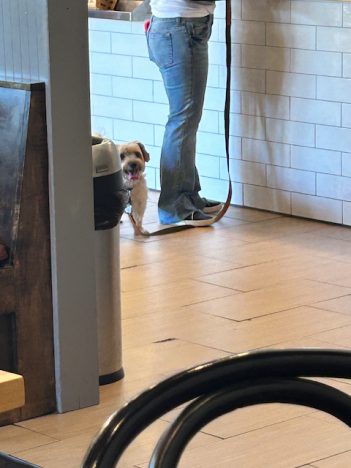
Yes, it’s another cute little dog in a business. Some sort of terrier? Norwich? I have no problem with dogs, and at a basic level I can completely tolerate when people bring dogs into places like this anonymous coffee shop in Alexandria, Virginia. I’m featuring the dog in thumbnails to lure more traffic to this article; there’s the ticket. My problem is that customers presume they can bring in a dog like this, and businesses seem to have little to no capacity to restrict them. The predicament with this cute little dog is, indeed, its size. It’s not that it’s too big; I deliberately use the adjective “cute” because its is both a compliment (physical attractiveness) and a diminutive (recipients of the “cute” label tend to be on the smaller size). And therein lies the problem: this terrier is too small.
In keeping with the August thesis, businesses are not allowed to restrict service animals: i.e., those creatures (nearly always dogs) that receive specific training to aid people with disabilities (often but not always visual impairments). Per the legal definition, service animals are not pets. Provisions for service animals have existed since the early days of the Americans with Disabilities Act (ADA) and even earlier. And some 2010 refinements to the ADA’s provisions have helped clarify what constitutes a service animal versus the alternatives; cats, crows, and capybaras are not service animals under any circumstances. As the definition for service animals has crystallized, those dogs that receive the training and registration are first and foremost an aid for a disabled person, and, since disability is a protected class, businesses must allow them as part of “reasonable accommodations” for persons with access and functional needs. These usually include such breeds as Labradors, golden retrievers, German shepherds, Bernese mountain dogs, but also standard poodles, collies, great Danes—in other words, big or very big dogs.
But those alternatives to service animals are the problem. The cute dogs below a certain size (probably 50 pounds) are simply not large enough to carry most objects that help a person in need, nor are they powerful enough to steer a blind person in the correct direction. While small dogs can be service animals according to the US Service Animals Registration site, the likelihood is significant lower. Small dogs confer some advantages: they are cheaper, live longer, are easier to travel, (usually) less rambunctious, and better in compact urban settings. But they cannot perform as many tasks. Their reduced size prevents them from carrying important objects (medicine or emergency info) on their harnesses; many aren’t tall or strong enough to work within a harness or to pull open doors. Under a certain size, a cute little dog simply cannot serve as a guide dog for the blind. However, this same US Service Animals site also articulates three tasks that small service dogs can perform: 1) medical alerts (for potential seizures or low blood sugar risk), 2) hearing aids for the deaf. Both are functions that are easily within the reach of large dogs as well.
Then there’s Task 3), the one that creates problematic ambiguity: psychiatric service dogs for people suffering from anxiety, PTSD, or depression. Again, size doesn’t matter; big dogs can be fine here too. But this is the role that bleeds heavily into an entirely different category: therapy animals. Cute little dogs like this are nearly always therapy animals, which places them into a categorization that can just as easily include cats. Or birds, ferrets, chinchillas, skunks. No legal, universal licensing exists for therapy animals, and therefore a person can designate an animal as “therapy” without it having received any assistance training. They are pets.
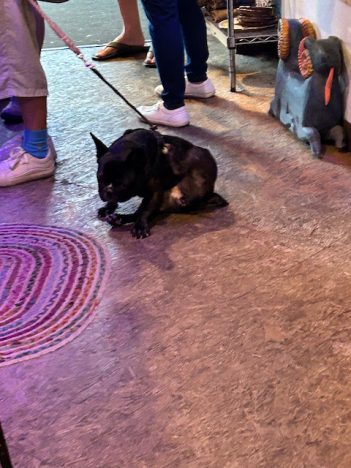
And patrons are increasingly using this loose “therapy animal” definition to bring their pets into any business under any circumstance, like the Alexandria coffee shops featured in these photos. In fact, since I’m a regular at coffee shops, I can now assert that, in a three-hour session typing away at a blog article, I can typically expect that at least one person will enter toting a pooch. Nearly always a cute little dog (this is a city after all, and city clickers love their Frenchies), and usually no evidence that it is a service animal. Per the 2010 ADA clarifications, businesses are legally permitted to ask very basic questions: A) if the dog is required because of a disability and B) what tasks the dog performs. But businesses cannot ask the nature of the disability itself, nor require medical proof. Furthermore, though owners must keep their dogs on a leash or harness, they are not required to overtly display the service animal label. However, it is illegal for an owner to declare a pet to be a service animal without registration. And without the training; even the most talented German shepherd is still a pet, like all untrained therapy animals. (No legally recognized code of training/registration exists for therapy animals.)
Rhe opportunity to include small dogs as psychological service dogs prompts a legal loophole that owners of therapy animals can—and do—exploit to bring their cute little dogs (or cats or pot-bellied pigs) wherever they feel like taking them. And private businesses, who fall under strict scrutiny in terms of what questions they can ask, lose the capacity to restrict. Granted, a person who pretends his/her dog is a service animal is committing fraud; but since businesses cannot ask, how many are going to feel comfortable cracking down, even if they would prefer keeping all animals except guide dogs out of their establishment? A business owner’s only other provision is to request the owner and animal leave if the animal creates a disturbance. But how big must that disturbance be? If a person brings in a cat and another customer claims an allergic reaction, the situation requires the business owner/manager to pit one customer against another. Sure, cat dander is the bigger culprit for triggering allergic or other auto-immune responses, but the rising prevalence of haired (non-fur) dogs like poodle mixes proves that a demand for hypoallergenic canines exists as well. Then again, a customer who develops an allergic reaction to a collie brought in as a service dog has no recourse; the dog is a fundamental accommodation allowing a disabled person to navigate public life.
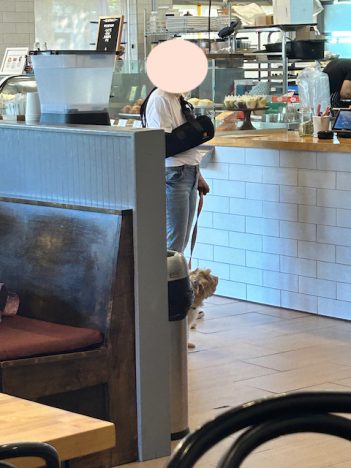
Small animals like the one(s) in the photos are almost certainly not service dogs. They may not even get the designation “therapy animal”, but that is precisely what an owner would use if a business ever tries to restrict them. The proprietor would have to use a script akin to this one:
PROPRIETOR: Hello, welcome to our store! That’s a cute little dog! What kind of breed is it?
DOG OWNER: She is a Bichon frisé.
PROPRIETOR: Very nice. Is she a service animal?
DOG OWNER: Not a registered one, but she’s my therapy animal.
PROPRIETOR: Okay, I see. What tasks does this therapy dog perform?
DOG ONWER: I have agoraphobia and Fifi helps relieve my anxiety. She sits on my lap and nuzzles me if I start to get a panic attack.
PROPRIETOR: Got it. Well, that is still just a pet, and we have a rule here that only allows registered service dogs.
DOG OWNER: But Fifi is a service dog, just not registered. She is my therapy for my trauma condition.
PROPRIETOR: Yes, but this is still a pet by the legal definition.
DOG OWNER: I would love to get Fifi registered and am trying to do so but have not yet gotten around to it yet. Are you making light of my trauma?
Yes, I confess I created a script that essentially provides a worst-case scenario for the business owner: long and drawn out and no clear-cut case of deception or fraud. But one can imagine the awkward situation this can potentially impose on the management of a public-oriented business. Most of them don’t want the hassle. And sure, they might love dogs, but it’s still not fair to a business that the customers can exploit this ambiguity to run roughshod over the owner’s right to exclude, or create the risk that other customers might have a fear of or allergy to dogs, a risk that is amplified since a therapy dog on a leash has far more freedom to roam or dart than a true guide dog on a harness. Yes, a business owner can ask both the customer and dog to leave if the dog creates any real disturbance—even a registered guide dog—but do they really want to get to this point?
In 2024, the only efficient, foolproof method by which an owner can both restrict and avoid the awkward situation is through a sign out front. Finally, I reach the point in the article where cute little dogs and other weak excuses for therapy pets may have met their match:
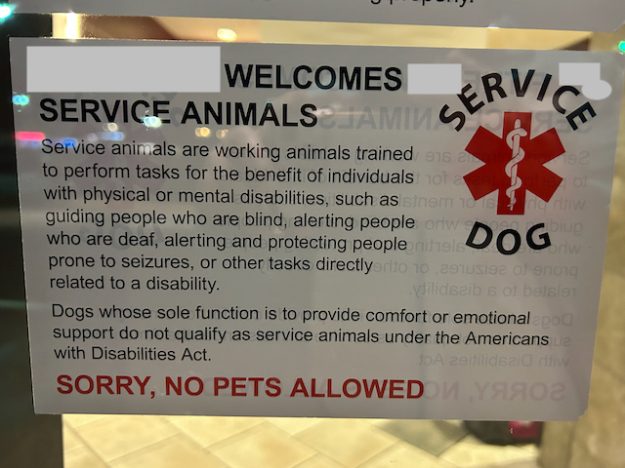
It’s another business in Alexandria, which I will leave anonymous. Sure, it’s a national chain, while the coffee shops are all locally owned. But this national chain clearly has legal counsel: its lawyers have done the requisite research to articulate the distinction between service animals and a pet. This sign spells it out better than anything else I have seen: any person reading knows exactly which animals can paw their way to the interior.
Props to this business for knowing its rights and for using a polite, succinct sign to state them with no ambiguity. It will help the manager enforce the rules without being a jerk, and it lets customers know they shouldn’t try to push their luck. If I seem like I’m being callous to people with anxiety who need their therapy animal, I am happy to offer two provisions: go to the numerous businesses that clearly don’t care enough to state their case with a sign out front, or use the resources available to get your dog trained to manage your psychological disability so it because a legally sanctioned service dog. It can be a cute little dog or slobbery Dogue de Bordeaux. But it can’t be a cat (and I love cats too). Or a peacock. Sorry ‘bout that.
“Any dog under 50 pounds is a cat, and cats are pointless.” ~ Ron Swanson, Parks and Recreation (2013)

9 thoughts on ““Cute little dog” effect: how customers abuse business owners’ rights to exclude pets.”
I often see these little “Emotional Support Animals” in my local grocery store. They are being cuddled in someone’s arms, riding in a strolleror walking around on a leash. I know they are not trained service animals because their owners allow others to interact with the dog so the dog’s attention is taken away from their person. Emotional Support Animals are not the same as Service Animals and do not have the same rights under the ADA. I’m going to print the sign you used in this article and give it to the manager at my local grocery store.
Yes, yes, and yes. It really goes back to the rights of people articulated in the Fair Housing Act that was such a discussion way back at you-know-where. Disability is a protected class, so a property owner who excludes pets cannot exclude a person with a service dog (not a pet). But a therapy animal is not the same thing; it is still a pet. And yes, you’re right: a true service dog should not get treated like a pet by other onlookers–the person with the service dog has every right to say “NO”. But business owners should have that same right when people push the limits by bringing an animal into a business. The “no pets allowed” rules from the past didn’t come out of thin air. (And I can guarantee, since that rule is the understood standard, no insurance policy would cover a dog who goes haywire and significantly damages merchandise or real property in a business; the owner/manager didn’t abide by longstanding rules.) Bringing a dog into a coffee shop is one thing, but a grocery store is playing with fire.
The biggest thing–I’m sure you agree–is not to blame the poor doggos who get swept into this. The problem is the dog (cat, peacock, capybara) owners who presume “anything goes” simply because service dogs are allowed. They are exploiting an ambiguity, which is no fair to other customers with allergies. If a dog gets spooked and jumps/scratches/bites another random customer, I can imagine the injured customer could sue the business owner, who once again would have little recourse.
I work at a grocery store & I’m over the pets. Please leave them at home so the real service dogs can do their job.
The worst case scenario I can come up with: what if a person brings a vanity dog to a store, then it gets territorial and aggressive and injures an actual service dog nearby? It sounds far-fetched, but it absolutely could happen, and it may be what we need to scale back on these “all dogs are welcome everywhere” assumptions.
Itself not so far fetched. And if that happens and the service dog reacts to being attacked, it might be ‘retired’. I don’t think people understand that.
This is eye-opening to me: I have seen many service animals over the years, but not therapy pets in public businesses. Is this common? Is there a general distaste for their access in cafes and coffeeshops? Have you happened upon a confrontation?
I am trying to imagine how I would respond? I am not sure the little pets would bother me most places, but their owners trying to “game” the system would be annoying.
Does anyone have an annoying example of a therapy animal in a really inappropriate public space?
It has become very noticeable in the last two years or so, from my perspective. These days, if I spent, say, a 3-hour session at a coffee shop, I’d say the odds are more than 50/50 that at least someone will walk in with a cute little dog. Here’s a deal: if I discover new dogs inside coffee shops, I’ll add them to the photograph series within this article and my article from a month ago…it shouldn’t take long to have a real montage!
Again, I single out the cute little dogs because the chances are slim that they are service dogs. They aren’t required to wear signage attached to their harness, but as another commenter here noted, a true service dog should not be petted and doted about by strangers…but that’s nearly always what happens with these cute little dogs. This means they are not legally defined service dogs; they are, at best, therapy dogs (which has no legal protection and is just a pet), or just a plain old pet….which means it is a pet owner riding own the coattails of good-faith legal protections for disabled people and their service dogs.
I don’t mind seeing dogs all that much in coffee shops. They’ve never been a problem other than an occasional bark, and usually only once at that. It’s the presumptuousness of the owners. But seeing a pet dog at a grocery store is just completely inappropriate. Yes, the really trendy breeds right now (bichons, shiba inus) are often just as fastidiously clean as cats, but we all know it takes a nanosecond for a strong-willed dog to “disappear” a scrap of food. Why give them a smorgasbord that is supposed to end up in someone else’s refrigerator?
I haven’t yet heard of “bring your dog to work” day at a standard service-oriented business, but I’m sure it has happened from someone willing to test the waters.
I’m with Eric. Recently we were at a winery in Michigan, and a couple came in with a cute little dog. It was clearly a little put off by all the people, noise, and unfamiliar sights and smells. It wouldn’t have hurt a person if it had gone off the rails, but it might have caused someone to drop a glass or spill a drink or upset a larger service dog. (None were present.)
We have two adorable little white dogs at home. They are companions, entertainers, and general mood brighteners on crappy days. Both are breeds with hair that doesn’t aggravate allergies.
And they stay at home when we go out, and in the “doggie hotel” when we travel.
Lest I be accused of being a grumpy old man, our Millennial kids (20s-30s) all have dogs at home too. Where they stay, unless they’re visiting other family members where known dogs are welcome.
Wineries and breweries (especially the ones in rural areas with big outdoor components) seem like an easy place for people to connive their way around a “no dogs” policy. I’ve seen dogs at bars–even if they have no outdoor component, it’s not a huge deal.
I suppose I can at least give away the type of business that featured this legally literate “no dogs allowed” sign out front: it was a health club. If these policies get abused badly enough, I could easily see people taking their pets to a gym and treating it like an all-weather dog park. Just imagine a dog playing fetch on the Astroturf of a Cross-Fit gym… And then, one can only imagine if the pet dog gets injured.
I have a feeling liability concerns will eventually rein things back in.