Search
Search
The search "Virginia" yielded
151 articles

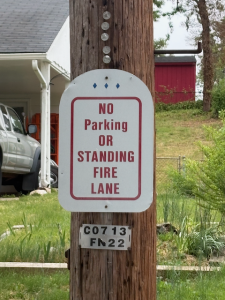
On-street parking restriction: if it looks funny, it probably doesn’t come from the City (which is humorless).

On an otherwise run-of-the-mill middle-class street, in the altogether run-of-the-mill and middle-class Washington DC suburb of Springfield, Virginia, a tiny sign indicates an on-street parking restriction, under certain terms that need a textual explanation.  The notion isn’t strange that a sign can order drivers not park on this side of a quiet, residential, local road;
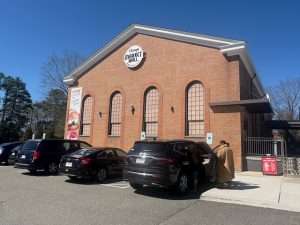
Ukrop’s: an old Richmond family grocer re-enters the market. As a real estate developer.

Just spitting distance from the municipal boundary of the independent city of Richmond, Virginia is a small, inconspicuous shopping center called Triangle Park.  Truth be told, all of the photos in this article depict properties just outside the commercial property called Triangle Park.  However, these photos still sit within the same triangle shaped superblock where

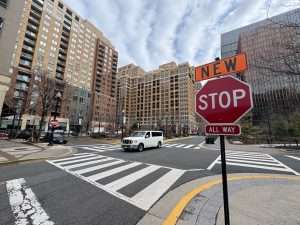
New stop sign: is it engineering?  Planning?  Marketing? 

Whether by foot or by wheel, the average American encounters a certain red octagon frequently enough that 99% of adults will know what I’m talking about with no additional context.   It’s not just that only one commonly occurring icon comes to mind that fits this “red octagon” description—though that’s certainly the case—it the fact

Bailey’s Crossroads might sound like “cow country”. But the only cows nearby are between two slices of bread.

Country estates.  Buffalo trace.  Woodland grove.  Rolling acres.  Everybody is aware of it, even if they haven’t actively noticed it.  It’s the adoption of rural, almost pastoral language in suburban place-naming strategy, almost as a hat-tip to what the developers bulldozed yesterday to get the strip malls and split-level ranch homes today.  I referenced one

Dying wing in a healthy mall: the Sears phenom all over again?

Potomac Mills, in the heart of the vast Washington DC suburbia that is Northern Virginia, continues to show remarkable resiliency amidst the widespread decline of many—perhaps even most—conventional enclosed shopping malls.  Dead and dying malls are, obviously, a familiar subject on this blog; even from the earliest days in the late 2000s, I explored Lafayette

Panic buying: when winter gusts blow the food right off the shelves. 

As a general rule I avoid subjects that are extremely timely, that reflect current events as they unfold.  First of all, I prefer topics that have more staying power, which is something that rarely characterizes breaking news.  Secondly, this blog is always only a side hustle, and, when I begin an article, I never know

Eastgate Shopping Center: getting ready for The (chopping) Block.

Yes, this article is a filler; I fully confess.  The demands of a November where I was out of the country for one-third, sick for another third, then in full Thanksgiving prep mode for the final third has made it hard for me to reach my quota.  So I’m cramming this one at the end

The lapse lingers a little longer.

The last ten days have involved a hiatus from this blog that’s lasted longer than just about any lapse since my Afghanistan days. I have been overseas—and still am—with even more limited Wi-Fi access than I expected, and I didn’t expect much. Therefore, the lapse hasn’t just involved posts, it has included comments, consolidation of

Dying wing in a healthy mall: the Sears phenom all over again?

Potomac Mills, in the heart of the vast Washington DC suburbia that is Northern Virginia, continues to show remarkable resiliency amidst the widespread decline of many—perhaps even most—conventional enclosed shopping malls.  Dead and

The lapse lingers a little longer.

The last ten days have involved a hiatus from this blog that’s lasted longer than just about any lapse since my Afghanistan days. I have been overseas—and still am—with even more limited Wi-Fi