Search
Search
The search "suburbs" yielded
203 articles

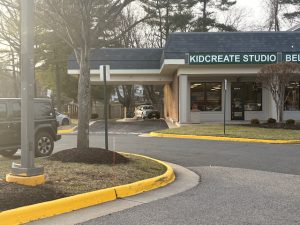
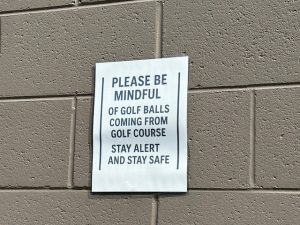
Flying projectiles and French pastries: not exactly a familiar pairing!

I had visited this little shopping center just south of Alexandria, Virginia more than a few times before I ever noticed this bizarre little sign about flying projectiles. It didn’t occur to me during any previous visit, since I normally sat indoors to avoid the scorching summer sun, but apparently some people opt to eat
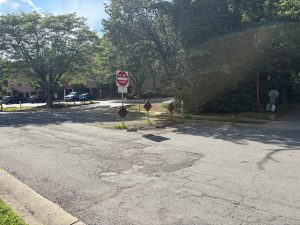
Mid-block mastery: how a surging Northern Virginia suburb stanches the flow on country roads.

Vienna, an incorporated town in northern Virginia, doesn’t have much in the way of a conspicuous downtown—or at least it didn’t until recently.  Little by little, it’s getting one, through higher-density infill development.  Until recently, the main drag, Maple Avenue (State Route 123), consisted of a mix of small strip malls, repurposed auto-oriented outparcel buildings,

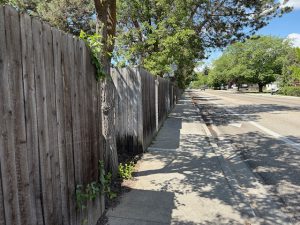
Privacy fences are nothing new in suburbia. So why is this one so special?

Returning back to my home turf after some time away—combined with other academic obligations—has forced me to rush through some briefer-than-usual blog articles so that I can still meet my May quota.  Having become too dependent on greater Washington DC for inspiration, it’s a refreshing change to cover content outside of Maryland and Virginia.  Therefore,

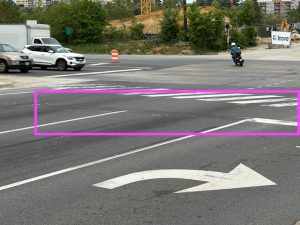
The turn radius—what does it limit more: the car or its driver?

The vehicular turn radius might seem like a simple feature, but its impact on the urban environment is akin to a pebble plunked into a pond.  And that simile carries extra weight because the pebble-in-a-pond’s impact is a series of concentric rings outward—basically another incarnation of the radii of varying sizes.  Traffic engineers have long

Fairfax Station Square: a humble strip mall perseveres in the thick of sprawl. But why?

In this nation of abundant strip malls, it should come as no surprise that quite a few of them look pretty drab, underinvested, and plagued with low occupancy.  Why expect anything else?   As I’ve noted countless times before, America grapples with a glut of retail-oriented real estate: a supply that accommodates the demand almost

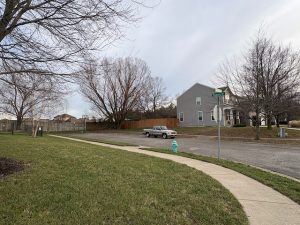
Stub street seminar: why developers keep building tiny, pointless dead-end roads.

The term “stub street” rarely comes up in conversation, yet enough people have a mental image of what it entails that it would be almost patronizing to explain what it means.  However, those cognitive apparitions vary so greatly that I’m going to go right ahead and patronize.  After all, a consistent definition of a stub

Cotton Company: shopping is fun again! The motto? “Bigger is worse”.

Wake Forest, North Carolina isn’t exactly obscure.  But it’s better known as the name for a university than for the town that (formerly) called the school home.  This might not be the case much longer.  It’s the suburb immediately north of the capital to the Tarheel State, and while Raleigh itself has enjoyed tremendous growth

Delayed green lights: a subtle safety measure aiding the vision of zero pedestrian deaths.

As one urban advocacy campaign sunsets, another rises.  I’ve written multiple times—mostly before 2015—about the complete streets initiative: an effort to encourage municipal public works departments to design urban streets for all different tiers of users.  In short, a “complete street” does not just feature vehicular lanes; it offers distinct bike lanes or grade-separated cycle