Search
Search
The search "logos" yielded
98 articles

Ocean Terminal in Edinburgh: proof that the dead mall is NOT an American phenomenon?

It’s not a rhetorical question, but it’s one that I would have struggled to answer until recently.  After all, I’ve spent years exploring some of the dreariest corners of underperforming American retail: one or two dead malls in my hometown of Indianapolis (which has resisted mall decay more than most cities, almost entirely due to

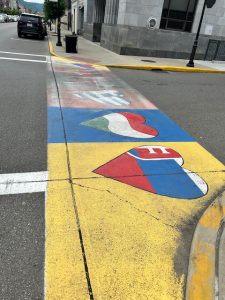
Flag Day celebration (and quiz)! How one PA steel town bravely recognizes its past.

It’s Flag Day!  And it’s kind of remarkable how, given my blog’s fixation with flags over the years (including some very creative flag reimagining), I’ve never really covered this 75-year-old holiday, commemorating the 247th anniversary of a distinct American flag.  Yes, it was June 14th in 1777 that the Second Continental Congress adopted an official

Blank wall bravado: a trendy neighborhood’s supermarket is more and less than meets the eye.

This article represents an interesting first.  Frankly, I’m surprised it’s taken this long—15 years of blogging!—for someone to approach me about this while I was out snapping pics for my blog.  Given that I have over 20,000 photos consisting primarily of mailboxes, parking meters, cracked curbs, lonely utility poles, labelscars, and miscellany that would only

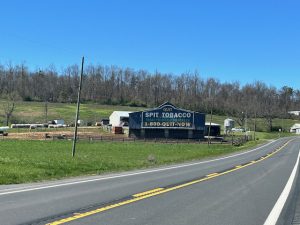
Folk pop: the classic Mail Pouch Tobacco ad gets the meme treatment. For better health.

I’ve never bothered to discern what Pierre Bourdieu would probably brand the “echelons of taste” that distinguish “folk” from “pop”.  Their thematic intersection owes a great deal to the fact that they share a prosaic, anti-elitist undercurrent, but the commonalities probably don’t extend much further.  While both folk and pop eschew the highbrow ethos that

Rax Roast Beef: a peek inside one of the last locations of a once-mighty 80s chain.

“Fast food with style.”  That’s the motto that I, coming of age in the late 80s and early 90s, associate the most with Rax Roast Beef.  But let’s face it: when this formerly thriving restaurant began floundering, the slogans shifted with the seasons.  Thirty years later, it’s hard to say which marketing campaign is the

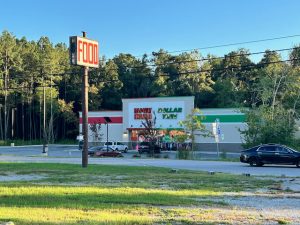
Dueling dollar stores in a small town: why would identical companies share a party wall?

During the season of giving, it’s not likely that most people’s first notion of a repository for seasonal gifts is a dollar store.  Christmas, Hanukkah, Kwanzaa, Festivus, you name it. I suppose I’m making an elitist generalization here: after all, many people lack the wherewithal for purchase gifts anywhere other than a dollar store.  Furthermore,

Color choice: a gladiator match between brand green and brand red, in a strip mall coliseum.

The infamous book How to Lie with Maps initially offered a light-hearted attempt to explore how maps can entice, mislead, inflame, and generally propagandize, often without necessarily depicting anything geographically untruthfully.  Juxtapositions (not always to scale), labels, color choice, and infographics can all endow an editorial skew on what seems like objective spatial representation.  And

Yellow caution bumper stickers: not just a safe driving strategy. Now a meme.

It’s time to confess: I’m beholden to my most successful blog posts, which sometimes feature a subject I don’t really care all that much about, but hey—if it gets good engagement and stimulates conversation, why not explore it again?  That’s precisely the case with those yellow caution bumper stickers (or perhaps they’re magnets?) that have