
For the most part, I am loathe to chronicle institutional decline because it captures the livelihoods and aspirations of so many affiliated with the institution (both currently and previously). It feels not just that I am exploiting the decline but, by drawing attention to it, that I’m exacerbating it. But the institutions in my crosshairs at the moment are higher education, as they have been in my “dead campus” tours of the past, as well as those former campuses that have spawned a complete reinvention. But it’s hard to ignore the dire state of higher education in the United States, suffering not just a crisis in credibility after multiple terminations/departures of presidents of prestigious universities just a few years (or even months) after they came to office. Much more woeful than the top-down leadership is the entrenched skepticism manifesting itself from the bottom up, in terms of admissions and enrollment. Already flatlining for many schools during the 2000s, the condition reached a critical watershed through at the onset of the Great Recession of 2008, which yielded two devastating consequences: a) households clamped shut their wallets amidst financial uncertainty, forcing young high school grads to seek employment right out of school rather than matriculating; b) economic anxieties prompted lower household formation and a baby bust to which the nation has not really recovered, in terms of remotely approaching a replacement-level birth rate. Now, in 2026, the comparatively small cohort born during the bust is reaching the age of eighteen, meaning that a considerably smaller pool of high school grads is considering or applying to universities, concomitant with the already declining trends. These macro-level factors have prompted me to rotate my lens on a school likely suffering the brunt of the enrollment crisis: Wheeling University in Wheeling, West Virginia.
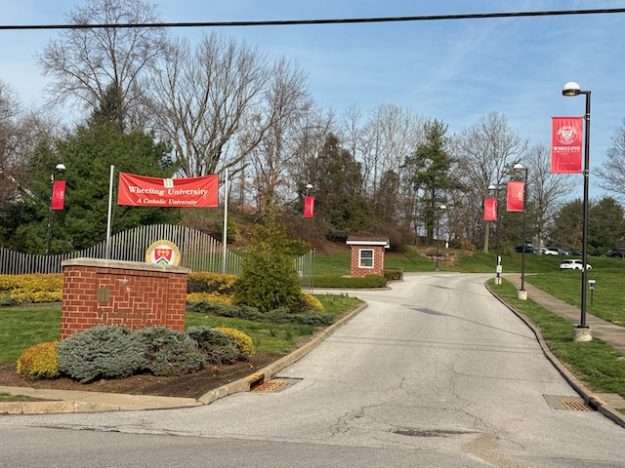
This university nestled in the northern Panhandle of the Mountaineer State counts an enrollment smaller than many high schools: just over 600 undergraduates and 150 grad students, based on 2024 counts. It is relatively new, having opened its doors in 1954—the youngest of the nation’s 28 operating Jesuit colleges. Contrary to most contemporary universities, it is predominantly male, with 42% female enrollment. Most importantly as an indication of its current challenges—and what largely caught my attention (after having driven through Wheeling many times over the years)—the school has changed names multiple times: it began as Wheeling College upon its founding through the a partnership between the Roman Catholic Diocese of Wheeling-Charleston and the Maryland Province of the Society of Jesus (Jesuits). The Jesuit Order comprised a component of the faculty from the very beginning, and in 1987, the name changed to Wheeling Jesuit College to reflect this. The school achieved university status in 1996: Wheeling Jesuit University. Then, in an act that caught my attention in 2019, the school eliminated several liberal arts programs and engineering, simultaneously terminating twenty faculty, all as part of the cost-cutting measure to overcome weakening enrollment figures. Theology and philosophy—two of the academic departments that Wheeling Jesuit University decided to cut—are instrumental to Jesuit academic identity, prompting the order to end its academic affiliation and forcing the school’s latest name change.
In defense of the school’s milestone de-Jesuitification, only three remaining Jesuits still remained at campus assignments by 2019, and the elimination of those departments was instrumental to maintaining solvency. In 2017, school leadership sold its 65-acre campus and all buildings to the local diocese, which took control and paid off $32 million in bond debt, prompting the school to offer early retirement to several faculty. Despite the bailout, the school declared financial exigency two years later: a precursor to the elimination of departments and forced termination of additional tenured faculty. The reinvented Wheeling University dropped its offerings from 47 undergraduate majors to just seven: nursing, respiratory therapy, exercise science, education, business, criminal justice, and psychology. Graduate offerings are physical therapy, business administration, education, and nursing.
So what does the “leaner and meaner” Wheeling University look like? Is it obvious that the university is operating on a shoestring? Well, somewhat.
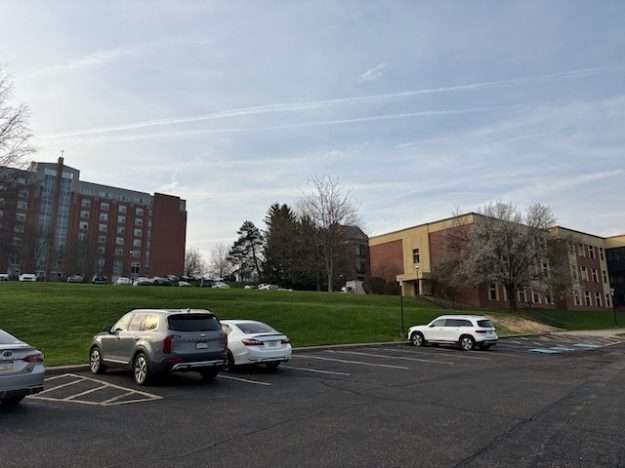
At first blush, it looks like a fairly normal small liberal arts college campus. And it is fully operational on a comfortable spring day. But institutions that operate in campuses often face exponentially higher operating expenses in comparison to those who lease or own a single building. After all, relatively little of the space beyond the structures themselves directly translates to commodities, and even academic buildings—which represent the core service a university provides—are difficult to calibrate to an exact value, though I’m sure the bean counters among a board of trustees strive to do so. (After all, some entity had to deliver the data that prompted school leadership to make the decision to eliminate so many humanities departments.) Conversely, some school functions offer a clear dollar value: sports fields and stadia can charge for events; dorms usually enumerate a separate charge for room and board.
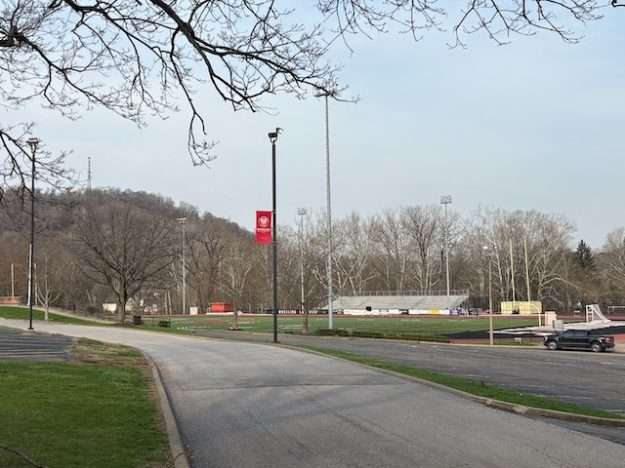
But what about all those lawns and sidewalks and pedestrian paths in between? A school flush with cash is likely to beautify its campus with landscaping, but decorative flora is largely absent from Wheeling University.

The lawn appears well-enough maintained, though the season when I took these photos (late March) might precede the first large-scale lawn mowing effort for the year. Furthermore, paving surfaces for roads and parking may not require as much routine maintenance, but the improvements are more expensive, time consuming, and likely more disruptive.
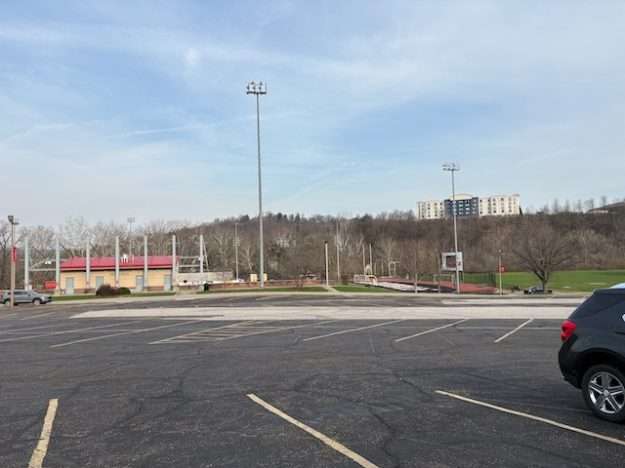
It’s a lot of land to support just fifteen buildings. With such a reduction in academic offerings, I imagine the downsized Wheeling University educates considerably fewer students than it did in 2017, or certainly in 2007 before the nadir of the Great Recession. As a result, even on a typical school day, the parking lot seems fairly sparse. It may only fill for major events like graduation or football games.
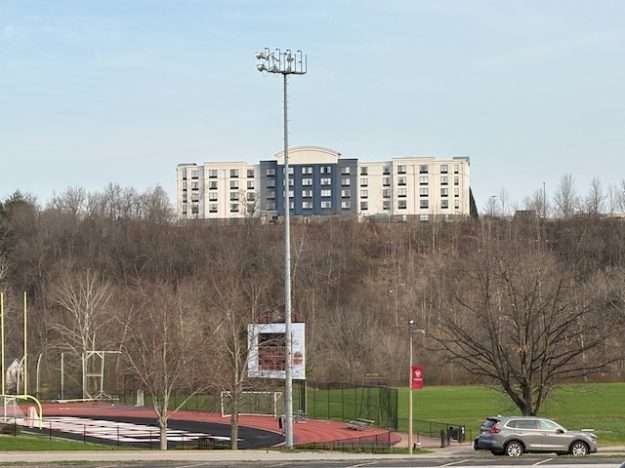
Perched on the bluff beyond Bishop Schmitt Field is an unrelated building: currently a SpringHill Suites by Marriott. It’s a bit striking because its contemporary color scheme contrasts sharply with the much less updated aesthetics of Wheeling University’s campus buildings. At the very least, it offers a glance at the dramatic topography that characterizes Wheeling, the Ohio Valley, and the Northern Panhandle of West Virginia in general.
But outside of those bluffs, the campus itself is aesthetically nondescript. Though fundamentally walkable, the parking lots are huge, and it lacks any sort of central showpiece or landmark as Kevin Lynch might have defined it in his book The Image of the City. The freshest-looking building on Wheeling University’s campus itself is also its apparent largest: a dorm called Ignatius Residence Hall, which, by virtue of its height, functions as the closest equivalent to a landmark.
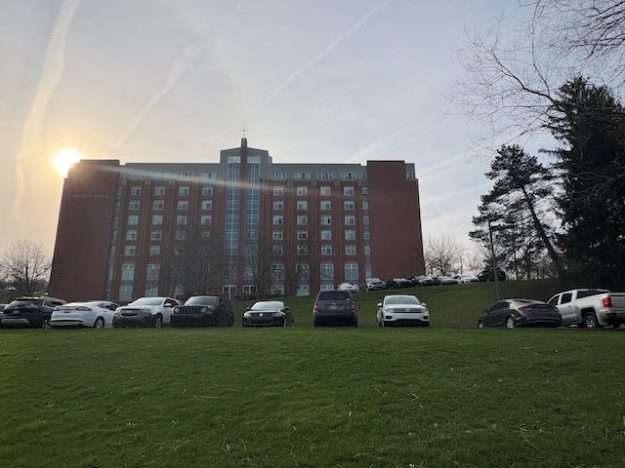
Not a bad-looking building, and, dating from the mid 1990s, it’s the second-newest dorm on campus. (The newest, Kirby Hall, opened around 2000, but I failed to take a photo. Here’s a Street View.) I couldn’t help notice a nagging detail:
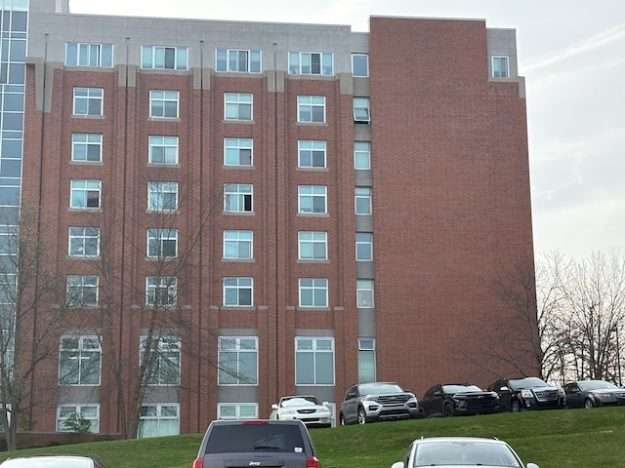
Quite a few open windows. It was, as I recall, an uncommonly fair day for Wheeling in late March, probably well above 60°F that morning. Most likely it’s too early in the season to activate building-wide air conditioning—and yes, according to my research, Ignatius Hall does offer A/C—but old-fashioned climate control methods are no longer a feature many demanding undergrads are willing to overlook. I’m being petty by observing this (admittedly, I assumed the building had the same climate control as my dorms did at the turn of the century and early 2000s, which was none at all to manage heat). But I’m not necessarily any less petty than the average prospective student, who increasingly expects domestic comfort and residence hall amenities that were unheard of way back in 1990. Can a small school, struggling to unload its debt, expect to maintain facilities to the standard that Gen Z demands?
It’s hard to imagine that would be very easy, when groundskeeping must get short shrift.
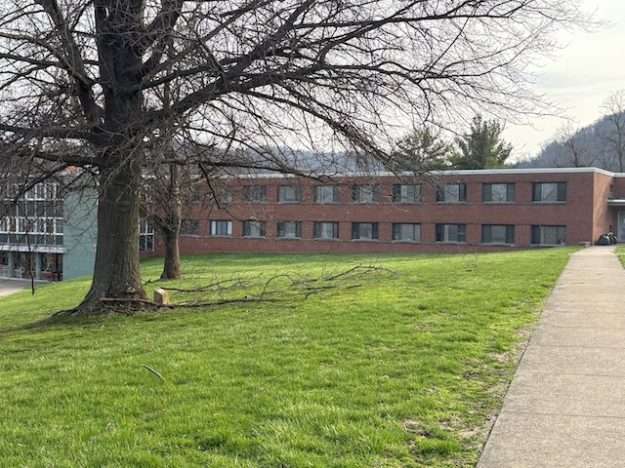
Even if lawn-mowing hadn’t yet begun, a grounds crew should be picking up dead and fallen tree branches, but they were everywhere. And these squat, mid-century buildings look sadly austere and uninviting without some rudimentary landscaping.
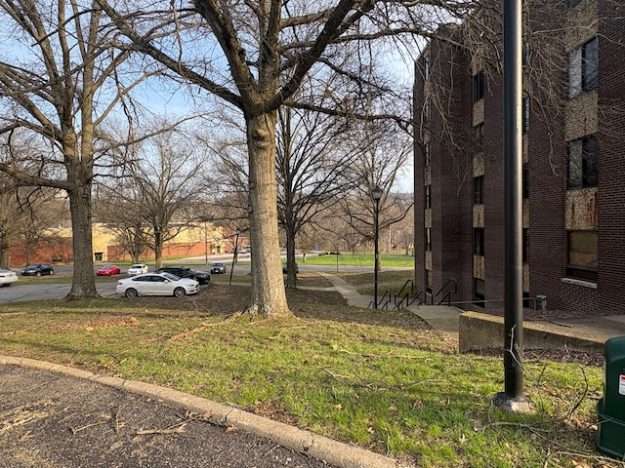
The building to the right of the photo deserves special mention.
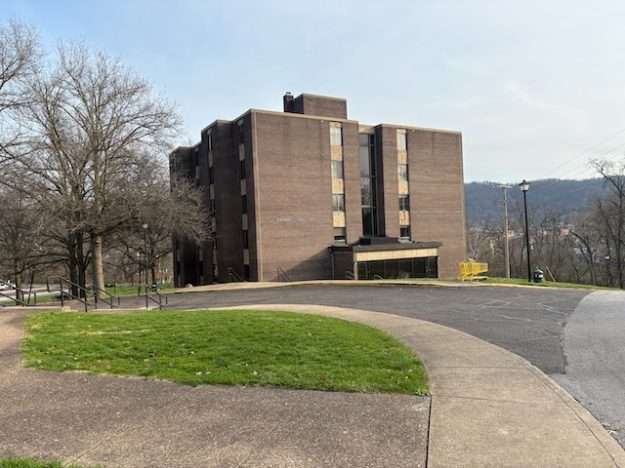
Thomas More Hall clearly sits well within the Wheeling University campus, but it doesn’t get a mention on the campus map. If it did get referenced, it’s the little gray structure between the #13 and #16 on the map as listed. Why no reference? Thomas More Residence Hall is closed. Most likely it is—or was—the smallest and oldest residence hall, less desirable than the others. In the years following the downsizing, it was probably no longer necessary for a campus oversized to accommodate significantly fewer than 1,000 students. Thus, More Hall sits in a state of semi-neglect, including an apparent depository for bright yellow shopping carts.
I have struggled with this article on Wheeling University because it feels like it’s kicking an institution while it’s already doubled over in pain. Why single out this school when so many others are similarly struggling? The name change was my initial red flag. Leadership turnaround (thirteen presidents since 2000) is a potentially bigger concern, concurrent with a probation declaration from the Higher Learning Commission. In light of such turbulence at the highest echelons, my act of pointing out open dorm windows and fallen twigs is indeed petty. After all, even the most well-endowed universities have a few bedraggled structures that manifest their deferred maintenance. An old university roommate took me on a tour of the school where he was faculty a few years ago; it was a Catholic university much larger, higher-profile, and prestigious than Wheeling University. This school, too, had a mothballed building that looked much worse than More Hall here. My own big, rich alma mater had an academic building still heavily used when I was there, with doors and walls disintegrating. This building hosted a variety of musical instruments that were subject to all sorts of temperature changes, which shortens the lives of pianos and keeps them out of tune. (At least the school leadership provided window units for the rooms with Bosendorfers.) From what I can tell, that creepy and kooky music administration building is also basically unused today.
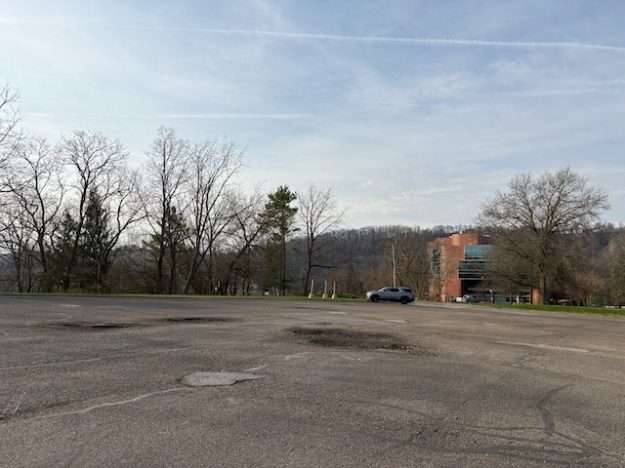
Therefore, even amidst the crumbling asphalt and underwhelming grounds, I have to offer both some grace and a few commendations to Wheeling University for exercising this necessary fiscal restraint. It’s impossible to say what a tiny array of course offerings will mean for this Appalachian school as teenage preferences and aspirations change in the years ahead. But Wheeling University leadership is cutting its losses and, presumably, by narrowing the focus in scholarship, is refining the sense of community and fellowship. I’ve seen institutions—churches, clubs, sports teams—flourish even amidst dumpy facilities. Everyone liked one another and liked being there. When I was in school, our decrepit music building was amusing and almost charming. And even if high school grads have higher standards for dorm living today than they did forty years ago, at some point they’ll leave the dorm and, more likely than not, move to a big city where they’ll take out an insane lease that’s well more than 33% of their income. So, picky though they might be at age nineteen, by twenty-three they have no choice but to bite the bullet and shell out wads of money for a flophouse. And in that respect, the struggling liberal arts colleges of 2026 (Wheeling University and many others) might prepare them for the discomforts of adulthood.

14 thoughts on “Wheeling University: tiny schools trim their budgets, then their lawns.”
our local Uni has some amazing later mid century buildings
https://snipboard.io/zAs284.jpg
I would love to play “guess the campus”, but my chances of success are so tiny that I’m going to embarrass myself. Allow me two attempts. MIT? Northwestern?
Then again, you’re saying “uni”, which Americans rarely use, so this might be somewhere completely unexpected for me.
it’s in Melbourne Australia
Winthrop University just demolished twin brutalist dorm buildings.
It’s hard to find a university that doesn’t have at least one brutalist structure. (The top candidate is usually the library, as it was in my alma mater.) When most people write about brutalism today, it’s to say something negative. I’m not (usually) one of them. But it is interesting how the style became popular during the years of peak urban crime; their fortress-like fenestration is definitely not by accident.
The building I featured here, More Hall, probably went vacant in the early days of COVID, but not because of COVID, since the school announced its downsizing in 2019. It has brutalist touches. And I don’t expect it ever to come back. It’s small for a dorm and aesthetically not easy to love. The only saving grace for More Hall is that it’s on the edge of campus, so Wheeling U could subdivide and sell the land as a separate parcel to repurpose the building. But why spend all that money for a renovation? Dorms don’t make good apartment conversions; not enough plumbing. It’ll probably go the way of the Winthrop U brutalism within the next few years.
Winthrop U’s library and former “Student Center” are definitely mid century and the library may be slightly brutal. I’m not sure if either building is still in use. Now, I wonder. It’s my hometown U and alma mater.
UC (University of Cincinnati for those of us in the Midwest) is taking down its monumental Brutalist building that has for decades been a landmark there…it’s how one navigates that part of the city since it’s on a hill.
My alma mater built five Brutalist apartment-style dorms in the Urban Renewal era and updated them to change the window systems to a then contemporary “Mondrian pattern” look (15- 20ish years ago) and to stain some of the concrete walls.
Not knowing UC campus really at all, I’m going to assume it’s this building and is part of the library complex? https://maps.app.goo.gl/RaEEt7z3Bbnn6vk87
Correct me if I’m wrong, but it definitely seems like it would be a landmark. For those of us who know German, “Langsam Library” is a funny name.
And if the five brutalist dorms at your alma mater are what I think they are, this Street View should be accurate as well. I’m clipping the one I lived in while I was a graduate assistant there. https://maps.app.goo.gl/JN7nvg4FB4YZSk5c8
Much to my surprise, I can no longer easily capture an image from that dorm through a Walnut Street vantage point because other fancy new buildings are completely blocking it. Your “Mondrian pattern” windows reference is spot-on, and it definitely softened the brutalism. Otherwise, I suspect the interior configuration of the rooms is a “herringbone” style similar to the hapless little Thomas More Hall that I captured at Wheeling University.
Yes on UC.
I was thinking of the three towers in the complex you shared (and I lived in the one you captured for two years), plus these (called Grad Towers colloquially when I was on campus), which still look like commie blocks: https://www.google.com/maps/place/Chestnut+St+%26+36th+St/@39.9546726,-75.1944596,3a,75y,239.49h,111.27t/data=!3m7!1e1!3m5!1sbRZqJlZBS1on4WLoaXEAxQ!2e0!6shttps:%2F%2Fstreetviewpixels-pa.googleapis.com%2Fv1%2Fthumbnail%3Fcb_client%3Dmaps_sv.tactile%26w%3D900%26h%3D600%26pitch%3D-21.27158208033387%26panoid%3DbRZqJlZBS1on4WLoaXEAxQ%26yaw%3D239.49309954948188!7i16384!8i8192!4m6!3m5!1s0x89c6c650c7c33c0f:0x3bef857caf676791!8m2!3d39.95462!4d-75.194565!16s%2Fg%2F1ts3m4sw?entry=ttu&g_ep=EgoyMDI2MDgwOS4wIKXMDSoASAFQAw%3D%3D
Very interesting. I’m from WV but never heard of this university. Of course if it was faith based I would not have even considered it. I wanted and went to WVU. Their coliseum is worth seeing at least once in your life.
Wheeling is going through some transformation. Maybe they can find their way.
It’s tiny and just got tinier in 2019, after eliminating 40 undergrad majors and leaving only seven. With the humanities gone, the Jesuit order pulled out its support (hence the removal of “Wheeling Jesuit” to just “Wheeling”). I’m not sure if the school is still Catholic or only “culturally Catholic”. But the renewed focus may actually keep the school alive when so many others close.
I hope so if it makes sense.
Unfortunately they did it to themselves. Snake eating themselves truly comes to mind
Yeah, there’s a case to be made for that…the gravy train was going to leave the station eventually.