
Tucked away in Fairfax County, Virginia’s extensive park network is one by the name of Brookfield. Fairfax Park Authority maintains an abundance of green space that shields this urbanized county from a state of near 100% buildout. With 43,000 acres managed by either the County, the Commonwealth of Virginia, the regional system (NOVA Parks), or the municipalities within the county, Brookfield Park is not high profile; no access exists from any major roads. The single-family residential area that it primarily serves is large but not particularly distinct; it’s a mere component within the resolutely middle-class unincorporated area known as Springfield, which I featured not so long ago. The homes featured in that article look pretty much the same as the ones surrounding Brookfield Park. Brookfield, Springfield…pretty standard suburban names. (This definitely isn’t the famous Chicago park with a massive zoo.) Brookfield Park doesn’t offer a lot of athletic recreation either, so it’s hardly a destination park at either a statewide or even a local scale. It has a small playground, a picnic shelter, basketball court (supposedly—I didn’t see it), and a small bike track. But I can’t imagine the park hosting any major sporting events or gatherings. About the biggest component that distinguishes Brookfield is the paving material for one side of a path that circumscribes a lake. And what a doozy it is. Porous pavement, to be sure. But did it really have to look like this?!
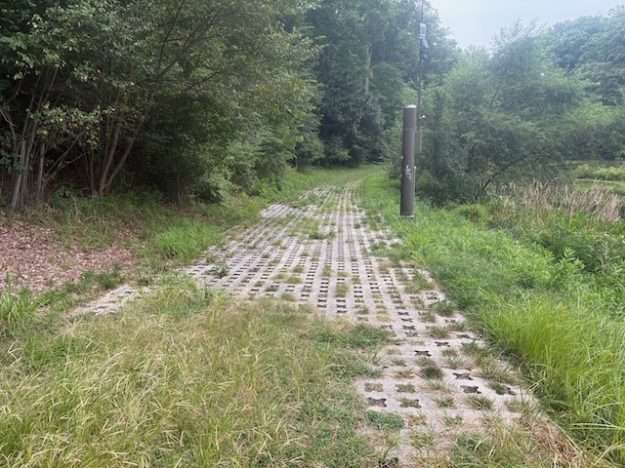
For those unacquainted with the concept of porous pavement, the label represents a variety of strategies to mitigate the most negative ecological impacts of a general impervious surface like concrete or asphalt: both of these popular paving materials, once installed, impose an abiotic new “floor” that largely resembles a ceramic or polymer, neither of which encourage percolation of rainwater into the soil. Instead, the pavement channelizes the water, with gravity forcing it down a contrived stream created by even the slightest grade change, so the water concentrates in select places—puddles or sumps—rather than dispersing evenly as it would if the rain fell directly onto soil. Furthermore, the impact of the rain hitting the concrete/asphalt creates a scouring effect, so rivulets of stormwater convey all the gunk from the pavement into the soil wherever it lands. In short, the impervious nature of most pavement can result in both localized flooding and diminished soil quality, or water quality if the runoff continues into the nearest stream, river, pond, or lake.
Porous pavement tries to prevent this.
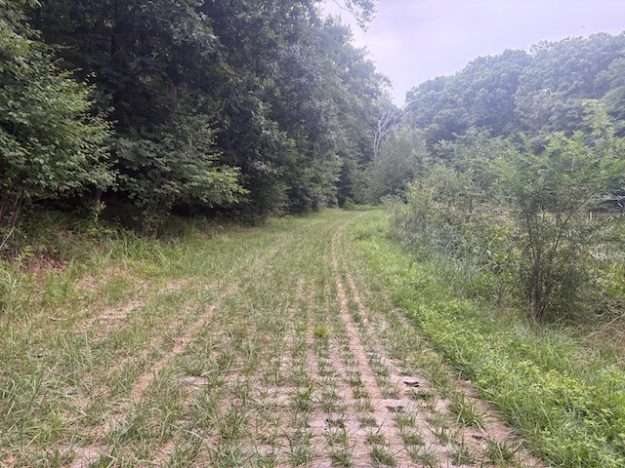
It represents a compromise between the load-bearing capacity of asphalt or concrete, while allowing a fair degree of percolation otherwise rendered impossible, thereby also promoting ground water recharge. As is typical of a compromise, the engineered material is neither as effective at conveying wheeled vehicles as normal pavement, nor as good at supporting penetration of rainwater as unpaved soil. But it doesn’t preclude one for the dominance of the other.
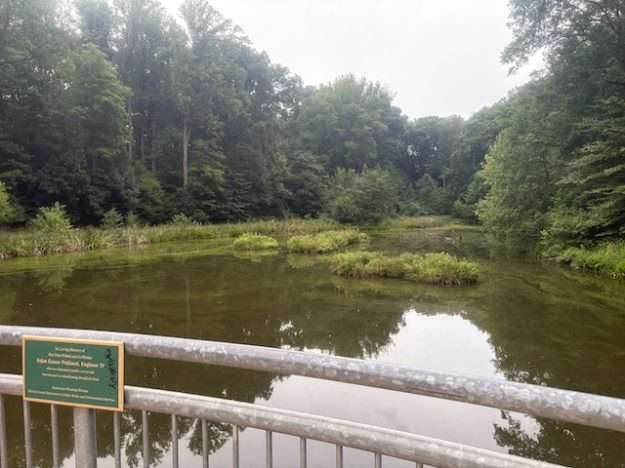
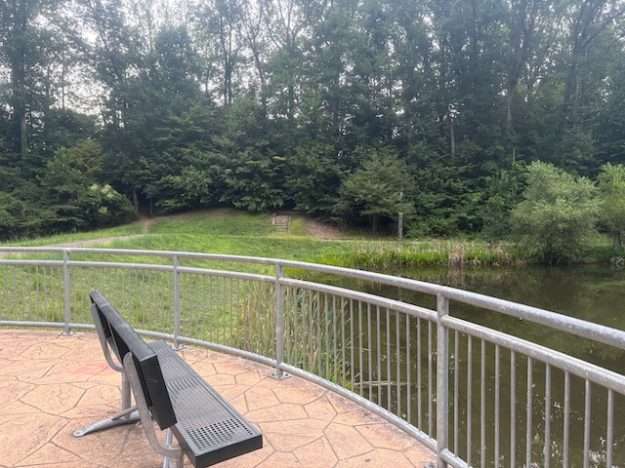
This wet pond represents the core of Brookfield Park: the nucleus of a glade within the predominantly forested park area. Like the porous pavement, it functions as an engineered strategy to improve local watershed ecology.
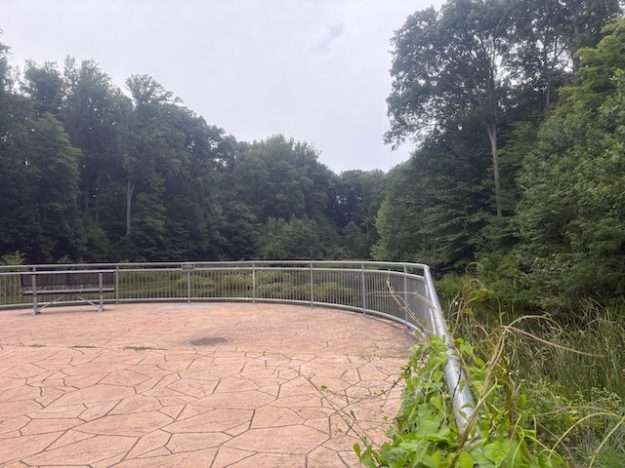
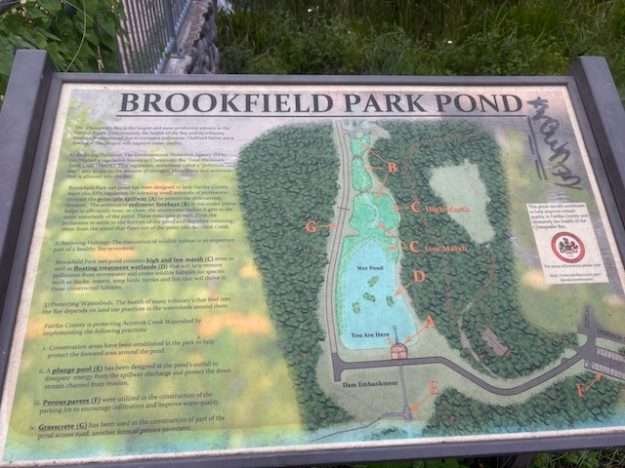
I’m standing on a viewing area that itself is part of a dam embankment: the damming of a minor tributary to the 25-mile-long Accotink Creek, which in turn flows into the mighty Potomac River, which transforms into one of the most prominent component estuaries within Chesapeake Bay, the biggest estuary of them all. This wet pond and the adjacent dam help control levels of rainwater entering the Potomac watershed, preventing excessive amounts of sediment, phosphorus, and nitrogen—penetrating rainwater through aerosolized pollutants—from entering the Accotink Creek, the Potomac River, and the Chesapeake Bay. The spillway gate—ostensibly part of the viewing platform upon which I’m standing in the previous photos—can open as needed, based on rainfall patterns. This nearby diagram articulates the full process.
Virtually every manmade feature in these photos comprises stormwater management infrastructure that the engineers have aestheticized so that it doesn’t look like a retention pond.
It’s an attractive green element within a park that, humble though it may be, certainly adds value to the homes nearby. And, as that sign reveals, the wet pond is only a small element: sediment forebays, high and low marsh features, and floating treatment wetlands (miniature islands that, to crudely simplify, act as sponges) all operate symbiotically within a stone’s throw of one another. Here’s an alternative angle of the pond with those floating wetlands and the dam embankment on the left side:
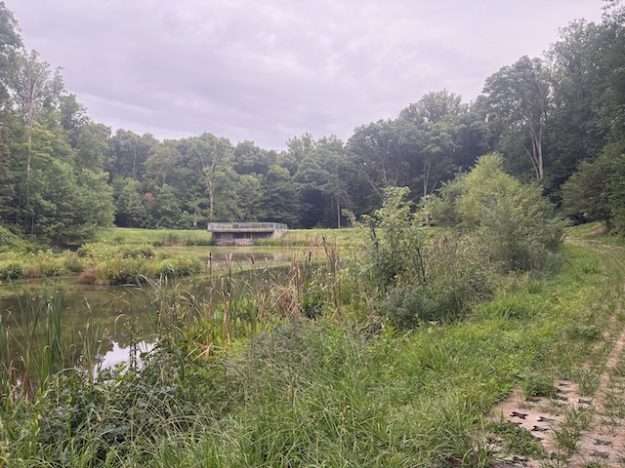
These carefully designed features yield a park that confers more ecological than recreational benefit to the area. I can safely say this because, dang it, the designers of that porous pavement sure didn’t have exercising humans in mind!
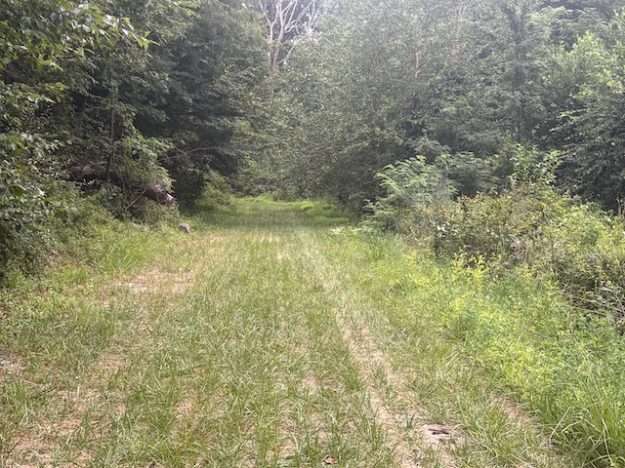
The diagram references the path on the northwest side of the Brookfield Park Wet Pond, calling this type of porous pavement Grasscrete. That portmanteau feels like a neologism but is, in fact, a patented product from a UK-based company Grass Concrete Limited, which has been fabricating load-bearing porous concrete for over half a century, offering a variety of designs for ground paving, roofing, and walls. Per the company definition, Grasscrete is “a cast on site cellular reinforced concrete system with voids created by styrene void formers.” In short, the concrete gets poured around the styrene, leaving these carefully shaped “holes” as it cures into Grasscrete. It intends to serve as a lighter, subsidence-resistant alternative to precast concrete, all while offering about as good of drainage capability as possible while still supporting hefty vehicle loads. I have no doubt it works well enough at both functions—I have seen it elsewhere—and here at Brookfield Park, the path is wide enough for service vehicles. But the Grasscrete also links with and intends to serve jogging/hiking nature trails in the area. And by that metric, it fails.
Each one of these voids is large enough to provide relief from the imperviousness of the surrounding concrete; they’re like miniature flower pots. They work well. But do they need to be the perfect size for the average human heel to get caught inside them?

Not a selfie kind of guy, I am showing some “skin” for the first time in this blog. (Okay, maybe the second time.) My fluorescent yellow shoe pokes out of the bottom of the photo above, showing how easily one could trip and seriously injure one’s self by getting either the toe or heel wedged into a void. I wasn’t expecting this path as I was was running; I entered Brookfield Park through the much more conventional Gerry Connolly Cross County Trail, which links Brookfield to other parks to the north and south and features a combination of asphalt, crushed rock/gravel, and dirt. And then, stampeding through the woods at my usual 4-minute-mile pace, I had to stop short when I encountered this obvious hazard.
I’m no stranger to foot and ankle injuries; running across Grasscrete seemed like a death wish. I pirouetted my way alongside the wet pond, noting all the little quirks along the path.
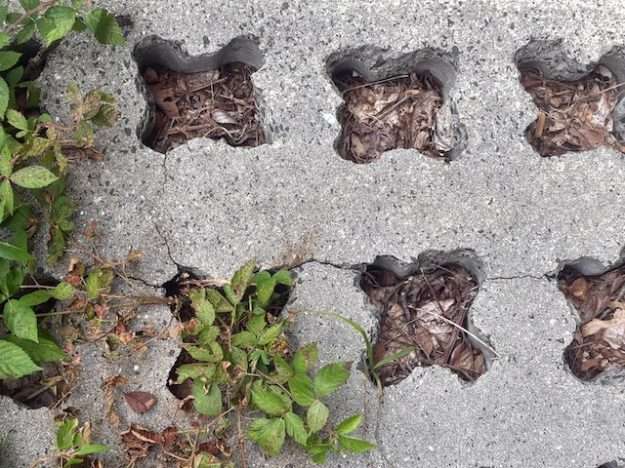
Load-bearing or not, the Grasscrete is demonstrating its age through the numerous hairline fractures between two adjacent voids, akin to a ceramic, which, if my memory from freshman-year materials science serves me correctly, coincides with the carbon arrangement of concrete. Then there’s the paint:
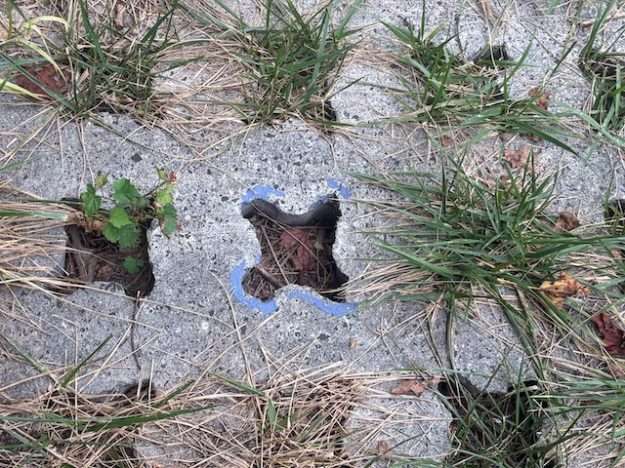
At least a half-dozen voices have a faint blue outline like the one here. Not sure what that means, but perhaps it suggests something abbot about that specific void; clearly no grass is growing. Or perhaps there’s something extra perilous to the human foot, akin to the spray-painted tree roots one encounters in recreational trails to draw attention to them as tripping hazards—or the spray-painted irregularities in pavement on paved trails, typically caused by buckling or tree roots. Was this an Eagle Scout project?
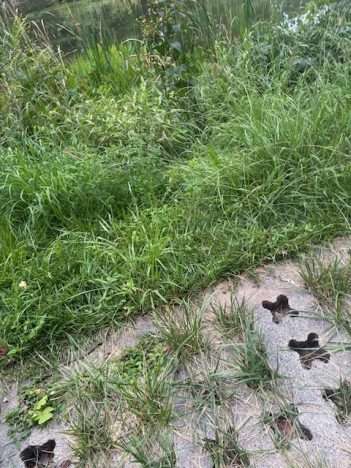
It doesn’t really matter. This exact design and these specific voids are probably perfectly fine in parking bays or service roads that don’t see a lot of recreation. They’re not uncommon infrastructure, but merging stormwater conveyance and recreation is always risky. (Case in point: I’ve rarely seen signs around retention ponds that overtly encourage people to swim or canoe or even go fishing.) I’m not expecting anything to change here at Brookfield Pond, but I do feel that our litigious culture is just waiting for the other shoe to drop—pun fully intended. Grass Concrete Limited offers a brilliant array of shapes and configurations, so I can hardly fault the company. Surely the alternative X-shape would have been better in this context, when a porous pavement pathway is likely to receive far more recreational runners/walkers than vehicles. Or perhaps the latticework design that I wrote about in suburban Detroit many years ago would have been a safer alternative. Regardless, it kills me to vent my spleen at an initiative so well-intentioned and otherwise so attractive. And perhaps I am indeed overreacting: I made it safely through, and it would seem like someone else by now would have pressed charges if this material had caused serious injury. Or perhaps I’m the first one to shine a light on the whole thing: like I said before, Brookfield Park is kind of obscure.

24 thoughts on “Brookfield Park, where porous pavement meets a new enemy: the human foot.”
Hmm. Even someone doing 15-minute miles walking would be at risk of tripping on that path.
Perhaps they could have filled the voids with sand or crushed stone (“Dusty 12s”) level with the concrete surface. Probably that would have encouraged only opportunistic weeds (rather than grass) to grow, but it would have significantly reduced the trip hazard.
I most often see this kind of “pavement” on embankments next to, you guessed it, retention ponds in suburban developments. It usually exists so that “aquatic service” companies can get a boat trailer down to the water’s edge. There is an American alternative, which is basically a thicker and heavier version of the 50s MCM concrete lattice squares (which were typically 12x12x4) that have larger openings. Still a trip hazard, though.
Yes, your alternative might work, though from the perspective of environmental activists, the filling of the voids with sand/gravel would heavily undermine their intended function. And they would indeed have a point.
Grass Concrete Ltd has numerous photographic examples of Grasscrete in use, and almost all of them are as you describe: next to retention ponds to serve as boat ramps. Sometimes also used for parking bays–less likely for the access lanes themselves within a “car park”. But I couldn’t find any examples of pathways that would get heavy recreational pedestrian (runners, joggers) or bicyclist use. Here at Brookfield Park, I’d imagine most people coming from one of the neighboring parks who take the Connolly Cross Country Trail and incorporate this segment into their jogging plans simply have to change course or stop and walk on through. This configuration simply isn’t that safe.
I’d like to see this employed at my parish church parking lot.
That is a much MUCH better use of this material. And typically closer to where I’ve seen it. It has tremendous weight-bearing capacity, but at a parking lot, there’s little concern of runners passing through and hurting themselves.
Still, maybe the pattern itself would concern people wearing spiky heels into the church building and your note about runners made me understand this. I’ll have to think on this. The back parking lot is gravelled with 60 years of grass growth; it drains well but folks in nice shoes won’t park on it. I enjoy your photos.
Is the point of this to become overgrown with weeds growing through the holes, or for it to be a cleared walkway? In a place like this both options seem crappy.
Good question. This design seeks, above all else, to balance the load-bearing capacity of a service road with reducing stormwater runoff by allowing as much perviousness as possible. It also integrates with the trail network and probably would get a fair number of runners, if it were safer.
I think the turf grass/weed growth is just a consequence of providing these voids (as the manufacture calls them), like miniature flower pots. At the very least, it demonstrates percolation–that, however small, these voids can sustain herbaceous plant life amidst concrete. But, when overgrown, it becomes harder to discern what the intent is, and the really shaggy parts make an unprepared runner more vulnerable to injury because they might move quickly from more conventional paths of dirt (or gravel or asphalt) onto this, then continue running across the “grass” and hurt themselves. A lawnmower could probably rein this in, but it’s probably low-priority investment.
In my opinion, outside of its stormwater management function, it doesn’t look good…but aesthetics are a personal thing. More important, it’s ambiguous and people not attuned to this won’t know the intent. I think a ped-friendly trail should have been installed parallel to this (for walkers, runners, bikers) and this should be exclusively for service vehicles. Someone could get seriously hurt.
Agree that a ped-friendly paved or stone trail, even one just a few feet wide, should have been incorporated at one of the edges or even down the middle of the pervious area.
Looking at the last picture, it appears the idea of it may be that the grass grows up and spreads out, thus covering the holes. The lattice is then an under support over time
Could be. That is certainly more aesthetic. But it also conceals the hazards for walkers and runners. If this segment of path weren’t fully integrated with the trail network I would think it’s a great idea.
The main feature is the permeability. They will inevitably fill up with dirt to ground level, while still allowing rain to soak in. Maintenance vehicles can traverse that just like it was pavement, without creating ruts.
I don’t know about the blue paint. As far as plants, thyme, violets, or corn speedwell (Veronica arvensis L.) might work. White clover would work but you would have to contend with bees on the blooms. Chickweed is another possibility. I’m trying to think of vegetation that is easy to grow from seeds, low growing and doesn’t attract stinging insects. .
River sand might be an option.
The blue paint is rare but not a one-off. I’m wondering if it correlates to “voids” in the paving surface that don’t seem to sustain plant life. Like the one in my photo example.
Permeable pavers tend to get hot. First additional fill soil/sand would be needed, then replant with a heat resistant ground cover.
Personally I don’t like this type and would want a budget to tear it out and replace with a hidden frame type, ex. gravelpave or grasspave2. https://invisiblestructures.com/products/grasspave2
I’ve seen this grasspave2 before, I think, as bays within a parking lot? Would that make sense? How safe are they for pedestrians and the human heel?
Carex plugs would be great but they tend to like shadier areas. Carex woodii can handle sun.
I had to look this up to know what you were referring to. No doubt sedge would be an attractive blanket…but I’m not sure it benefits many people to hide the trailway (except maybe landscape painters). Servivce vehicles, however rare, need this paving for stability…and if the latticework of voids (holes) becomes too hard for pedestrians to see, it will only amplify their chances of getting hurt. All of this could be solved with a simple parallel path devoted to walkers/runners. It can be crushed rock or even dirt. We aren’t picky!
Don’t run there.
Would agree…but it would also be nice if the maps didn’t indicate it as part of the trail network.
If they are looking for a more uniform surface whilst retaining porosity then I would think the best solution might be to cover it in a layer of crushed bluestone.
Glad to see you’re keeping a form of the word pervious alive!
I love it. And I think once it grows in it’ll be safe for running, though it’ll need more maintenance than something like concrete or asphalt to keep it relatively flat in the long-run.
Thanks for sharing. Do you know how old this porous concrete is? It doesn’t look new; it has hairline fractures and seems pretty settled. I’m not sure how things growing will make it safe for human feet, because each of these little “voids” is about 1″ deep and just the right size for a heel or toe to get wedged and twist an ankle. Even if the soil inserted flush with the top of the paving surface it would eventually settle. I just think this style of porous pavement works much better for vehicle tires than for runners/walkers. If the park designers wanted to accommodate both, they should have chosen a different surface.
What else can we complain about?
Ay-yi-yi