
Through this blog, I strive to be a “noticer”. In many instances, no doubt, I’m realizing shifts or trends that unfolded many years ago, either so slowly that almost everyone failed to notice them (the boiling frog condition), or I’m just slow at catching on. Hopefully not the latter, and preferably neither, as far as this blog is concerned. I stopped going making convenience-oriented visits to drugstores several years ago when I realized they were indeed glorified convenience stores with the tremendous professionalism of licensed pharmacists. But without that expertise, the typical drug store was a Circle K or 7-Eleven but with even more inflated prices. Then again, this is before I noticed drugstore clinics.
Alas, when it comes to CVS and Walgreens (basically the only national drug store chains still operating), they aren’t as convenient as they were even six or seven years ago. I’ve noted before how rare the 24-hour pharmacy is, though it used to be one of their selling points. And, no doubt part of the rash of retail theft and shoplifting that spiked in the early days of the COVID-19 pandemic, many locations of these two companies shuttered. But the fact remained that they largely did operate as convenience shopping up until a few years ago; they were everywhere, which undermined their own market share to the point that widespread closures should have come as no surprise, even if the “inventory shrinkage” epidemic never took place. And I’m sure the steadily escalating share of online shopping cut into their bottom line.
As drug stores scale down in sheer numbers, the ones that survive seem to be scoping out new ways to graft additional services to the one they have always provided, to distinguish themselves from convenience stores. Yes, they have always featured the pharmacist curation of prescription drugs. But here is what I, as a noticer, postulate is a relative innovation in drug store amenities:
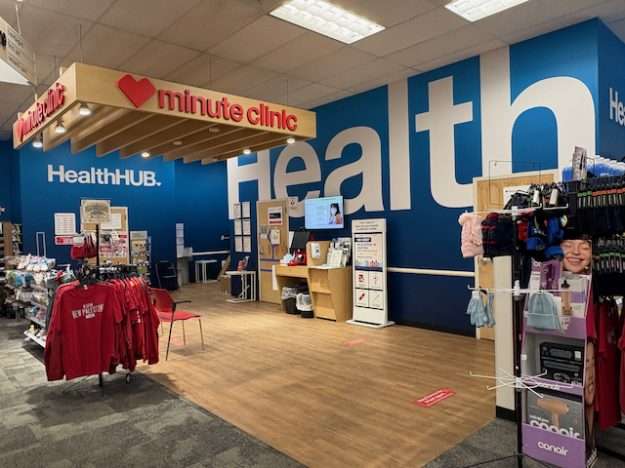
It looks like a clinic nestled into one corner of the CVS property, which very will may exist within the drug store’s overall management, but it doesn’t need to be: it could also a sublease. Regardless, it suggests this massive drug store chain is branching out to incorporate new services under the same roof as the greeting cards, OTC drugs, toiletries, cosmetics, and convenience foods (as overpriced as convenience stores, if not worse). These would indeed be drugstore clinics.
The presence of this clinic begs the question: what kind of CVS would support this? And to discern “what kind” for a national brand, the bigger question is “where”? In this case, the community is New Palestine, Indiana, an emergent suburb southeast of the city that was barely a blip on the map as recently as 1990. The 2020 Census shows that the town doesn’t yet pass 2,750 people, but it has grown 300% in the last 30 years. Most adults in the metro area have heard of New Palestine and know where it is, which is not something one could necessarily say 30 years ago. Growing though it may be, it’s still fairly sleepy and hasn’t remotely cast aside its historical Mayberry aspirations. I suspect drugstores in New Palestine haven’t exactly faced the waves of shoplifting akin to what takes place in, say San, Francisco. And while I wouldn’t claim that “New Pal” is completely free of hooligans, they’re more likely to face prosecution or at least some punishment than in the West Coast.
And Indianapolis has long been test market territory. Why not try a new blended approach to health care and pharmacology? Hence, New Palestine gets an early (or early-ish) model of the drugstore clinics.
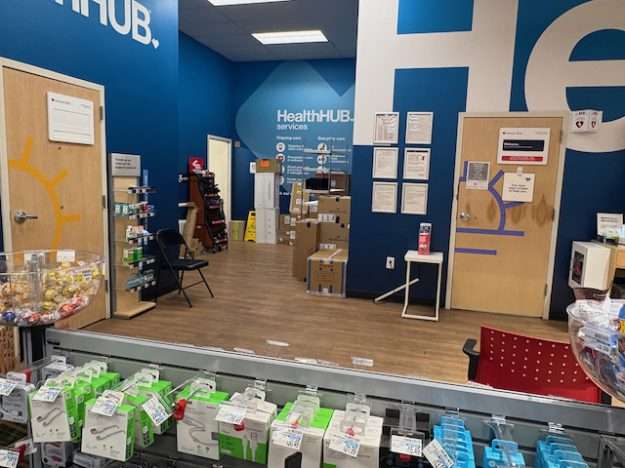
Not visiting drugstores all that much these days, I have surmised that HealthHUB represents an expansion of the previously existing MinuteClinic operations, which began as an independent business back in the early 2000s, originally under the name QuickMedx. In 2006, CVS Health purchased the small but rapidly growing company—it operated in just ten states at the time—when it had already forged a successful partnership, given that more than 75% of its 83 clinics already operated out of CVS pharmacies. The ensuing years have witnessed an expansion of the MinuteClinic model to 33 states and over 1,000 locations (at least until the post-COVID drug store contraction). MinuteClinics have offered much of what people need from routine family and in-person health care, staffed by licensed nurse practitioners and physician associates: immunizations, screenings, physicals, and treatment for minor illnesses or injuries.
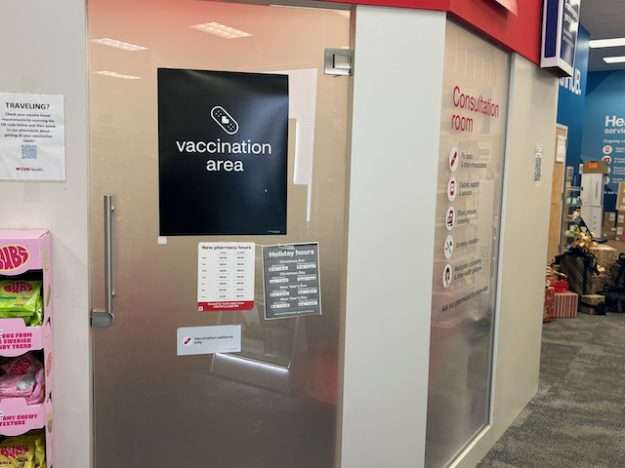
HeatlhHUB only began in early 2019, concurrent with CVS Health’s acquisition of Aetna insurance, based on an aspiration to provide broader wellness services: health management that reduces or prevents the need for routinely clinic visits. HealthHUBs feature licensed therapists and offer considerably more services related to diabetes monitoring, tobacco cessation, sleep disorder management, and dedicated space for wellness related interaction: health seminars, yoga classes, nutritionist sessions, and so forth. Within this particular location in New Palestine, I’d estimate that HealthHUB and MinuteClinic collectively comprise about 20% of the retail floor space. Drugstore clinics for New Palestine, and quite a bit more.
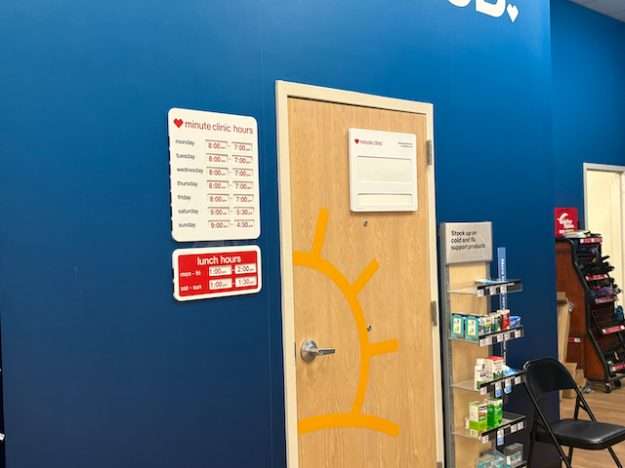
Through this additional research, it seems clear that my initial assumptions were off-base. I saw all these discrete, unfamiliar functions at a CVS—including completely separate operating hours for the MinuteClinic—and suspected that it was a sublease: a separate company leasing space within the CVS building, which in itself may also be a lease. Drugstore clinics certainly started that way, but this is much closer to horizontal integration—the same principles that, decades ago, wedded convenience store shopping and pharmacies under one roof. (And yes, the pharmacies with a CVS nearly always have separate operating hours, much like the MinuteClinic and other drugstore clinics.) A facility with licensed pharmacists dispensing prescription drugs could easily also include licensed nurses, medical assistants, and, maybe eventually, general practitioners. If the visibility is better when affiliating with a run-of-the-mill drugstore rather than a hospital or medical office park, why not?
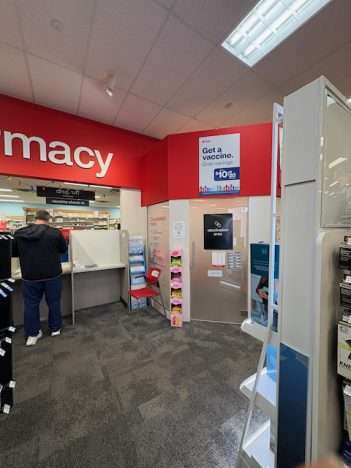
So, when it comes to MinuteClinic and HealthHUB, even if they started as separate companies, they no longer operate as such; it’s all part of CVS Health. I should have probably taken a closer look at the logos, since the CVS “heart” ties it all together. But perhaps I wasn’t entirely mistaken in my assumptions about a business operating within a business. Walgreens, CVS’s biggest (only?) competitor, has enjoyed considerably less success with initiatives like Village Medical (a partnership with the company VillageMD), but its rapid rollout during the onset of COVID-19 shutdowns proved non-fortuitous and by 2024, it began shutting down many of these VillageMD outposts. Apparently the corporation had a difficult time recruiting clinicians, due to a professional stigma against working in retail stores. I’m not certain why drugstore clinics at CVS haven’t faced similar challenges, but perhaps the featured New Pal drugstore in these photos is not seeking personnel with the same licensing prestige. Regardless of the differences, Walgreens has maintained FindCare, a portal and broker for booking in-person services akin to those one might find within HealthHUB and MinuteClinic at CVS. And Walgreens maintains partnerships with separately owned/operated clinics: Hartford Healthcare, Community Clinic at Walgreens, Advocate Healthcare, or MedExpress Urgent Care for immediate needs. These comprise genuine partnerships where the businesses operate within Walgreens real estate, but they are much rarer than the MinuteClinic or emergent HealthHUB initiative at CVS. And shrinking.
Then again, perhaps “emergent” is a misnomer; since the HealthHUB initiative has operated within CVS pharmacies for seven years already, I guess I’m not as much of a noticer of drugstore clinics as I’d like to think I am. Or I’m just not a regular at drugstores. Or clinics. I can live with that.

15 thoughts on “Drugstore clinics: bringing health care to the spot where we buy $8 milk?”
I can’t claim to know the place, but it appears to be a very small place to have a CVS.
An online search reveals that New Palestine has a large health provider, Hancock health. But someone at CVS must see an opening.
Your sleuthing is impeccable. Even I overlooked the reference to New Pal on the shirts, and since Indiana has the only incorporated “New Palestine” in the country, you can form a reasonable conclusion.
And yes, New Pal does seem a bit small for a CVS, especially in the wake of all the recent drugstore closures. I thought the same. But this formerly obscure town has quadrupled in population since 1990 and the major provider Hancock Health suggests that developers are anticipating the place will surge in the years ahead.
But this forthcoming article is not so much about New Pal having a CVS as the nature of this particular CVS.
thanks!
It looks like there might be a whole urgent care back there. Maybe its just the nature of the health care facilities in the DMV, but I’ve never seen one in a CVS here.
In your hometown CVS is more rapidly closing locations than Walgreens currently. The two CVS stores closest to my home have both closed in the last year.
Part of the issue is the CVS pharmacy inside the local Target store. Another part of the issue is that the big grocery chains (Kroger, Walmart, Meijer) all have supercenters with pharmacies as well as much lower prices on beer, wine, liquor, and c-store munchies. I think the one-stop health-care center model might be the next evolution for both CVS and Walgreens.
Interesting point. I haven’t noticed necessarily that CVS has closed more than Walgreens here in the NoVA area, but I would agree about Indy from my memory and observations from very infrequent visits. Most of my research, however, suggestions that Walgreens has contracted further at the national level. Walgreens faced the private equity buyout last year. After all Walgreens’ attempts to acquire Rite Aid (including some successful regional buyouts), CVS co-existed more frequently with the defunct chain when it finally gave up the ghost last year, so it probably absorbed some of that customer base.
That said, CVS Health purchased Target’s pharmacy operations a decade ago, and Walgreens has no such similar relationship (just as it has no relationship with a MinuteClinic equivalent). I suspect you’re right that the pairing between Target and CVS has rendered standalone CVS less necessary, while standalone stores have been a pivotal force in Walgreens’ business model all along. Then again, Target ain’t doing so great these days, and while you’re undoubtedly right that Target/Kroger/Meijer is much more competitive for the convenience merchandise than a drugstore (not to mention greater inventory), CVS has somewhat shot itself in the foot in terms of standalone, while simultaneously diversifying its business model to a greater degree than Walgreens.
Regardless, I don’t see either chain completely failing any time soon–Americans sure do love their drugs.
Tangentially related (and I haven’t read your actual blog post yet)….I walked into my nearest Staples the other day – for the purposes of depositing my Happy Returns return – and discovered that it had a whole wall and a couple of aisles emblazoned with Party City product. The actual nearby store just closed in the past year. And at the back of the store they are constructing an optometrist office! Kind of an interesting restructuring strategy, I feel like I haven’t seen quite this sort of thing too much. Cheaper for the optometrist, and Staples maybe gets to stay in business (a year or two?) longer by becoming a mini-mall.
Yeah I always wondered how those office supply big boxes stay in business when they’re usually so empty. Then someone reminded me that they are basically just giant showrooms for office furniture, which people then typically order online. So these companies can actually still make a killing, but they don’t have close to the need for physical retail space that they did in the past.
Party City though? That’s hilarious. Aren’t they completely out of business? It makes me wonder if your Staples just purchased the leftover inventory after liquidation!
Beyond that, the spinoff businesses, which grocery stores have piloted for at least 25 years, often a real symbiotic relationship: Office Depot and Staples have had strong partnerships with FedEx and UPS for quite some time.
Meanwhile the pharmacy itself is run into the ground
Yeah I’ve had very little need for pharmacies in recent years but they don’t seem to be the well-oiled machines that they were in the past. Case in point: ever notice how rare the once-ubiquitous 24-hour pharmacies are? I blogged about it not so long ago. It’s probably fairly dangerous to operate them in many cities.
I have seen these “readyclinics” in my local Kroger for years, but I am not familiar with the HealthHub. You mentioned that they have room for yoga, nutritionist sessions, health coaching. Did any of that seem to be going on? Were there signs for schedules or posters for events? This is an outreach I did not know existed. Not sure I would be interested in a yoga class in a CVS😳.
I didn’t spend a huge amount of time there–just enough to soak it in and take a few photos. Nothing much seemed to be going on in the early evening (~6:30pm) when I was there.
I agree that’s probably an uphill battle to convince a lot of people that these other, completely unrelated services can deliver the same quality when a drugstore like CVS offers them. My research indicated that many people feel they’re not getting top-tier quality from a nurse, nurse practitioner, or medical assistant who works at a business best known for retail. This probably shouldn’t matter; it’s not like there’s a stigma to pharmacists who work at CVS versus some more exclusively pharmacological operation. It’s probably just weird for many people to get their flu vaccinations or diabetes management regimen at the same place where they can buy toilet bowl cleaner or gummi worms.
It reminds me of that time I saw an realtor’s office as a side office within a coffee shop. https://dirtamericana.com/2019/12/coffee-commercial-real-estate/ There’s absolutely nothing wrong with this, and the realtor’s office probably earned some passive business from walk-ins to the coffee shop who otherwise wouldn’t know about it. At the same time, it conveys the potentially undeserved notion that this realtor isn’t good enough of his/her own to have an office of his/her own, instead riding on the coattails of another business. I could potentially see the same bias happening with a clinic running out of a CVS. But clearly CVS is bullish on the concept!
Seems just like the one at 16th of Meridian Street in Indianapolis.
Interesting: small town versus “inner city”—very different neighborhoods but similar rollout of service innovations.
CVS really money is in PBM. They screw you over on what you pay for your prescriptions. That should be illegal.
Admittedly I had to look this up, as the acronym didn’t mean what I thought it did. But I suspect you’re right, and retailers like CVS are more than willing to oblige the paper-pushers who form a basis for rising costs (and revenues). Without the pharmacy aspect, CVS and Walgreens are nothing more than beefed-up convenience stores, but the presence of these highly skilled (and well compensated) workers creates a huge need to buffer against the flagging sales of the non-prescription based merchandise. In an ideal world (for drugstores at least), people submit their prescription in the back of the store, then go on a spending spree while waiting for the fulfillment of their prescription. After all, what else are they going to do? CVS has all this stuff that they already need, even if it’s a little (or more than a little) marked up from the prices at a grocery store. So, at least in the past, customers would buy buy buy during that 15-minute wait. Not sure, in the era of online or drive-thru prescriptions, how much model still fits. Probably not much.
Combine this with the tendency for drugstores to become ground zero for inventory “shrinkage” (AKA “theft”, and preferred items seem to be cosmetics or laundry products), the incentive for pharmacies to integrate with convenience-based goods is diminishing. Meanwhile, the big corporate drugstore chains are testing the waters for full integration with services–health care, prevention, and wellness.