
It’s hard to find an old single-screen move theater that’s thriving, even in affluent urban areas. When it comes to those walkable, revitalizing main street districts—where people collectively demonstrate their affection for old architecture by refurbishing and repurposing old buildings for niche businesses—the vintage movie theaters from the Golden Age of Cinema should ride the wave of revitalization, either through enjoying a similar refurbishment or (at the very least) holding their own, thanks to customers who are nostalgic for that Golden Age. But all too often, they don’t. In the last two years, I pointed out the demise of the Uptown Theater in DC’s prosperous Cleveland Park neighborhood, which, after an 84-year run, never re-emerged after COVID forced all theaters into dormancy (although most indictors suggest the lease wasn’t getting renewed regardless of the lockdowns). Fifty miles to the south, the prosperous exurban community of Culpeper, Virginia has tripled in population since 1980, benefiting as Washington DC’s commuting orbit expands. A steamship transformed Culpeper’s four-block downtown and caught the defunct, blighted State Theatre in its wake; with the help of Virginia preservation grants, an entrepreneur invested nearly $10 million to restore the picture palace in 2013, only to find that people still preferred the more contemporary four-screen “multiplex” across the street (no doubt enticed by free and easy parking). Culpeper’s State Theatre folded again after just three years. Today, both of these theaters sit in mothballed underutilization, occasionally luring a reinvention or a proposed reinvestment plan from new owners. But a business model to keep the Uptown or State open for routine screenings or exhibitions has not come into fruition. By contrast, a rural single-screen seems to be defying all the odds.

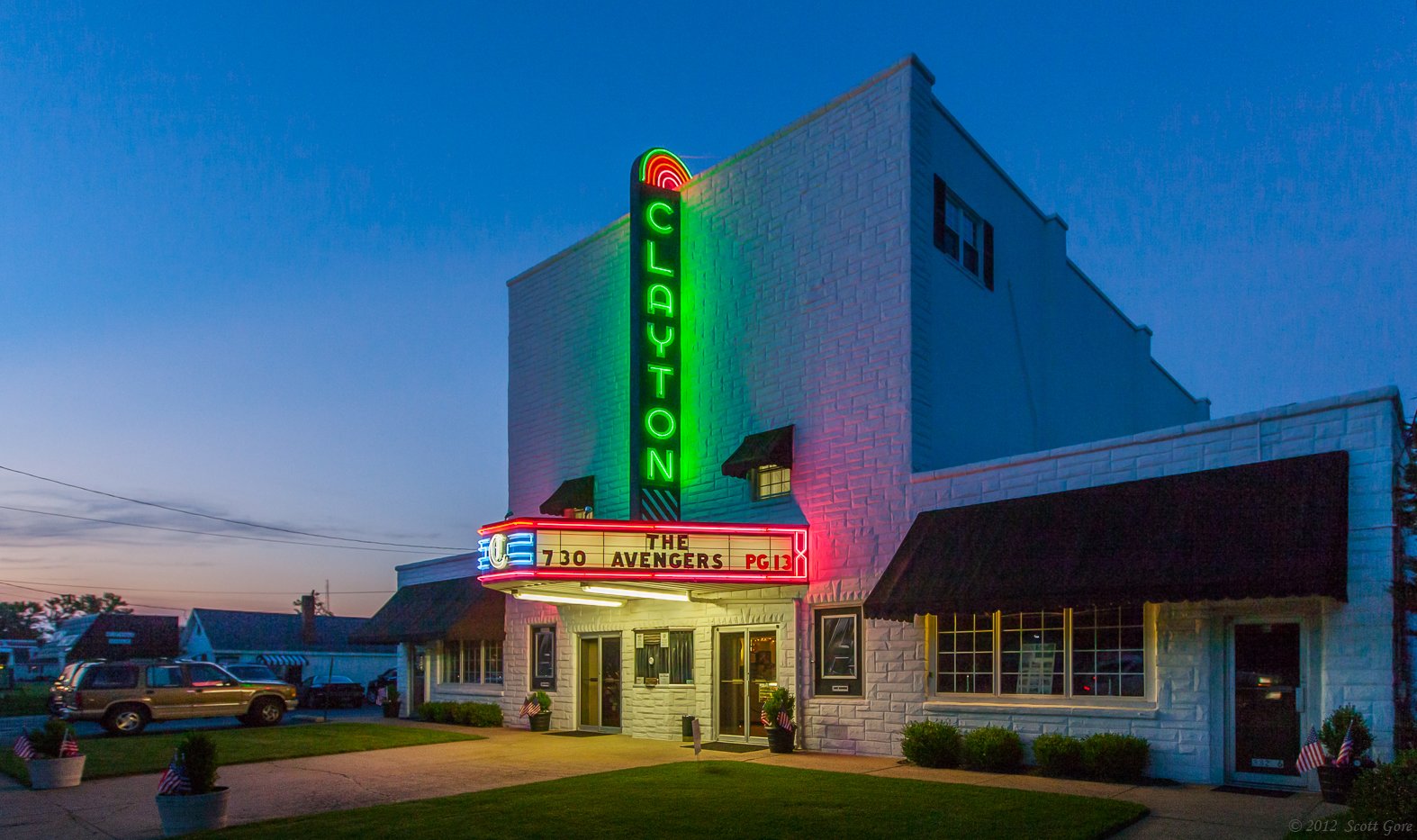
This theater cuts a striking profile against the flat horizon line in southern Delaware, especially at night, when the marquee glows with red and green neon. The Clayton Theatre is also one of the few buildings that comprise the historic center of Dagsboro, population 870 in 2020 Census. But Dagsboro only recently achieved such lofty numbers. It’s a rural town that’s actually growing; as recently as the year 2000 is hard around 500 people, and it hovered between 350 and 400 through much of the twentieth century. Considering how small it has been through most of its existence, Dagsboro can’t really claim a downtown or a main street (lower case letters), even though the principal arterial (State Route 20) is named “Main Street” throughout its length within Dagsboro’s municipal boundaries. Most of Dagsboro’s commercial buildings rest along DE-20, but they don’t cluster enough to comprise what any reasonable person would call a commercial corridor. Aside from the rural single-screen theater, Main Street Dagsboro in 2025 has a gas station, a paint supply store, a roofing contractor, a bank, a toy/coffee shop in an old revitalized building (with apartments on the second floor), a quilt shop, a martial arts studio, a pizzeria, a furniture store, an antique store, and a forklift dealer, along with a few of the requisite municipal buildings. But these operations sit scattered across six blocks, interspersed with private residences, so it doesn’t assume the appearance or function of a business corridor. (Several of the aforementioned establishments operate out of converted houses; possibly they are home businesses.) At the time that American towns were developing along main street archetypes, Dagsboro never had enough people to justify such a configuration.
If it wasn’t big enough to achieve a true main street in the first few decades of the 1900s, how was tiny Dagsboro able to entice an entrepreneur to build a movie theater in 1949, the year Clayton Theatre opened its doors? It could very well be that the venture capitalists of the time had their ear to the ground; according to the US Census, Dagsboro doubled in population from 1940 to 1950—from 222 to 474 people. Even if the 1950 Census numbers weren’t yet tallied, the evidence suggested that people were indeed moving to Dagsboro. The town did not maintain this momentum, fluctuating in population until steady growth after 1990 finally brought the current population to a rate approximately double the 1950 count.

The fact that Dagsboro is enjoying a multi-decade growing trajectory might secure the fortunes of the Clayton Theater…but probably not. My other two cited examples don’t support this. Culpeper, Virginia has grown tremendously in the last three decades but couldn’t keep its revitalized old movie theater open for more than three years. And the Cleveland Park neighborhood in DC, in the midst of affluence, still witnessed the demise of the massive Uptown Theater right before COVID, but not because of COVID. So what keeps a rural single-screen theater alive?
First of all, the projection room isn’t the only business under this rural single-screen roof.

Since its founding in 1949, storefronts have flanked the auditorium, endowing the structure with a symmetry that my photos fail to capture but a Google Street View can reveal perfectly. This aesthetic detail isn’t likely to contribute much to this rural single-screen theater’s perseverance, but offering leasable space for other businesses can help buffet the theater against the doldrums: for example, a slow movie-going period (spring is often pretty bad) or a much ballyhooed movie that proves to be a dud. Clayton Theatre hosts Town Barbershop on one side; I cannot tell if a tenant claims the other space, but the existence of that leasable area gives this structure the opportunity to monetize parts of its real estate with a separate income stream—an opportunity that doesn’t always exist in most rural single-screens.
However, the biggest physical advantage this particular rural single-screen has—and it kills me to say this—is the convenient and visible parking.


Atypical to most other old-school theaters, Clayton Theatre doesn’t sit along a dense, compact main street with other commercial buildings abutting it. The parking lot just to the north probably only accommodates about 25 vehicles, but that’s at least enough to serve a core customer base.

And, peering across Main Street, the squat building with the prominent gable in the distance is a Masonic Lodge, offering abundant parking out front. I have no idea if this Lodge allows patrons of the Clayton Theatre to park there when the Lodge itself isn’t busy, but it seems like an opportunity for a shared-use agreement. Or the Lodge could simply be lax and not enforce parking restrictions if the Clayton is hosting a big new release—which, apparently, is precisely what it does: it brands itself as the only surviving first-run single-screen theater in Delaware.
Easy parking is critical. And its absence—amidst the single-screen, storefront theaters that used to dot most towns of at least Dagsboro’s size—helped to usher the demise of this American tradition. The multiplexes that began to proliferate in the 1980s offered it in abundance, to the point that, even in the midst of summer blockbusters, the surrounding lot offered enough spaces that no two customers had to vie for a place. And, of course, the very essence of the multiplex (the “multi” prefix) is the possibility of selecting among a variety of features all under one roof. It proved tremendously hard for a rural single-screen to compete, if a minor city of 15,000 offered a four-screen theater twenty miles away.
Speaking of what’s twenty miles away, trade area may prove another factor that helps shape the Clayton Theatre’s success.

Rural though Dagsboro may be, the town sits just a little over ten miles from coastal Delaware. And though Delaware beaches lack the extroversion of the hyper-urbanized New Jersey Shore to the north, nor the expansive barrier island vacationland of North Carolina’s Outer Banks to the south, coastal Delaware remains a major attraction precisely for feeling less exploited and overdeveloped.


Bethany Beach in particular, just east of Dagsboro, prides itself as “the Quiet Resort”—lacking numerous bars, carefully patrolled, and increasingly affluent, the family-friendly reputation of these southern Delaware coastal communities has spurred a demand for nearby real estate, which undoubtedly has helped elevate Dagsboro’s profile. Delaware Beaches get plenty bustling in the summer months, but the only other movie theaters lining the coast are all conventional multiplexes: a 14-screener in Rehoboth Beach (about ten miles north of Bethany), an art house theater in a strip mall near the historic town of Lewes, and two big complexes in Ocean City, just past the state line in Maryland.
The rural character could prove a tremendous disadvantage in many parts of the country, but the income density tends to be respectable just ten miles from the Atlantic Ocean.

Amidst all those vacation homes and fancy hotels for wealthy urbanites, a rural single-screen like Clayton Theatre is a novelty. Reviewers comment on its ability to evoke “nostalgia” (the defining keyword) despite having a conventional interior. On a rainy July day when sunbathing at Bethany or Rehoboth is impossible, this small-town curiosity is enough of an outlier to entice at least a few of the patrons who cause the hotels and vacation homes to swell during the summer swelter. Gen X parents can take their kids (and, alas, their grandkids these days) to a venue that reminds of them of their childhood. Retired boomers might even remember the true Golden Age of Cinema. And, as coastal Delaware enjoys an ascending reputation as a great destination for retirement or vacation investment properties, the population doesn’t thin out as much between September and May. Lastly, the owners/proprietors of this for-profit theater must remain carefully attuned to fluctuating demand among Dagsboro’s dynamic demographic. In this rural single-screen’s earliest days, Delaware’s blue laws prohibited movie screenings on Sundays, but the theatre survived, while sprucing up its offerings with occasional traveling musical acts or live theater. Similarly, Clayton Theatre today must balance a push for first-run acts with timeless Golden Age classics, or from family-friendly bubble-gum stuff to midnight Rocky Horror screenings, while ensuring that the audio/visual quality remains competitive with the mega-chains. And the popcorn/candy needs to rot the teeth at reasonable prices.
Hope springs eternal for the Uptown or State theaters about 150 miles to the west. But, as their respective civic activists scratch their heads to devise new ways to revitalize (or re-revitalize) their ailing picture palaces, a rural single-screen in the First State keeps chugging along. In an era of soulless LEDs, it’s hard not to get mesmerized by the red/green neon.

7 thoughts on “Rural single-screen: how does the Clayton Theatre in Dagsboro, Delaware survive 75 years?”
I see they’ve got a first run film on which is amazing for a small inner-city screen.
Yes! My thoughts exactly. It’s a first-run movie theater, which means it’s competing with the multiplexes.
Don’t forget the The Historic Artcraft Theatre in Franklin, IN, and the Jean Cocteau Cinema in Santa Fe !
But of course! While I wasn’t aware of the one in Santa Fe, I would never forget the legendary Artcraft. It’s interesting, because, while single-screen theaters aren’t quite so rare that we call them critically endangered, they were ubiquitous until the late 70s so it’s still safe to say that probably about 95% have closed.
The big things that distinguish this one in Delaware are a) it’s completely rural (Dagsboro the town is too small even to have a one-block Main Street) b) it shows mostly first-run movies (so it’s competing with multiplexes) and c) it’s a for-profit business. Many of these old theatres stay afloat as non-profits with preservation grants. I believe the Artcraft is a non-profit? And that it mostly shows vintage movies?
I wrote about the Artcraft for their 100-year anniversary in 2022: https://www.indysouthmag.com/2022/09/08/the-heart-of-downtown/
Thanks for sharing this article! It seems to me that Artcraft is more authentically Art Deco than the Clayton Theatre in my article, which was late to the party in 1949. I didn’t realize that Artcraft received an initial renovation in the early 1980s. Was it ever completely mothballed–like around 2000, when it stopped showing first-run movies? I get the impression that, almost as soon as it closed, it earned nonprofit status and state grants helped restore it.
Fun!